

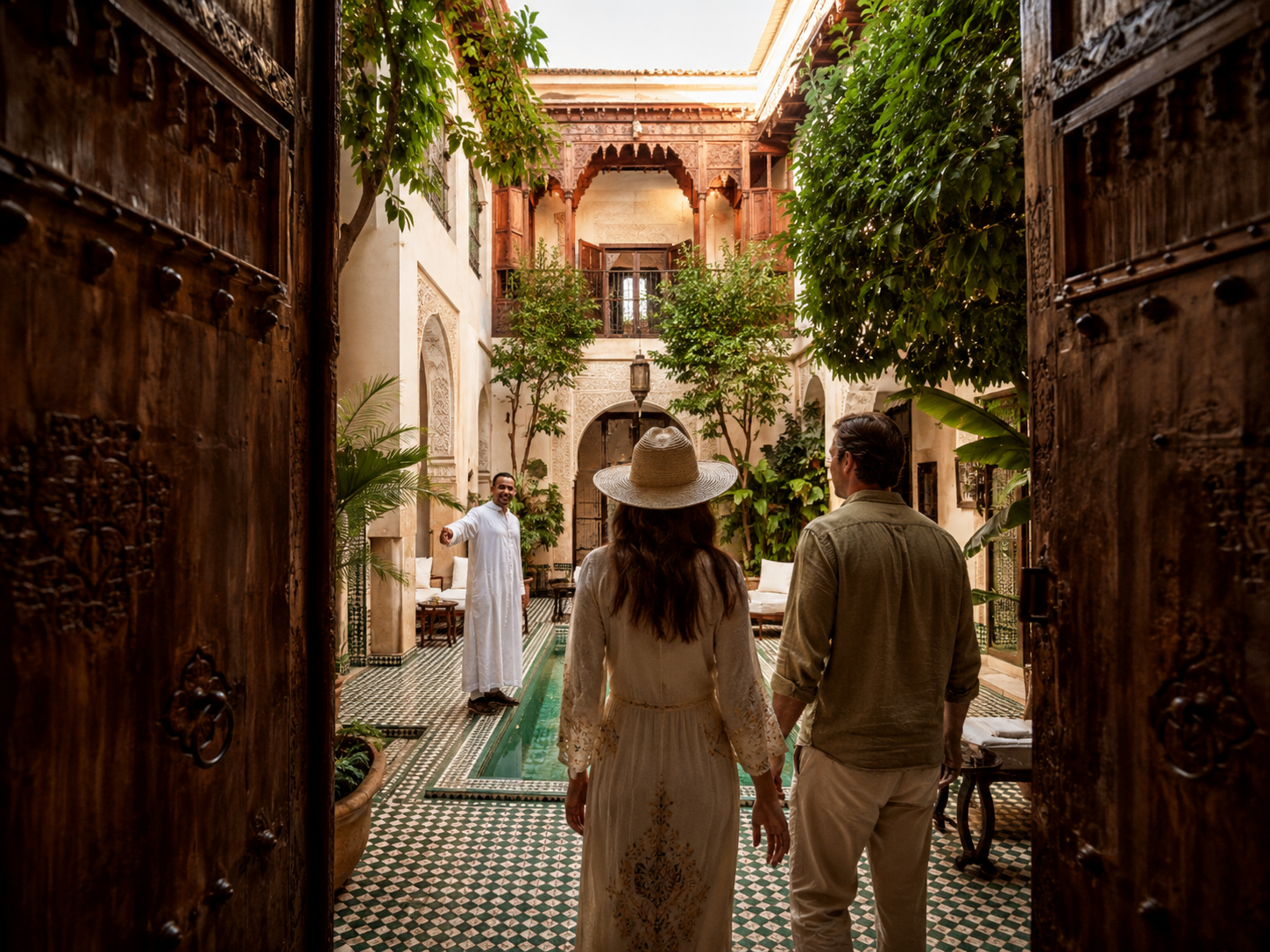
Behind the heavy wooden doors of Morocco’s medinas, some of the country’s most beautiful homes are quietly changing what an Airbnb stay can look like. Pools, rooftops, centuries-old architecture and serious design are turning the traditional riad into a luxury travel experience of its own.
Morocco’s riads have always had one major advantage.
You rarely know what is waiting behind the door.
Outside, the medina can be loud.
Scooters.
Market stalls.
Spice merchants.
Children weaving through narrow streets.
Then a wooden door opens.
And everything changes.
A courtyard.
Zellige.
Orange trees.
A fountain.
A pool.
Sunlight dropping through an open roof.
That contrast is part of what has made the Moroccan riad one of the country’s most recognisable forms of hospitality.
Now Airbnb is pushing that experience further into the luxury market.
Vogue’s latest selection of Moroccan stays highlights seven riads across Marrakech, Tangier, Essaouira and Fès, ranging from highly designed contemporary homes to buildings carrying centuries of history.
MARRAKECH IS STILL THE DESIGN CAPITAL
It is no surprise that Marrakech dominates the list.
The city has become one of the world’s most recognisable destinations for Moroccan design.
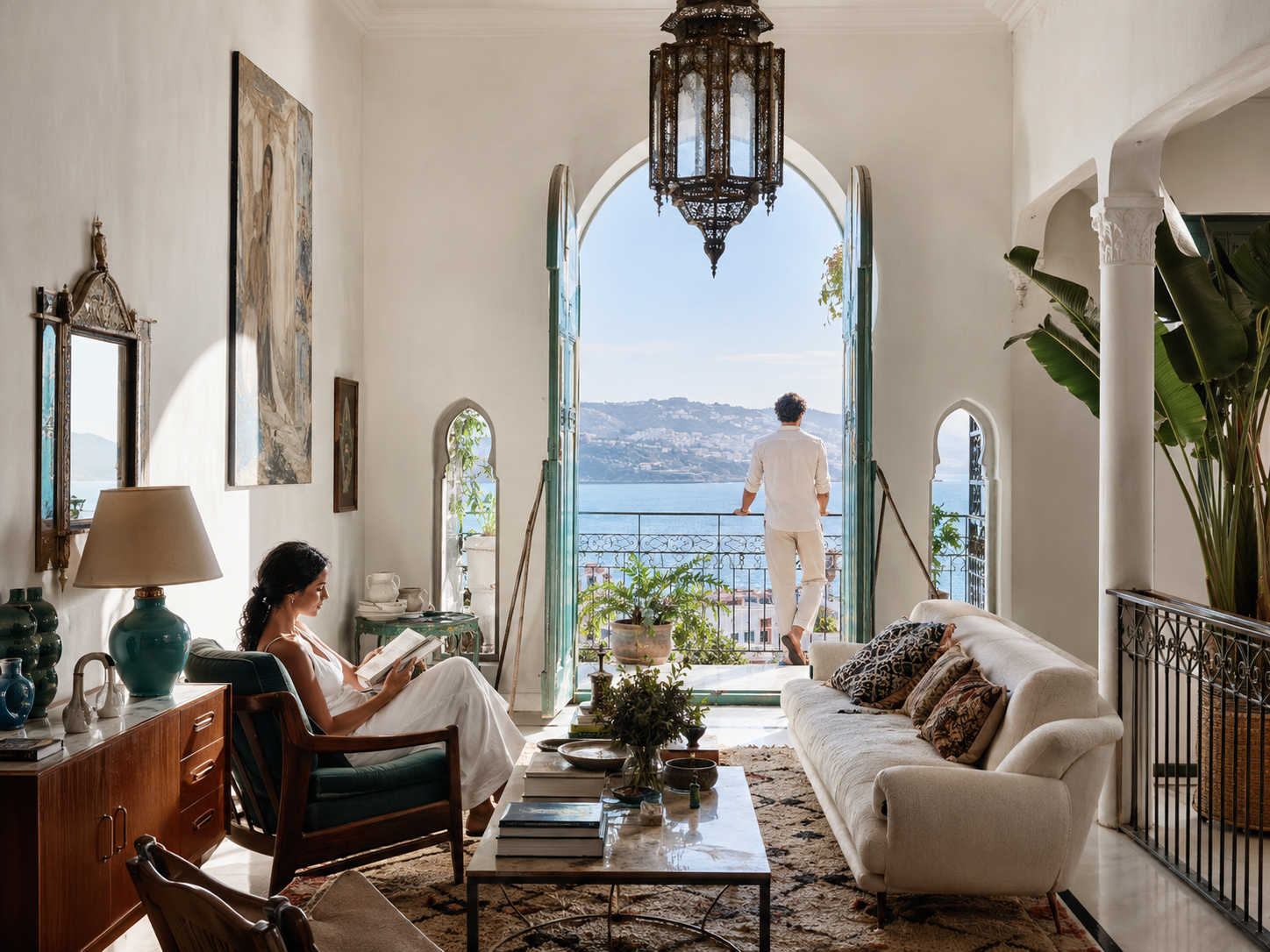
At Riad Umaia, Vogue highlights terracotta tadelakt walls, Berber-style rugs, glazed ceramics and a courtyard pool, with rooftop breakfasts built around Moroccan staples such as msemen and mint tea.
The property sits close to Jemaa el-Fnaa and within easy reach of Sidi Ghanem, Marrakech’s increasingly important design district.
That location matters.
Visitors are no longer coming only for palaces and souks.
They are coming for furniture.
Ceramics.
Textiles.
Lighting.
And the modern Moroccan design scene.
The riad becomes part of that experience rather than simply somewhere to sleep.
RIAD ISOBEL MAKES THE COURTYARD THE CENTRE
Another Marrakech property, Riad Isobel, is built around the classic riad idea.
Rooms open inward.
The courtyard becomes the heart of the home.
Orange trees surround a swimming pool.
A tiled rooftop sits above.
Vogue notes that each of the four bedrooms is named after local flowers and herbs, while antiques and Moroccan pottery fill the interiors.
That is one reason riads work so well for group travel.
They provide privacy without losing communal space.
Everyone can disappear into a bedroom.
Then meet again around the pool or on the roof.
It feels more like having your own small hotel than renting a conventional apartment.
RIAD YAZ HIDES CALM INSIDE THE MEDINA
Riad Yaz sits in the heart of Marrakech’s medina.
Outside is noise.
Inside is the opposite.
Vogue describes a rooftop overlooking the medina, Koutoubia Mosque and Atlas Mountains, while the interior mixes Moroccan design with a more relaxed bohemian feel.
This may be the real luxury of a riad.
Not marble.
Not chandeliers.
Silence.
The ability to walk through one of Morocco’s busiest neighbourhoods, close a door, and suddenly feel separated from everything outside.
That is hard for a large hotel to reproduce.
TANGIER BRINGS THE MEDITERRANEAN IN
Moroccan riads do not all look the same.
Tangier proves it.
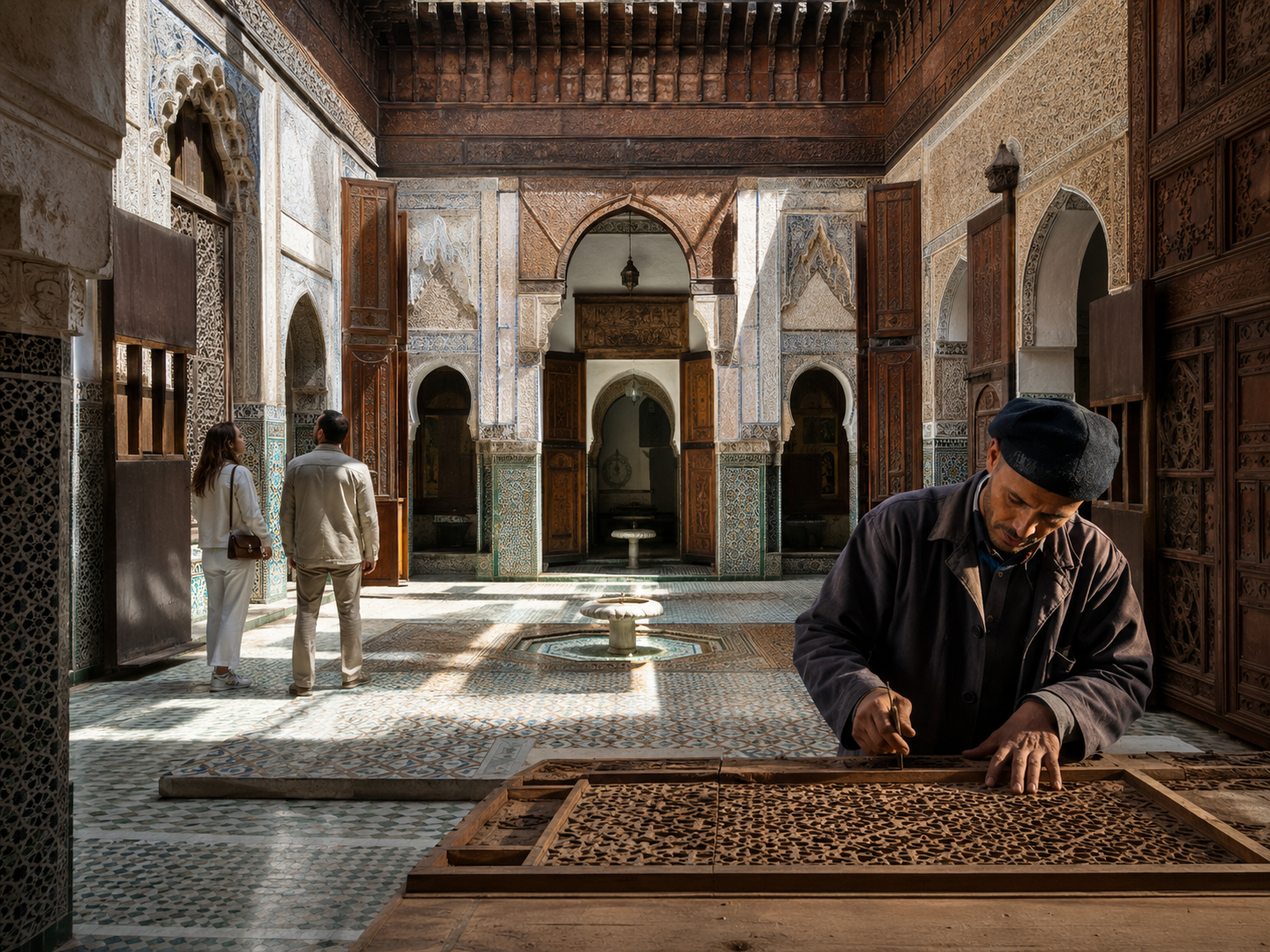
At Dar Tus, Vogue points to whitewashed walls, wrought-iron railings and a style shaped as much by the Mediterranean as by traditional Moroccan interiors.
The property mixes mid-century furniture with Berber rugs and Moroccan lanterns.
That eclectic look fits Tangier.
The city has always sat between worlds.
Africa and Europe.
Morocco and Spain.
Traditional architecture and international influence.
Dar Tus is only minutes from the Kasbah and Petit Socco, while Spain is just across the Strait of Gibraltar.
That geography shows up inside the house.
ESSAOUIRA’S RIADS HAVE THE ATLANTIC
Then there is Essaouira.
Riad Atlante looks directly toward the Atlantic, replacing Marrakech heat with sea breeze and the sound of waves.
Vogue highlights a darker, moodier courtyard, weathered wooden doors and a rooftop hot tub overlooking the coast.
It is a completely different luxury proposition.
Less palace.
More retreat.
Essaouira has long attracted artists, surfers and travellers who prefer a slower Morocco.
Its riads reflect that.
The city itself becomes part of the interior design.
Wind.
Salt.
Blue.
Wood.
Stone.
And the Atlantic outside.
SOME RIADS ARE MUCH OLDER THAN AIRBNB
The most extraordinary property on Vogue’s list may be in Fès.
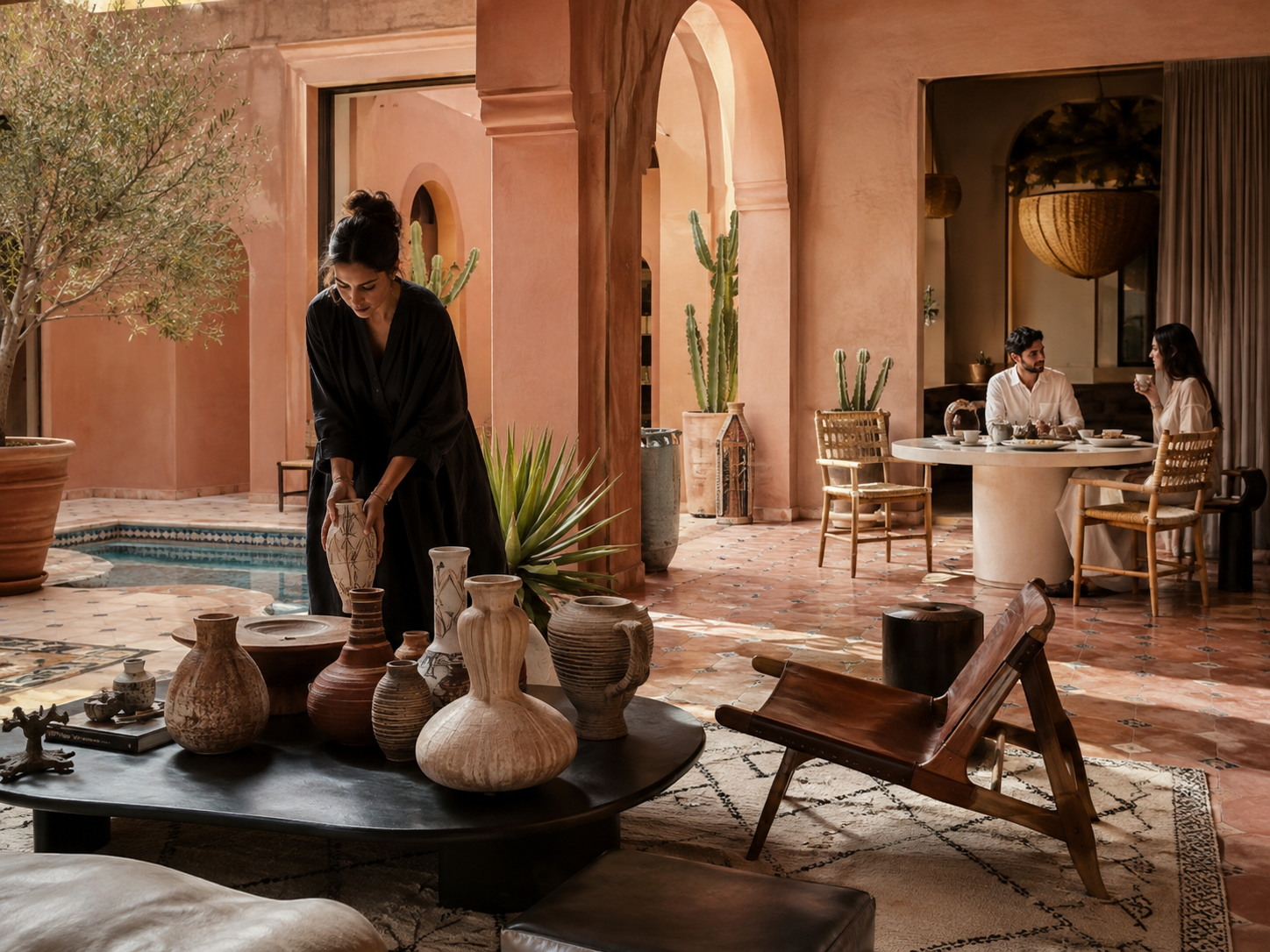
Le Petit Bijou dates back to the 14th century, making it one of the oldest houses featured.
It sits inside Fès el Bali, the UNESCO-listed medieval medina, close to the Mausoleum of Moulay Idriss and Al Quaraouiyine.
Inside are carved wooden details, zellige, bejmat tiles and traditional architectural elements.
This is where the idea of an Airbnb becomes almost misleading.
You are not simply renting a home.
You are sleeping inside a building that has survived centuries of Moroccan history.
That is difficult to compete with using a newly built hotel suite.
THE PRICE OF PRIVACY IS RISING
Luxury comes at a cost.
Vogue’s highlighted properties range from around $160 per night to nearly $500 per night, depending on the riad and dates.
But many of these homes have three, four or five bedrooms.
For groups, that changes the calculation.
A large riad can replace several hotel rooms while offering:
private pools,
kitchens,
rooftops,
courtyards,
and entire houses without other guests.
The appeal is increasingly obvious for families and groups travelling together.
THIS IS NOT JUST ABOUT AIRBNB
The larger story goes beyond one booking platform.
Moroccan architecture has become part of the country’s tourism brand.
Zellige.
Tadelakt.
Courtyards.
Carved doors.
Berber textiles.
Lanterns.
Plasterwork.
Those elements now appear in hotels and homes around the world.
But in Morocco, visitors can experience them in the buildings that created the aesthetic in the first place.
That authenticity has commercial value.
A beautiful riad does not need to compete with a global hotel brand by becoming more international.
Its advantage is being more Moroccan.
THE OLD HOUSE IS BECOMING THE LUXURY PRODUCT
Luxury travel used to mean escaping local life.
A large hotel.
A private resort.
An international brand.
The riad model does almost the opposite.
It puts visitors inside the medina.
Behind the same kind of doors local families have used for generations.
Inside architectural traditions designed long before tourism existed.
The luxury comes from privacy, craftsmanship and atmosphere.
That is a very different proposition.
And it explains why some Moroccan homes can now command hundreds of dollars a night.
MOROCCO’S MOST POWERFUL DESIGN ASSET MAY ALREADY EXIST
There is a broader lesson here.
Morocco does not always need to build something new to create luxury.
Sometimes the strongest product already exists.
An old house.
A courtyard.
A rooftop.
A carved door.
A traditional floor plan.
Restored carefully and presented well, those things can become internationally desirable.
Vogue’s selection is ultimately about beautiful places to stay.
But underneath it is a much larger story.
Morocco has turned one of its oldest forms of domestic architecture into one of its most successful modern travel experiences.
The streets outside may be centuries old.
The luxury business behind the doors is very much alive.
 Jamal Mahdad, Founder & Editor-in-Chief