

Salé’s centuries-old candle procession turns faith, craftsmanship and community memory into one of Morocco’s most remarkable living traditions.
SALÉ, Morocco, 25 August 2026
The Salé candle procession returned to the city’s historic streets on Monday, carrying a centuries-old tradition of faith, craftsmanship and community memory into another generation.
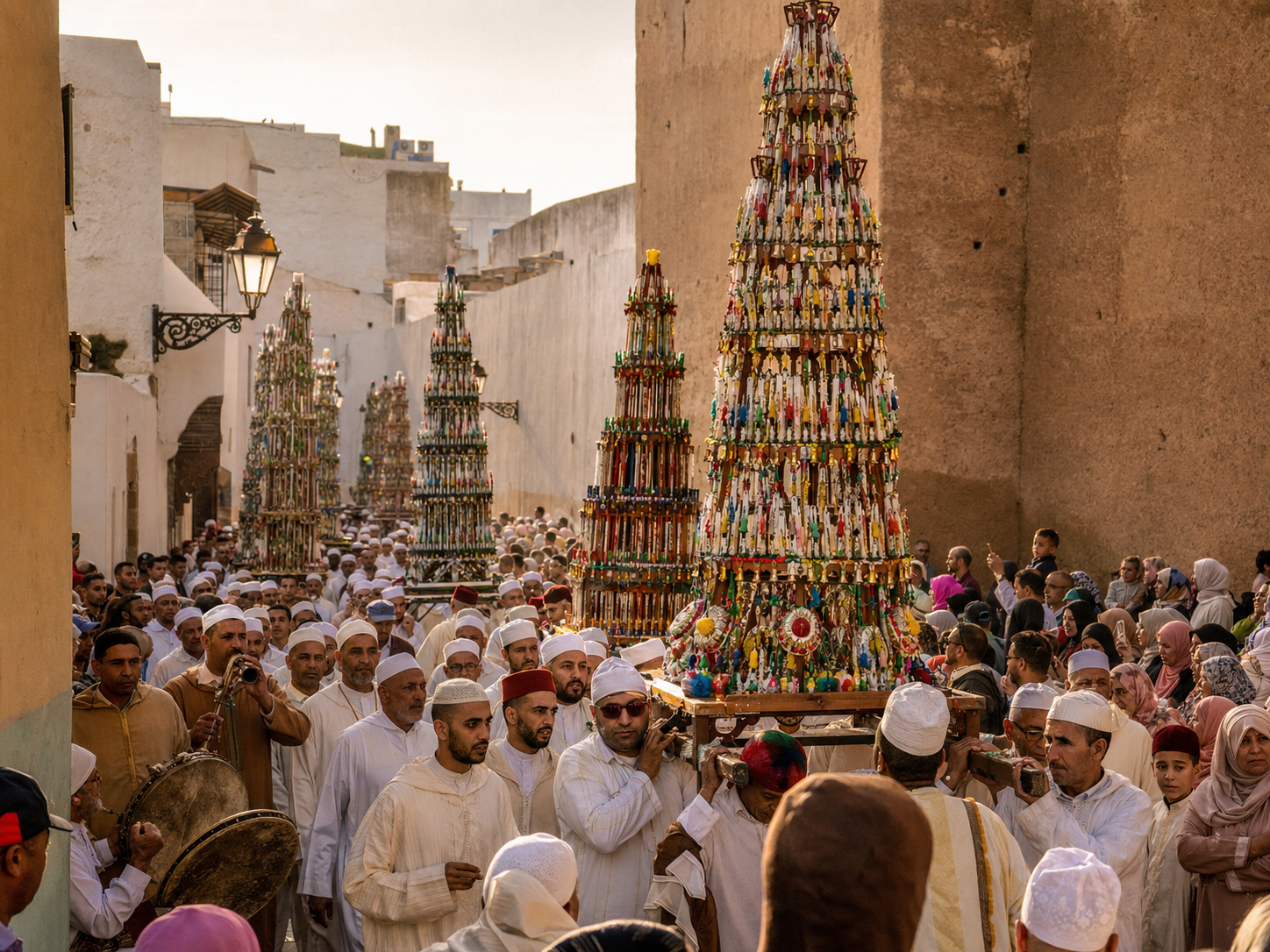
Its monumental structures look like illuminated towers, but they are carried on human shoulders.
Covered in red, green, yellow, blue and white wax, they rise above the crowd as they move through the historic streets of Salé.
Men in traditional clothing guide them forward. Drums mark the rhythm. The sharp notes of the nafir, a traditional trumpet, travel through the medina. Around them, families press closer to watch a ceremony their city has preserved for centuries.
On Monday, 24 August, intense summer heat failed to keep the crowds away.
Residents and visitors gathered for the celebrated procession, held on the eve of Eid Al Mawlid Annabaoui, the Moroccan commemoration of the birth of the Prophet Mohammed, peace be upon him.
The colours make it spectacular.
The people of Salé make it endure.
This is not a parade invented for tourists. It is one of the city’s deepest expressions of faith, craftsmanship and collective memory.
WHEN THE CANDLES BEGIN TO MOVE
Known locally as Dour Chmaâ and more formally as the Moussem des Cierges, the procession transforms objects normally kept inside a mausoleum into the centre of a public religious ceremony.
The 2026 procession began after the Asr afternoon prayer and continued through Salé’s historic streets towards the mausoleum of Sidi Abdellah Benhassoun, the scholar and spiritual figure closely connected to the tradition.
Contemporary footage showed bearers balancing the decorated structures as musicians, religious groups and members of the public accompanied them through the city.
The atmosphere combined movement with devotion.
Drums and the nafir accompanied madih, poetry and song in praise of the Prophet, and samaâ, Morocco’s tradition of devotional spiritual music.
The structures themselves are sometimes described as giant candles. That name captures their ceremonial purpose, but not how they are actually made.
They are not enormous blocks of solid wax.
They are works of architecture in miniature.
BUILT FROM WOOD, PAPER, WAX AND PATIENCE
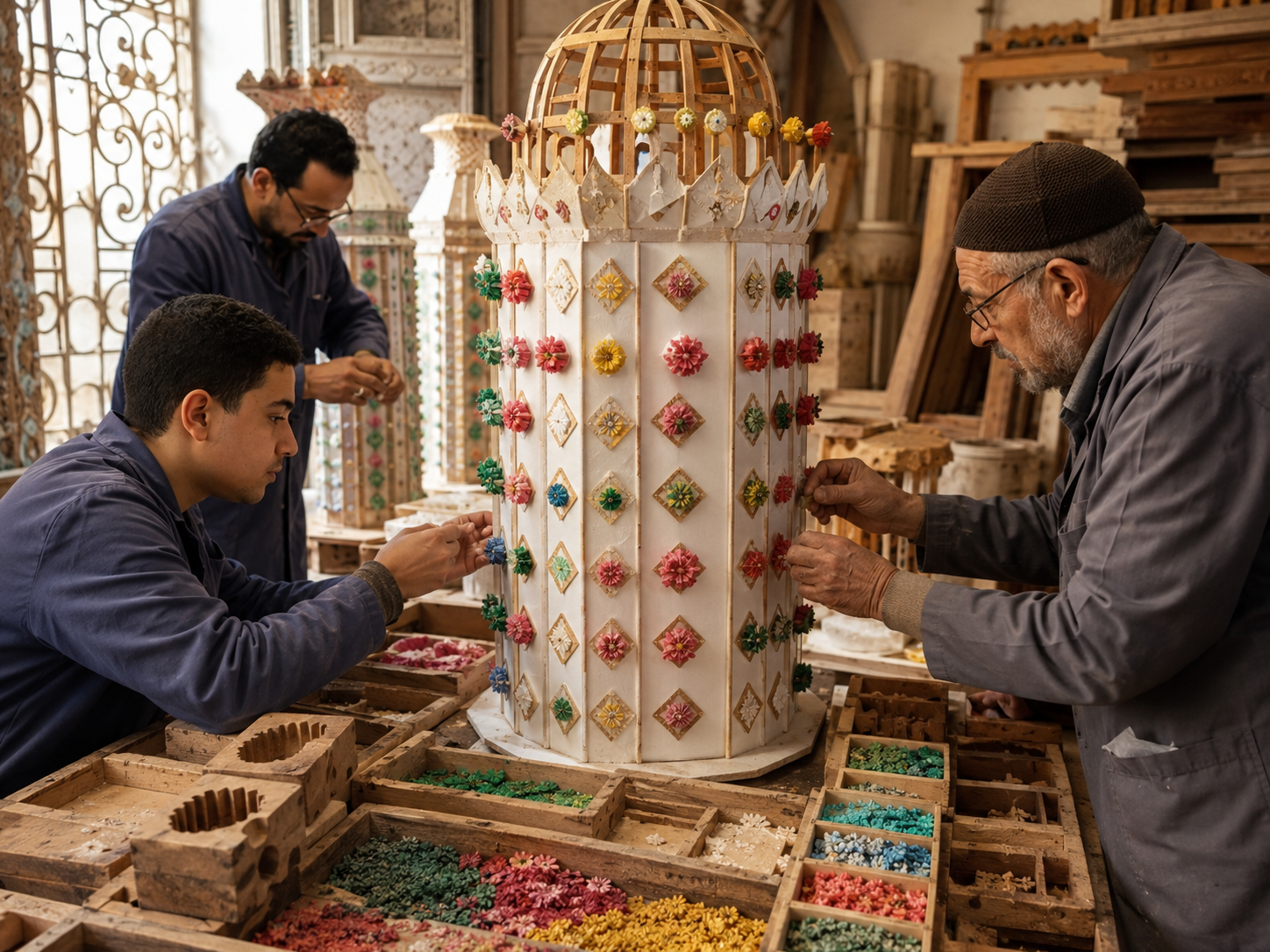
Beneath each decorated surface is a substantial wooden frame, usually shaped to resemble a minaret or ornamental tower.
The frame is covered with white paper. Artisans then attach hundreds of small wax pieces formed into flowers, squares, diamonds and other geometric shapes.
Seen separately, they are fragments.
Placed together, they become elaborate mosaics inspired by Moroccan and Islamic decorative art.
The work requires several disciplines: carpentry, wax preparation, colouring, moulding, restoration and an exact sense of composition.
According to the municipality of Salé, the master artisans may spend around a month preparing the structures before Mawlid. Wooden moulds are used to form the individual wax elements in a palette that traditionally includes red, green, blue, yellow, white and black.
Their designs may change, but the knowledge behind them passes from one generation to the next.
Several families have carried that responsibility over the centuries. Municipal records identify the Oubia, El Mir, El Hoceyni, Lamrnissi and Chakroun families among those historically associated with the craft.
Today, the work is entrusted to the Belakbir family.
For most of the year, the structures are kept at the mausoleum of Sidi Abdellah Benhassoun. About a month before Mawlid, they return to the workshop to be repaired, renewed and decorated again.
The procession may last an afternoon.
Preparing for it takes weeks. Preserving it has taken centuries.
A STORY WITH ROOTS IN THE 16TH CENTURY
The Salé candle procession is commonly traced to the reign of the Saadian sultan Ahmed Al-Mansour Al-Dhahbi, who ruled Morocco from 1578 to 1603.
According to Moroccan municipal and historical accounts, Ahmed Al-Mansour encountered Ottoman Mawlid celebrations during time spent in Turkey. Their candle processions are said to have inspired him to encourage similar ceremonies in Morocco.
Salé’s version became associated with Sidi Abdellah Benhassoun and is generally placed in the late 16th century.
But history is rarely as tidy as legend.
Researchers have also noted accounts of comparable Mawlid displays in Fez before Ahmed Al-Mansour’s reign. The procession may therefore reflect several influences: existing Moroccan customs, wider Mediterranean practices, royal patronage and the distinctive contribution of Salé’s religious and artisan communities.
Different cities reportedly developed different forms. Fez became associated with painted standards, Marrakech with paper decorations and Salé with wax.
It is Salé’s wax tradition that has remained most visibly alive.
The city did not simply inherit the ceremony. Generation after generation, it made the ceremony its own.
WHY IT COULD ONLY BE SALÉ
Across the Bouregreg from Rabat, Salé is sometimes introduced internationally as the capital’s neighbour or twin city.
The procession tells a richer story.
Salé has its own medina, old families, religious institutions, artisan traditions and civic memory. During the procession, those elements do not appear separately. They move together.
The historic streets are not merely a picturesque setting. The workshops, gates, homes, gathering places and mausoleum form part of the tradition itself.
Representatives of the Hassouni community, connected to Sidi Abdellah Benhassoun, have long held a central ceremonial role. Traditional descriptions place them at the head of the procession, followed by religious scholars and preachers, the candle bearers and the wider public.
That order matters.
It links spiritual authority, skilled craftsmanship and public participation. No single institution owns the entire tradition. Salé preserves it collectively.
Its continuation depends on people carrying out different responsibilities, often away from the cameras: maintaining the structures, preparing the wax, organising the gathering, performing the music and teaching younger generations what the ceremony means.
MORE THAN A COLOURFUL SPECTACLE
Eid Al Mawlid Annabaoui commemorates the birth of the Prophet Mohammed.
Across Morocco, it can bring Quranic recitations, prayer, religious gatherings, family visits, charitable acts and shared meals. Customs differ between cities, families and religious communities.
Salé’s procession belongs to that wider Moroccan observance, but it is not a generic national ritual. Its form, craft and organisation are intimately connected to this city.
The public procession is also only one part of a broader religious occasion.
Historically, the arrival of the structures at the mausoleum has been followed by further devotional ceremonies, communal hospitality and the lighting of candles accompanied by samaâ and madih.
For an outsider, the colours may be the first thing that attracts attention.
For the community, the procession carries meanings that cannot be captured in a photograph alone: devotion to the Prophet, respect for inherited knowledge, loyalty to the city and the return of a familiar ritual at a sacred moment in the year.
HERITAGE SURVIVES WHEN PEOPLE CARRY IT
The phrase “living heritage” is often used loosely.
In Salé, it can be understood literally.
This tradition remains alive because people continue to make it, repair it, organise it, finance it, perform it, attend it and carry it through the streets.
A wooden frame stored behind closed doors is an artefact.
Placed in the hands of its bearers, surrounded by music and watched by another generation, it becomes part of the city again.
Photography and social media have allowed millions of people to see a tradition that was once known mainly within Morocco. That visibility can bring recognition to Salé and encourage visitors to look beyond the country’s most familiar destinations.
But greater attention must not reverse the relationship between the tradition and its audience.
The procession does not exist because people come to photograph it. People come because the tradition already belongs to Salé.
No official UNESCO inscription for the procession was identified during the research for this article. Its importance does not depend on one.
Its strongest protection is continued transmission.
On Monday, under the late-August heat, the structures rose above the crowd once again.
They were built from wood, paper and wax.
They were carried by memory.
 Jamal Mahdad, Founder & Editor-in-Chief