

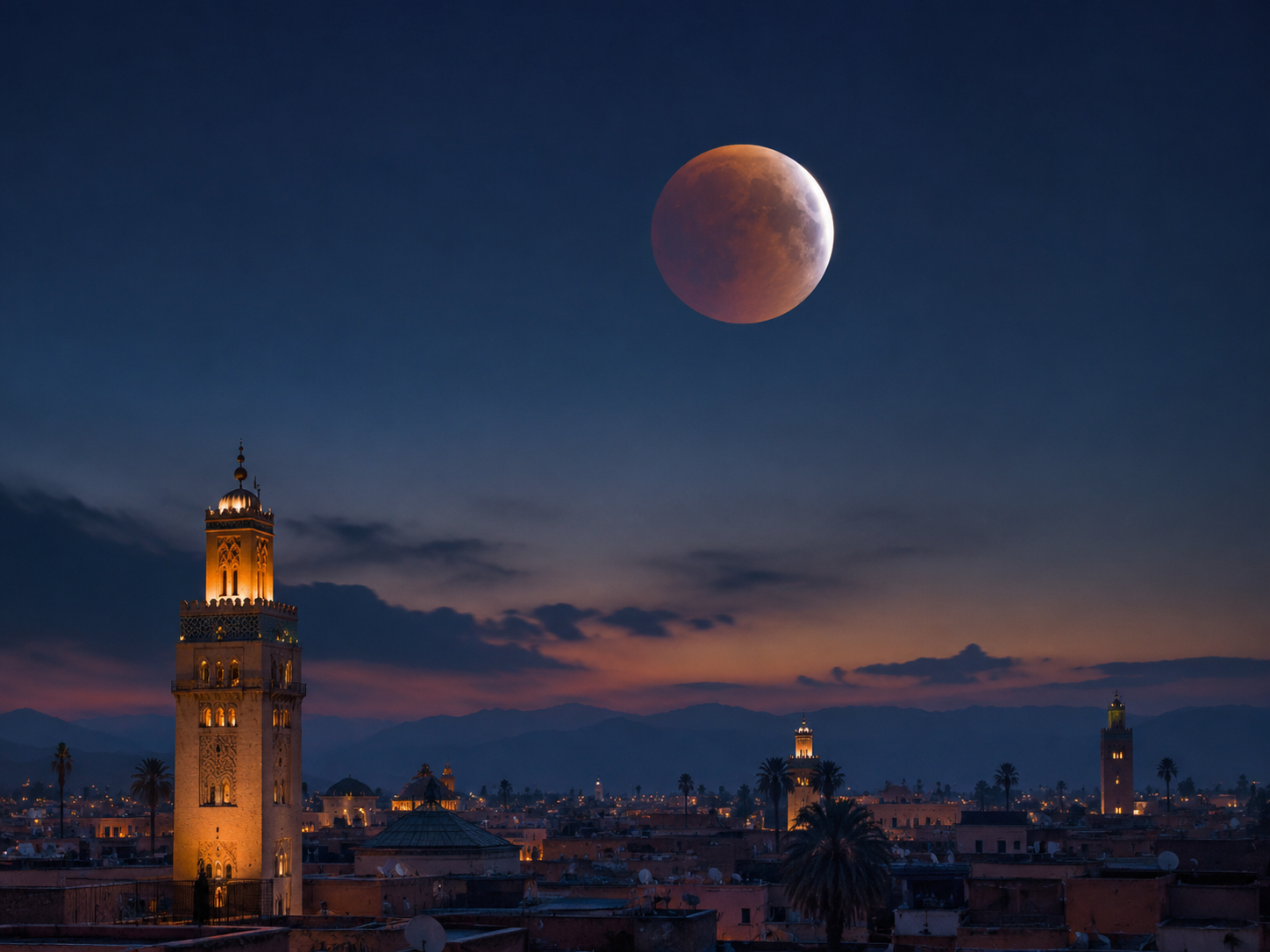
Around 96.3% of the Moon’s visible disk will enter Earth’s darkest shadow, with the eclipse reaching maximum shortly after 5am over Morocco.
Set an early alarm. Morocco will see the Moon move deep into Earth’s shadow before sunrise on Friday, 28 August.
The clearly visible partial phase begins at approximately 3:34am and reaches maximum at approximately 5:13am. At that point, almost the entire lunar disk will be inside Earth’s darkest central shadow.
Look southwest at first, then west-southwest as the Moon descends. Marrakech and Agadir currently have the most promising forecasts, while cloud could disrupt viewing in several northern, Atlantic and eastern cities.
MOROCCO’S LUNAR ECLIPSE: WHAT TO KNOW
| Essential information | Morocco viewing details |
|---|---|
| Date | Before dawn on Friday, 28 August 2026 |
| Eclipse type | Deep partial lunar eclipse, not a total eclipse |
| Penumbral phase begins | Approximately 2:24am |
| Clearly visible partial phase begins | Approximately 3:34am |
| Maximum eclipse | Approximately 5:13am |
| Partial phase ends | Approximately 6:52am |
| Viewing direction | Southwest, moving towards west-southwest |
| Eye protection | Not required |
| Main obstacle | Cloud or an obstructed western horizon |
| Timing sources | NASA and Timeanddate |
| Weather forecast checked | 27 August 2026 at 9:30am Morocco time |
| Last updated | 27 August 2026 at 9:30am Morocco time |
Times are rounded to the nearest minute from precise astronomical calculations. Some services display 3:33am and 5:12am because they show the minute already in progress.
MOROCCO LUNAR ECLIPSE TIMES BY CITY
The eclipse phases occur at the same astronomical moment across Morocco. The principal local differences are the Moon’s altitude, moonset time, weather and quality of the western horizon.
| City | Penumbral start | Partial start | Maximum | Direction and altitude at maximum | Partial end | Moonset | Forecast during main viewing period |
|---|---|---|---|---|---|---|---|
| Tangier | 2:24am | 3:34am | 5:13am | WSW, 241°, about 19° | 6:52am | 7:00am | Cloudy early, mostly cloudy around maximum |
| Rabat | 2:24am | 3:34am | 5:13am | WSW, 241°, about 21° | 6:52am | 7:06am | Cloudy conditions could restrict viewing |
| Casablanca | 2:24am | 3:34am | 5:13am | WSW, 241°, about 21° | 6:52am | 7:10am | Cloudy to overcast around maximum |
| Fes | 2:24am | 3:34am | 5:13am | WSW, 243°, about 19° | 6:52am | 6:58am | Cloud should decrease, with clearer spells possible |
| Marrakech | 2:24am | 3:34am | 5:13am | WSW, 241°, about 23° | 6:52am | 7:13am | Clear throughout the main viewing period |
| Agadir | 2:24am | 3:34am | 5:13am | WSW, 241°, about 24° | 6:52am | 7:21am | Clear throughout the main viewing period |
| Oujda | 2:24am | 3:34am | 5:13am | WSW, 244°, about 17° | 6:52am, below horizon | 6:45am | Cloudy to overcast around maximum |
These are forecasts, not guarantees. Conditions can change before dawn.
SET YOUR ALARM FOR FRIDAY MORNING
Do not wait outside early on Thursday evening. Morocco’s viewing window begins after midnight and becomes most dramatic shortly before dawn on Friday.
At approximately 2:24am, the Moon enters Earth’s lighter outer shadow, known as the penumbra. The first change may be so subtle that many viewers will not notice it.
The obvious partial eclipse begins at approximately 3:34am. Earth’s darker central shadow, the umbra, will then appear to take an increasingly large, curved bite from the Moon.
Maximum eclipse arrives at approximately 5:13am. Anyone who does not want to watch the full progression should aim to be ready by 4:45am.
The partial phase continues until approximately 6:52am. However, the Moon will be extremely low by then. It sets at about 6:45am in Oujda, before the partial phase ends, and between approximately 6:58am and 7:21am in the other listed cities.
WHERE TO LOOK IN THE SKY
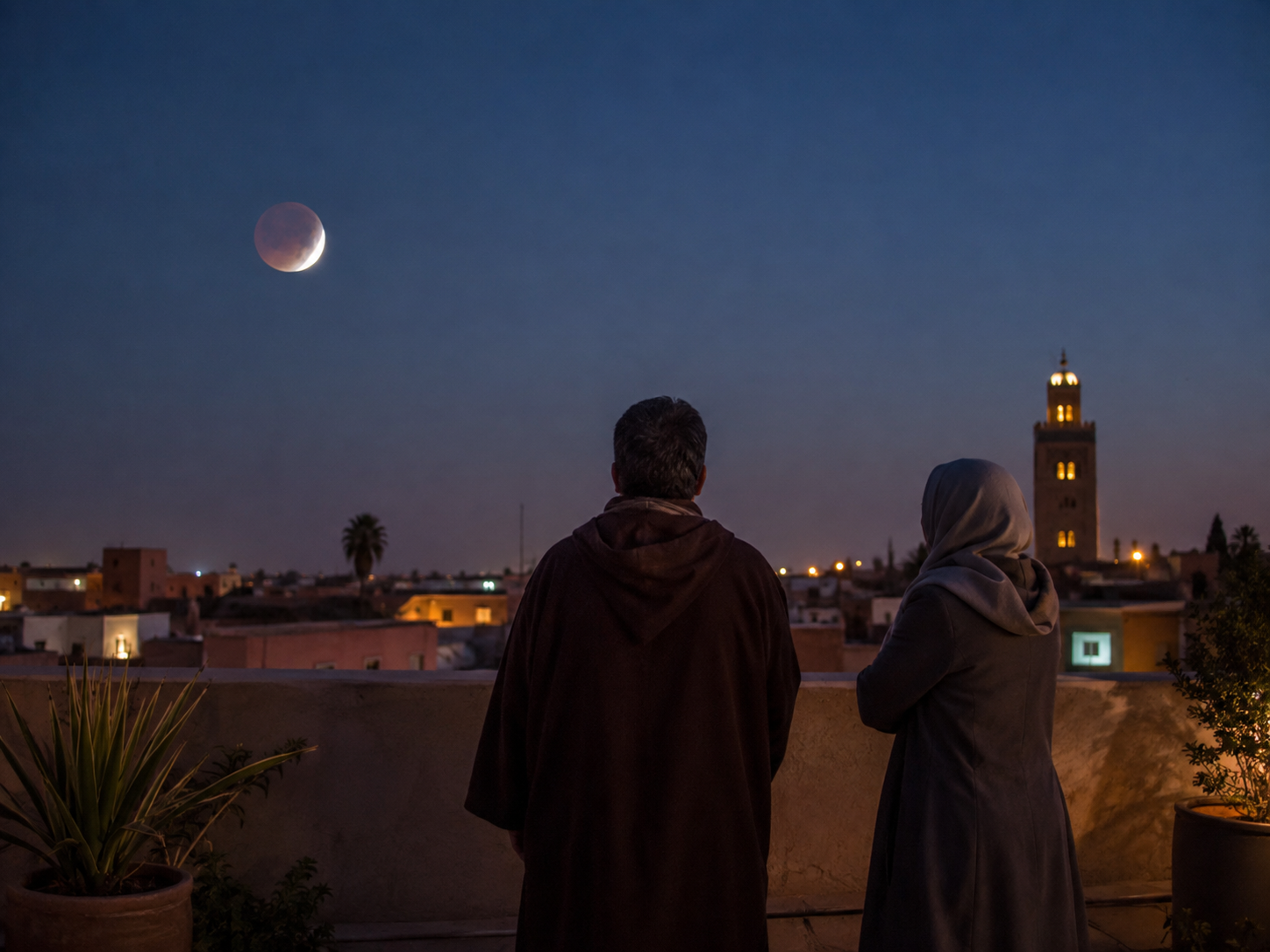
Look southwest when the partial phase begins. As the eclipse develops, the Moon will move lower towards the west-southwest.
At maximum, it will stand approximately 17° above the horizon in Oujda and between roughly 19° and 24° in the other listed cities.
Buildings, hills, trees and mountains could therefore block it. The western horizon becomes even more important after maximum as the Moon approaches moonset.
A balcony with an open western view, an open field or a safe public space may work well. There is no need to travel to an isolated location or climb onto an unsafe roof.
Do not stop on a motorway, stand beside moving traffic, approach an unprotected cliff or enter private land for a better view.
WHAT WILL THE MOON ACTUALLY LOOK LIKE?
A lunar eclipse occurs when Earth moves between the Sun and the full Moon, allowing Earth’s shadow to fall across the lunar surface.
The penumbra is the lighter outer part of that shadow. It produces gentle shading that can initially be difficult to detect.
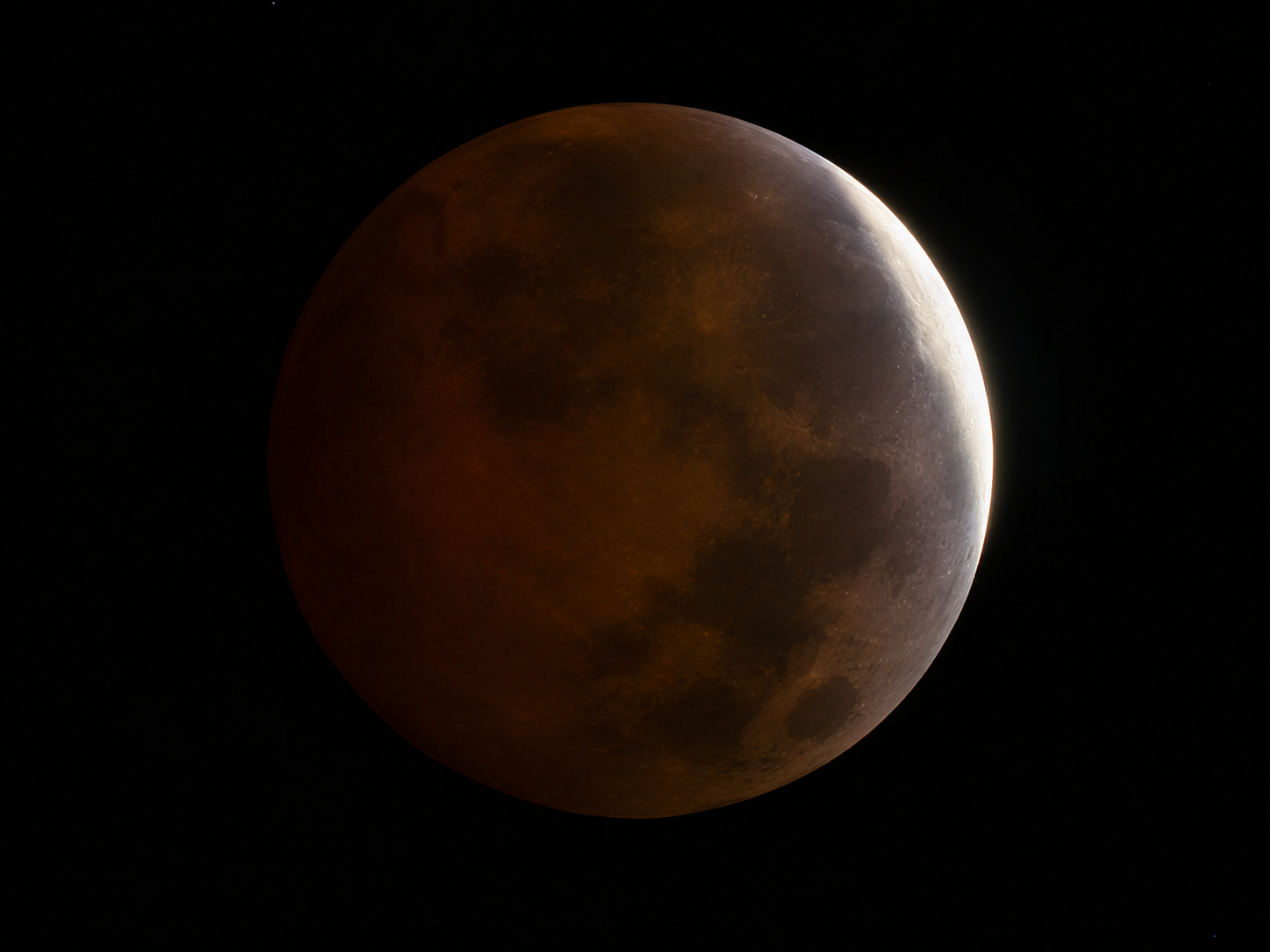
The umbra is the darker central shadow, where Earth blocks direct sunlight from reaching the affected part of the Moon. Once the partial phase begins, a distinct curved shadow should spread across the lunar disk.
Near maximum, only a narrow part of the Moon will remain outside the umbra. The shadowed area may look extremely dark, copper-coloured, orange or reddish because some sunlight is filtered and bent through Earth’s atmosphere.
A brilliant red colour is not guaranteed. Atmospheric conditions and camera exposure affect how bright or colourful the Moon appears.
This is officially a partial lunar eclipse. The Moon never enters the umbra completely, meaning no location on Earth will experience totality.
NASA describes the eclipse’s depth using two measurements. Its umbral magnitude of approximately 0.93 means about 93% of the Moon’s diameter, or width, will be inside the umbra. Approximately 96.3% of the visible disk’s total area will be inside it.
That does not mean 96.3% of the Moon disappears. The shadowed surface remains present and may still be visible as a dark or copper-coloured section.
WILL CLOUDS BLOCK THE VIEW?
Astronomically, the eclipse is visible across Morocco. Meteorologically, the experience could differ sharply between cities.
The hourly forecasts checked shortly before publication strongly favour Marrakech and Agadir, where clear conditions are expected through the main viewing period.
Fes could also have an opportunity. Cloud is forecast earlier in the night, but clearer spells may develop before and around maximum.
The outlook is less encouraging for Tangier, Rabat and Casablanca. Tangier is forecast to remain mostly cloudy around maximum, while Rabat could experience substantial cloud. Casablanca’s forecast indicates cloudy to overcast conditions during the most important phases.
Oujda also faces a considerable risk of cloud or overcast skies.
No meaningful rainfall is forecast during the main viewing period in most of the listed cities, but a dry forecast does not mean the sky will be clear. Cloud alone can hide the Moon.
The official Morocco weather vigilance portal and the latest hourly forecast should be checked again before travelling.
HOW TO WATCH SAFELY WITH CHILDREN
A lunar eclipse is safe to watch with the naked eye. Eclipse glasses are not required.
Binoculars and telescopes are also safe for lunar-eclipse viewing. This advice does not apply automatically to a solar eclipse, when looking at the Sun requires certified protection.
Children should remain with an adult in a secure viewing place. Bring an extra layer of clothing if the morning is expected to feel cool.
Never operate a phone or camera while driving. Stop only in a safe and permitted location before trying to find the Moon.
FIVE THINGS TO DO BEFORE GOING TO SLEEP
Set an alarm for 4:45am.
Check your city’s forecast.
Find a clear western horizon.
Charge your phone or camera.
Save a livestream as backup.
HOW TO TAKE A BETTER PHONE PHOTO
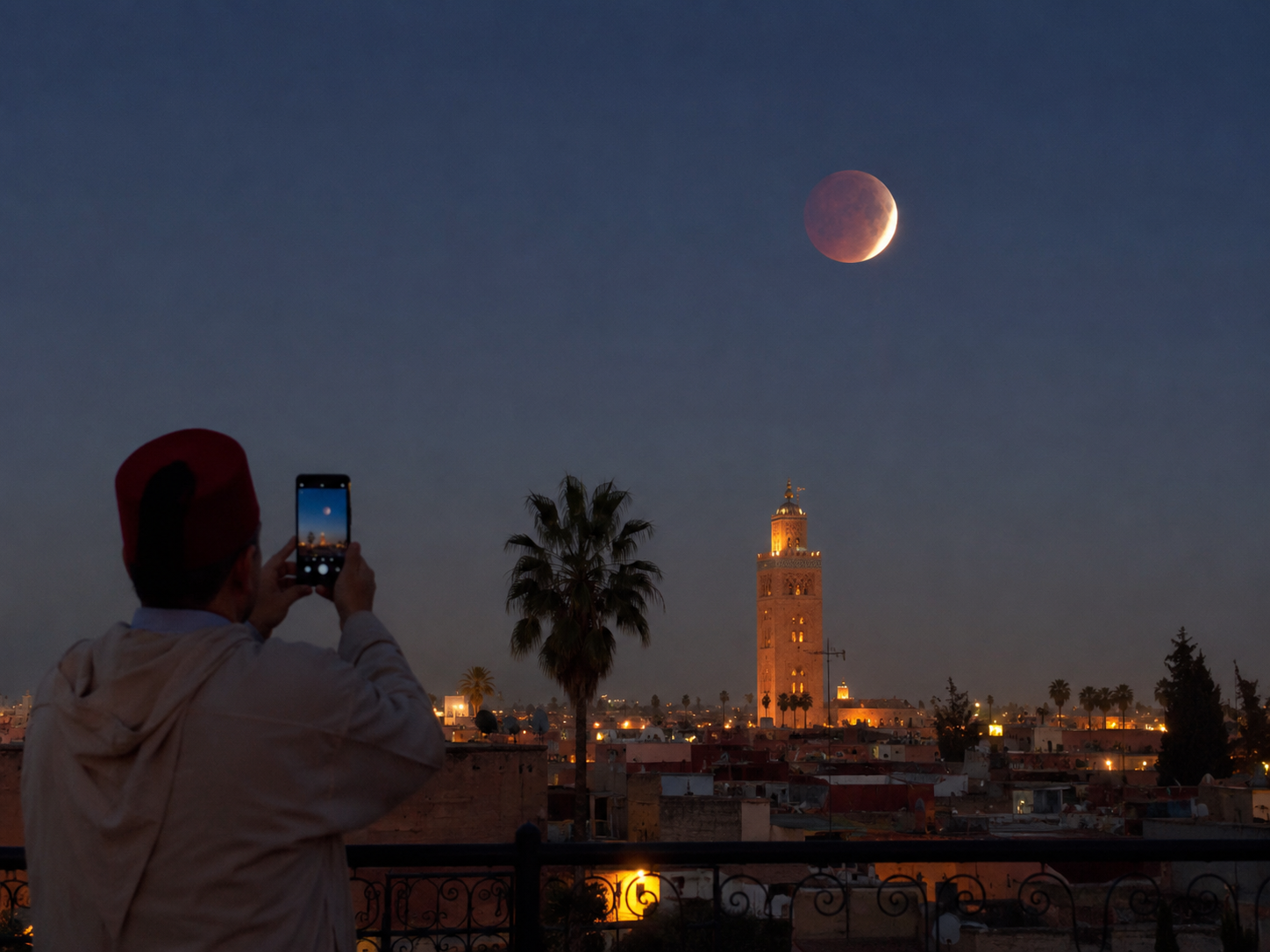
Clean the camera lens and keep the phone stable using a tripod, wall or another solid support.
Avoid excessive digital zoom. Tap the Moon on the screen and reduce the exposure if it appears as a featureless white circle.
Use night mode carefully. A long exposure may improve the landscape but blur the Moon or overexpose its bright edge.
Try including a palm tree, minaret, building or skyline. A recognisable foreground can give the image scale and a strong sense of place.
Take several photographs during different stages. Not every phone will reproduce the copper colour or shadow as clearly as the human eye.
Never trespass or stand in traffic for a photograph.
WHAT TO DO IF THE SKY IS CLOUDY
Three free broadcasts have been confirmed:
Timeanddate’s official eclipse stream starts at 3:00am Morocco time. Its mobile observatory is targeting an area near Seville, with additional international partners. Live pictures remain weather-dependent.
The Virtual Telescope Project starts at 2:30am Morocco time. The organisation confirms that it is a free online event.
Griffith Observatory’s official event listing schedules its online broadcast from 3:25am to 7:00am Morocco time, equivalent to 7:25pm to 11:00pm in Los Angeles.
Save at least one link before sleeping. Weather or technical problems can still affect any live broadcast.
ONE EARLY ALARM FOR A DIFFERENT VIEW OF THE MOON
No specialist equipment or distant journey is required.
For children, Friday’s eclipse offers a simple demonstration of Earth’s place between the Sun and Moon. For photographers, it provides a chance to place a familiar Moroccan skyline beneath an unfamiliar-looking lunar disk.
Set the alarm, choose a safe place and find an open view towards the west. If the clouds cooperate, Morocco will watch Earth’s shadow cover almost the entire face of the full Moon before sunrise.
 Jamal Mahdad, Founder & Editor-in-Chief