

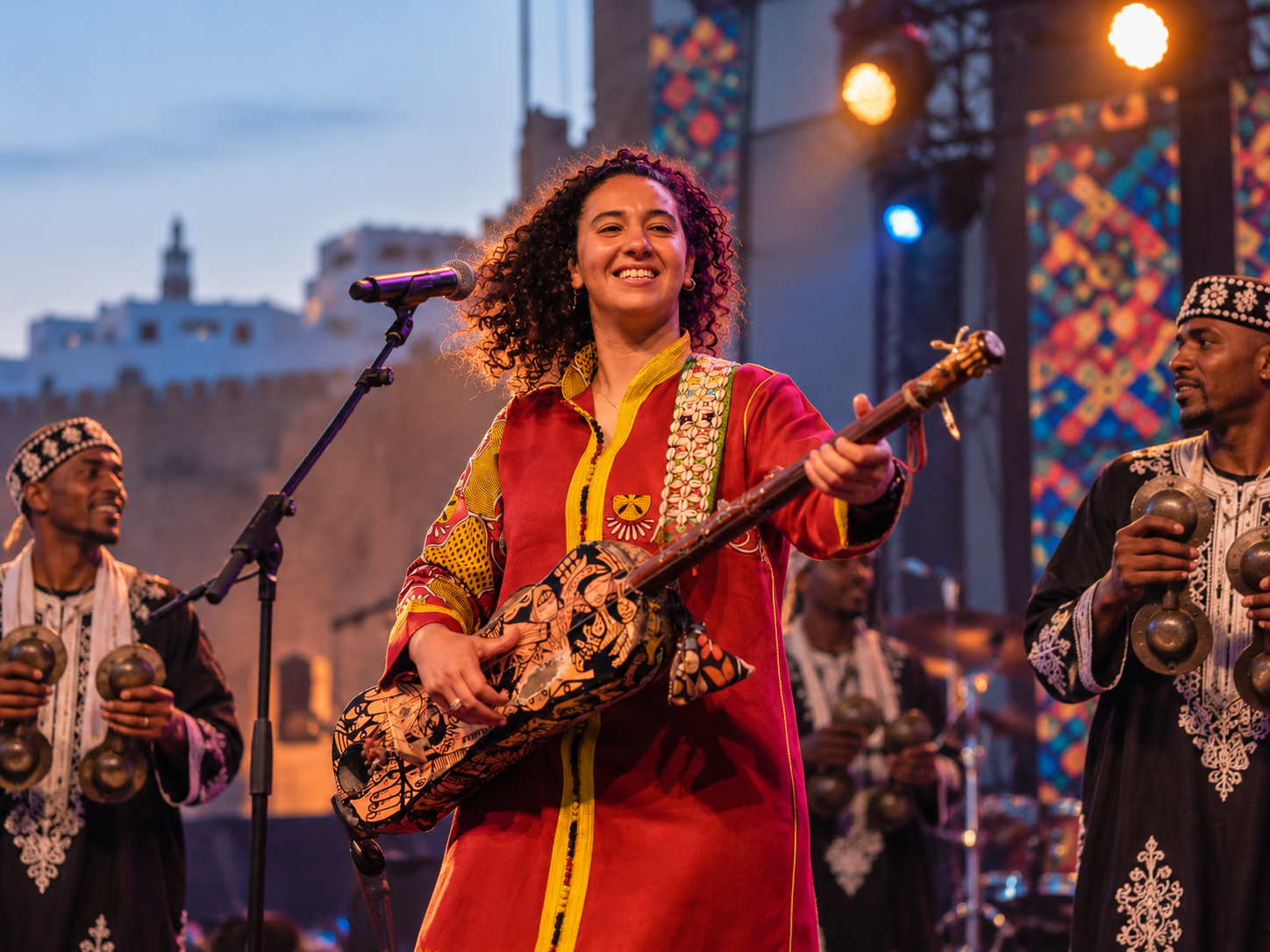
The self-taught Moroccan singer and musician is building an international career through traditional Gnawa, orchestral collaborations and electronic music. Her upcoming Paris performance reflects a musical journey rooted in Essaouira and sustained by curiosity.
Hind Ennaira bought a guembri and began teaching herself to play. YouTube lessons helped with the fundamentals. Concerts and Gnawa night-time ceremonies offered another education: the opportunity to encounter the music among the people who practised it.
The singer from Essaouira went on to form her own ensemble and perform internationally. Along the way, she brought the three-stringed instrument into collaborations with an Andalusian orchestra and an electronic music producer, while continuing to explore the traditional repertoire.
On 29 October, that journey takes her to the Cité de la musique–Philharmonie de Paris. Her appearance in “Transes gnaouas” will introduce another audience to a musician whose career combines independent learning, encouragement from established masters and an appetite for different musical settings.
An Education Rooted in Essaouira
In previously published interviews, Ennaira has traced her beginnings to 2016, when friends and people close to her encouraged her interest. A short video she made attracted a positive response from Gnawa listeners.
Her education extended beyond practising the instrument. She read about Gnawa, attended performances and ceremonies, and developed her singing alongside her playing. Essaouira provided opportunities to encounter a tradition sustained through musicians, families, gatherings and public performances.
Music was one of several pursuits in her early life. She also played professional basketball and worked in tourism. As her musical career developed, the city’s Gnaoua and World Music Festival became an important platform, helping her reach audiences from Morocco and abroad.
By 2022, she had formed her own ensemble. Bringing musicians together gave her a different responsibility: leading a group whose members shared an attachment to the repertoire.
Although described as self-taught, Ennaira has acknowledged the encouragement of established Gnawa masters. She has spoken of drawing inspiration from musicians in Essaouira, Marrakech and northern Morocco, each with a different approach to the music. Her development brought personal study into contact with knowledge accumulated across generations.
Three Strings, a Shared Musical Language
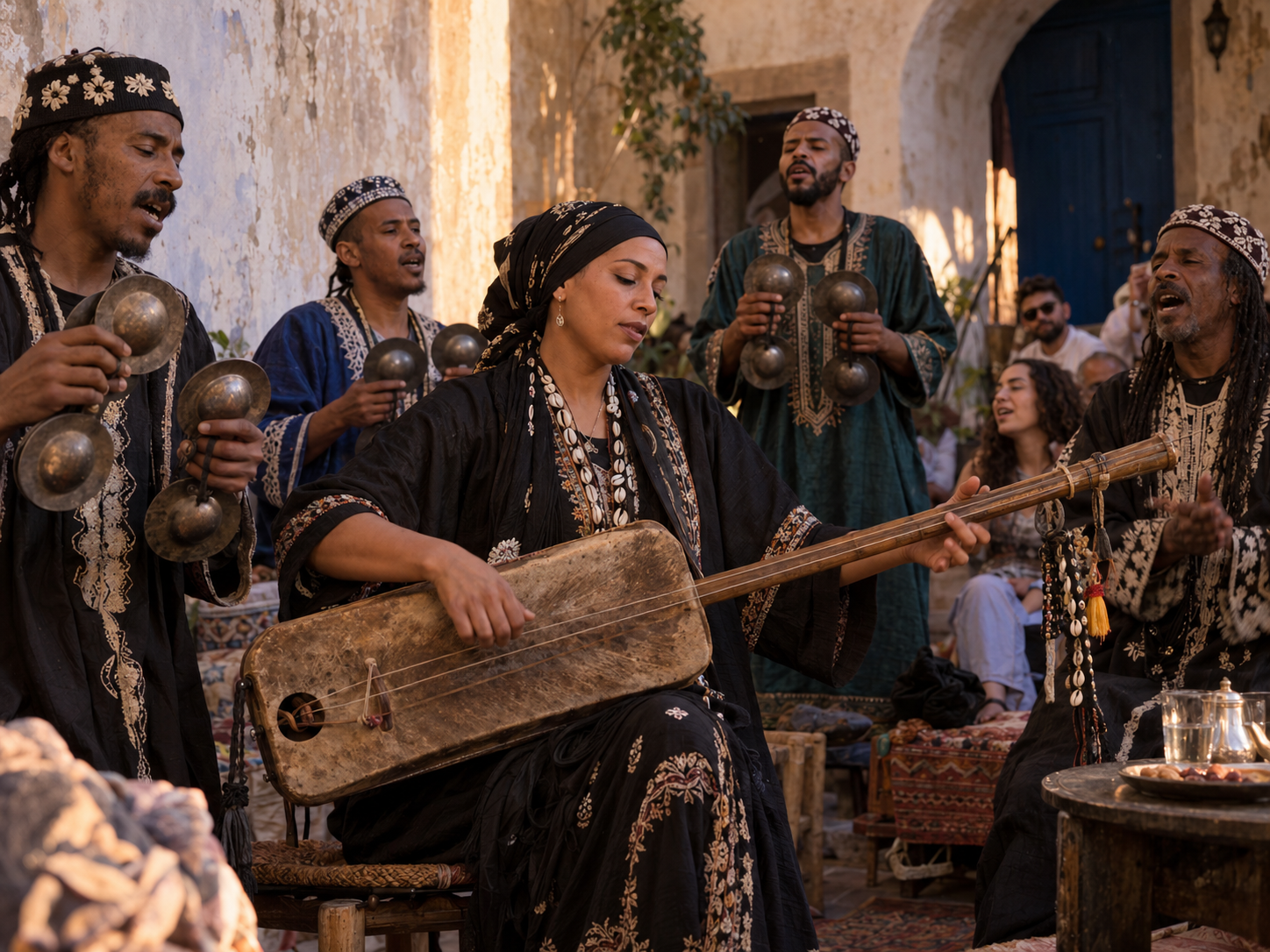
The guembri’s low melodies are central to much Gnawa ensemble music. Its three strings stretch over a skin-covered resonator, producing a sound that works alongside the voice and the metallic rhythms of qraqeb, hand-held percussion instruments.
The music depends on relationships between performers. A lead vocal phrase receives a choral response; the guembri and percussion sustain the musical patterns, while movement and dance also form part of the ensemble’s expression.
Gnawa’s history connects Morocco with sub-Saharan Africa, including communities shaped by enslavement and their descendants. Over generations, African musical and spiritual inheritances became intertwined with Moroccan religious and social life.
Recognised by UNESCO as intangible cultural heritage in 2019, Gnawa encompasses communal practices, spiritual rituals and public performances. The lila, a night-time ceremony associated with healing and spirit possession, is one setting for its repertoire. Concert halls and festivals provide others, with different purposes and conditions.
Women have longstanding roles within this culture, including hosting gatherings and overseeing ceremonies as mqaddemat. Ennaira belongs to the comparatively small number of women who also perform publicly as guembri players and ensemble leaders.
She has approached the title of maâlema with care. In a previously published interview, she explained that, although audiences sometimes addressed her that way, she did not claim the title for herself. She regarded it as a responsibility requiring recognition from established masters.
A Repertoire Open to New Encounters
Ennaira’s collaborations show the different musical settings she has explored.
In March 2024, she performed with the Amsterdam Andalusian Orchestra in a concert presented by Bimhuis and Muziekgebouw. The programme placed her voice and guembri alongside instruments including oud, rabab, violin, double bass and percussion, bringing Gnawa into an ensemble associated with Arab-Andalusian repertoire and other traditions.
In Essaouira the following year, she made another choice. Having worked extensively on fusion, she prepared an entirely traditional programme for her June 2025 appearance on the Moulay El Hassan stage.
Her collaboration with DJ and producer Omary took a different direction. Their Gnawatronic project, performed at Jazzablanca this July, combines Gnawa with electronic music and influences from jazz and funk. “Baba Mimoun” offers one example of the project’s pairing of guembri sounds with contemporary production.
The Paris concert will present two separate performances. Maâlem Abdelkébir Merchane is scheduled for the first half of “Transes gnaouas”, with Ennaira following after the interval. It begins at 20:00 in the Salle des concerts at the Cité de la musique, within the institution’s Morocco programme running from 29 to 31 October.
The appearance extends a career already shaped by international collaborations. Yet Ennaira’s decision to prepare a wholly traditional set in her home city remains a revealing part of that journey. Alongside the search for new musical partners, she continues to return to the repertoire that first drew her to the guembri.