

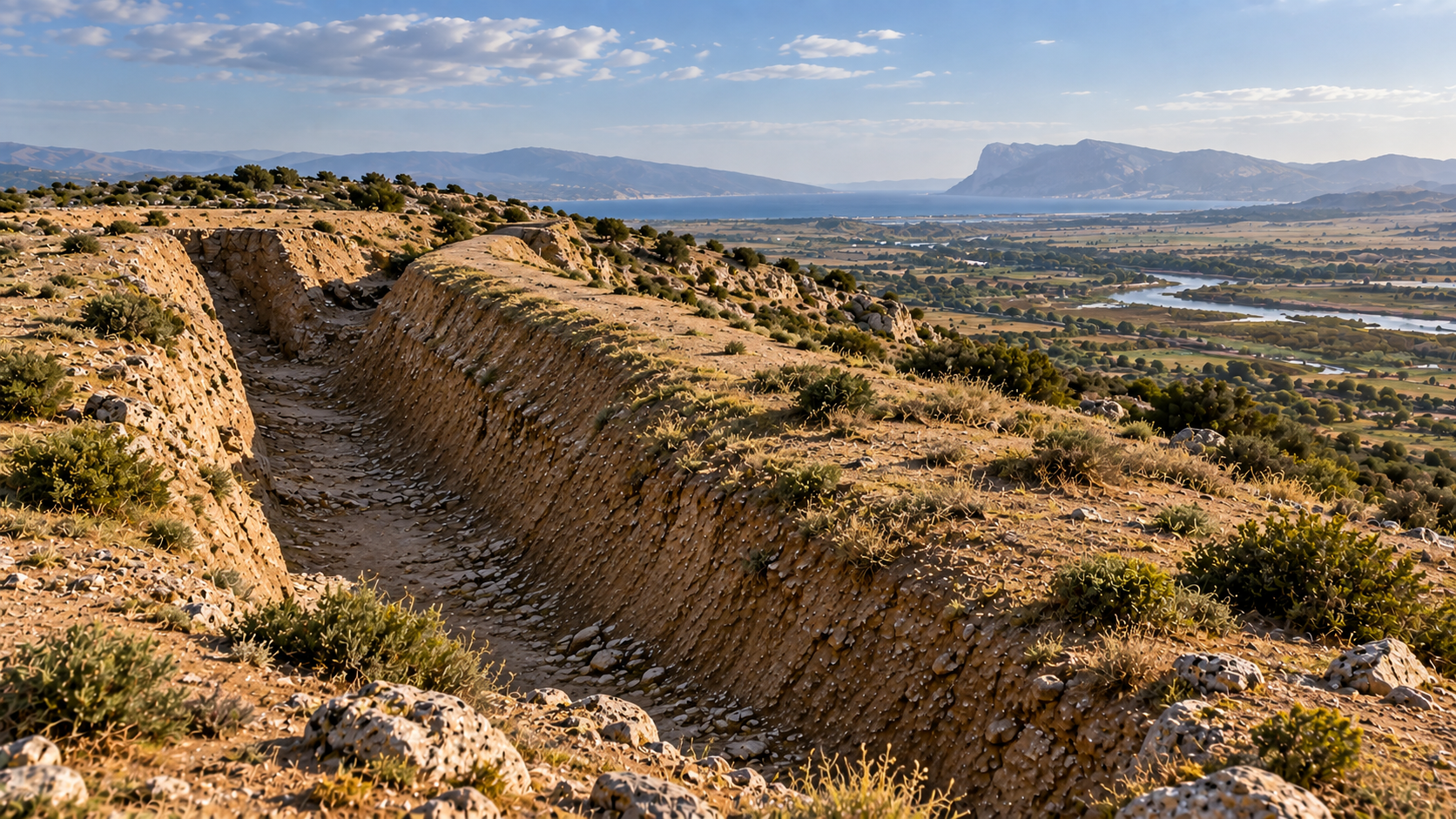
New research at Oued Beht reveals the oldest known defensive system in North Africa beyond the Nile Valley, built by an organised society 3,500 to 4,000 years ago.
Long before Morocco’s famous dynasties and great medieval cities, a community overlooking the Oued Beht river reshaped the land to protect its settlement.
Archaeologists have identified a prehistoric defensive system consisting of a ditch and an earthen rampart at Oued Beht, in Khémisset province in northwestern Morocco. Built during the early to middle second millennium BC, it dates back approximately 3,500 to 4,000 years.
Researchers describe it as the oldest known defensive system yet identified in North Africa beyond the Nile Valley.
But one distinction is crucial. The prominent stone wall visible at the site is not 4,000 years old. It belongs mainly to a much later medieval phase. The prehistoric defences were earthworks discovered beneath it.
The findings come from excavations and survey conducted in 2023 and were published in Libyan Studies in September 2026.
A DEFENSIVE SYSTEM BUILT THOUSANDS OF YEARS AGO
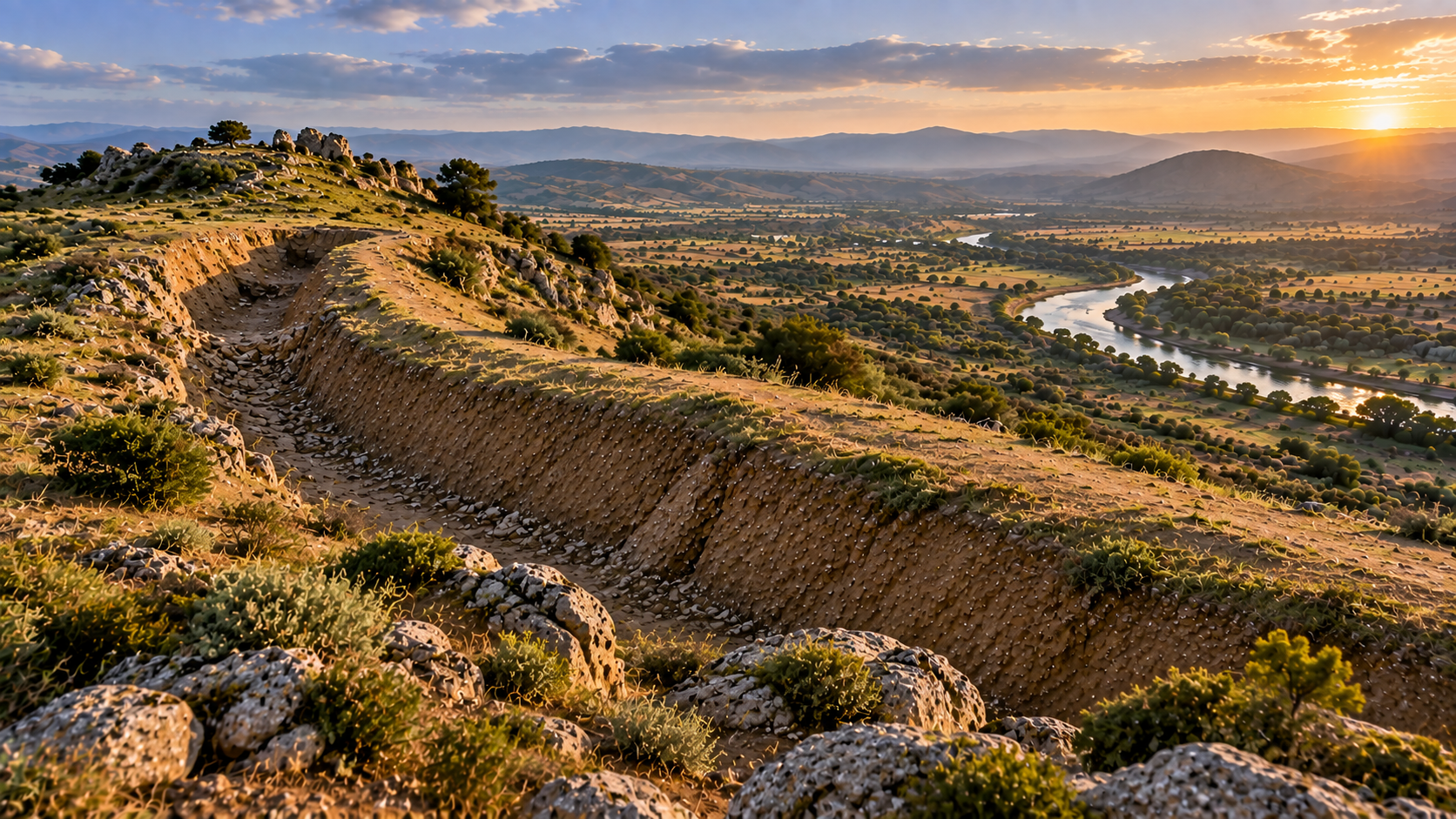
Oued Beht occupies a ridge overlooking the river from which the site takes its name. Its position offered wide views of the surrounding landscape, but its inhabitants did not rely on geography alone.
Beneath the later stonework, researchers found a prehistoric ditch running beside a multiphase earthen embankment. Radiocarbon dating places the principal ancient defensive sequence in the early to middle second millennium BC.
The system crossed the ridge near its southern end. Combined with the rocky terrain, the ditch and raised earthwork would have made access more difficult.
Evidence suggests that occupation shifted from a relatively exposed northern area towards a rocky southern spur that was easier to protect. Its builders were using the natural shape of the land strategically.
The researchers nevertheless remain cautious. Defence is the leading interpretation, but enclosure or internal division may also have played a role during parts of the site’s long history.
THIS WAS NOT A 4,000-YEAR-OLD STONE WALL
Images of Oued Beht can create a misleading impression. A substantial stone wall stands above the ancient earthworks, but this visible masonry belongs mainly to the medieval period.
The prehistoric system consisted of a ditch, an embanked rampart and earlier structural remains. Archaeologists identified several episodes of construction, repair and alteration.
The major stone-built phase came much later, with dating indicating medieval activity beginning between the 11th and 13th centuries AD. A medieval cemetery provides further evidence that people returned to the location many centuries after the prehistoric occupation.
Oued Beht contains remains from several distinct periods. Combining them into one uninterrupted settlement would misrepresent the archaeology.
OUED BEHT HAD ALREADY CHANGED MOROCCO’S ANCIENT STORY
The defensive system is not Oued Beht’s first major contribution to archaeology.
Earlier work revealed a far older settlement dating approximately from 3400 to 2900 BC. Covering around ten hectares, it was a remarkably large agricultural community for its period.
Its inhabitants cultivated land and raised livestock. Archaeological evidence also points to storage, food processing, production and other organised activities on a substantial scale.
The settlement helps correct an incomplete picture of northwestern Africa’s later prehistory. Oued Beht shows that large farming communities capable of intensive and coordinated activity were flourishing in Morocco more than 5,000 years ago.
However, the Final Neolithic settlement should not be treated as identical to the community responsible for the later defences. The defensive complex belongs mainly to a subsequent phase in the second millennium BC.
WHY THESE DEFENCES MATTER
Excavating a large ditch and raising an embankment demanded more than physical strength.
The work probably required planning, organised labour, knowledge of the terrain and cooperation. People had to select an effective location, move earth, coordinate construction and maintain or repair the finished system.
Its scale and position therefore point to a society capable of organising space around collective priorities.
Those priorities cannot yet be identified with certainty. The system may have protected people, animals, stored produce or important activities. It may reflect concern about conflict or insecurity, but the archaeology does not prove that an invasion occurred or that permanent enemies surrounded the settlement.
Defensive architecture records preparation and organisation. It does not reveal the precise danger its builders expected.
MOROCCO WAS PART OF A CONNECTED MEDITERRANEAN WORLD

Oued Beht also belongs to a wider history of contact across the western Mediterranean.
Previous research identified connections between the older settlement and contemporary developments in the southern Iberian Peninsula. These links do not prove a particular migration route or organised trading network, but they show that the Strait of Gibraltar was not an absolute barrier.
People, objects, knowledge or practices could move between North Africa and Iberia thousands of years ago. Morocco was not beyond the margins of Mediterranean history. It was an active part of a connected region.
The Italian National Research Council notes that fortified settlements and increasingly complex forms of social organisation were also developing in southern Iberia during the second millennium BC.
That comparison provides valuable context, but it does not prove that Oued Beht’s defences were copied from Iberian examples.
ONE SITE, MANY CHAPTERS OF HISTORY
Oued Beht remained attractive long after its prehistoric communities had disappeared or moved elsewhere.
During the medieval period, people returned to the ridge, constructed the substantial stone wall and used part of the area as a cemetery. Survey evidence from the surrounding landscape also records medieval rural settlement and agricultural activity.
The ridge offered visibility, access to land and water, and terrain that could be enclosed or defended.
This does not indicate continuous occupation by one community. Different groups recognised the advantages of the same location during separate chapters of history.
WHAT ARCHAEOLOGISTS STILL WANT TO KNOW
The research answers an important question about the age of the defences, but many uncertainties remain.
Archaeologists still want to determine exactly when the earliest ditch was cut, how the system developed and how long it functioned. Its original profile and full depth also require further investigation.
It remains unclear how many people occupied the protected area, what they intended to safeguard and what prompted the shift towards the southern spur.
Future excavations could refine the chronology and reveal more about the relationship between the Final Neolithic settlement, the later prehistoric occupation and the medieval reuse.
MOROCCO’S DEEPER HISTORY IS STILL EMERGING
The Oued Beht Archaeological Project brings together Morocco’s Institut National des Sciences de l’Archéologie et du Patrimoine, the University of Cambridge, Italy’s National Research Council, including its Institute of Heritage Science, and ISMEO.
The project is co-directed by Youssef Bokbot, Cyprian Broodbank and Giulio Lucarini. According to CNR’s Institute of Heritage Science, it is conducted in collaboration with Morocco’s Ministry of Youth, Culture and Communication and the local community of Aït Siberne.
Their work highlights the value of Moroccan archaeological expertise, international scientific cooperation and careful heritage protection.
Oued Beht needs no legend of a lost city to be extraordinary. Its earthworks reveal something more valuable: organised communities were farming, building and protecting strategically chosen spaces in Morocco thousands of years ago.
Across Morocco’s ridges and river valleys, Africa’s ancient past is finding its voice again, one carefully uncovered layer at a time.