
Morocco welcomed nearly 9.4 million visitors during the first six months of 2026.
That represents an increase of approximately 6% compared with the same period last year. Travel receipts also grew faster than arrivals, while overnight stays in classified accommodation continued to rise.
The figures confirm that Morocco’s tourism expansion remains strong.
More flights are arriving.
More hotel rooms are being prepared.
More destinations are entering international travel programmes.
More infrastructure is being built ahead of 2030.
But tourism capacity is not measured only in aircraft seats, hotel beds and terminal space.
It is also measured in people.
Receptionists.
Housekeepers.
Chefs.
Waiters.
Guides.
Drivers.
Revenue managers.
Maintenance teams.
Language specialists.
Digital marketers.
Hotel directors.
Morocco can construct new accommodation faster than it can produce experienced hospitality professionals.
That makes the next tourism challenge a workforce challenge.
Visitor Growth Raises The Service Standard
Tourism growth creates employment, but it also raises expectations.
A destination receiving nearly 20 million visitors annually is judged differently from one serving a smaller, less diverse market.
Travellers increasingly compare Morocco with destinations across southern Europe, the Gulf, Asia and the Mediterranean.
They expect efficient booking.
Clear communication.
Clean rooms.
Professional service.
Reliable transport.
Fast problem resolution.
Consistent digital information.
The strongest hotel or restaurant can deliver these standards.
The larger challenge is delivering them consistently across thousands of businesses and multiple regions.
Morocco’s tourism reputation will not be determined only by its best properties.
It will also be shaped by the weakest experience encountered during a visitor’s journey.
A beautiful destination can attract someone once.
Service quality helps bring them back.
More Beds Require More Skilled Workers

Morocco plans to add approximately 60,000 hotel beds before the 2030 World Cup, increasing national accommodation capacity by about one fifth. The expansion follows the addition of roughly 45,000 beds during the previous four years.
Physical capacity can be expanded through financing, land, construction and equipment.
Human capacity takes longer.
A new hotel may be completed within several years.
An experienced general manager, executive chef or revenue specialist may require a decade of professional development.
Even entry-level hospitality positions require structured preparation.
Employees must understand customer service, hygiene, digital systems, safety procedures and communication with international guests.
Opening a property without a sufficiently trained workforce can damage the investment from its first day.
Service failures create poor reviews.
Poor reviews weaken pricing power.
Lower pricing reduces the revenue available for wages, maintenance and training.
A workforce problem can therefore become a commercial problem very quickly.
Tourism Needs Careers, Not Only Seasonal Jobs
Hospitality is often treated as a source of immediate employment.
That is true, but incomplete.
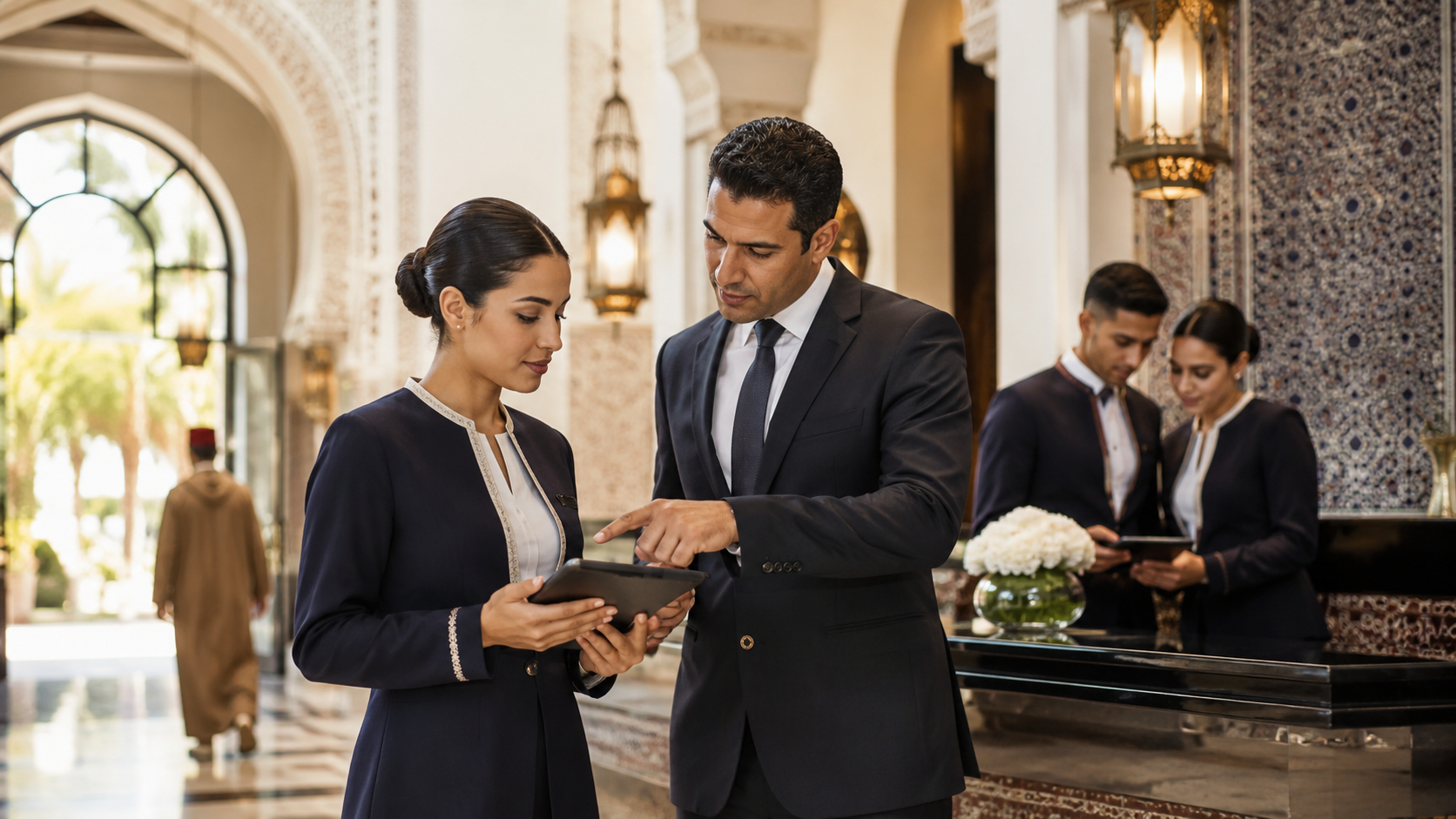
The sector needs visible career pathways.
A young employee entering as a receptionist should be able to understand how to become a supervisor, department manager or hotel director.
A kitchen assistant should see a route towards becoming a qualified chef.
A guide should be able to develop specialist knowledge, multilingual services and premium products.
Without progression, tourism jobs can appear temporary, low-status or financially limited.
That makes recruitment harder.
It also increases staff turnover.
Businesses then repeatedly train new workers instead of building experienced teams.
Morocco’s tourism strategy should therefore focus on retention as much as recruitment.
Employees remain when they see professional development, predictable scheduling, respectful management and realistic income progression.
The sector cannot promise premium experiences to visitors while offering unstable careers to the people expected to deliver them.
Language Is Becoming A Commercial Skill
Morocco’s traditional tourism languages remain important.
Arabic and French are essential across much of the industry.
Spanish is valuable in northern regions and for visitors from Spain.
But English is becoming increasingly central.
Morocco is attracting travellers from the United Kingdom, the United States, northern Europe, Asia, the Gulf and other African markets. During the first half of 2026, arrivals increased from several source countries, including Germany, the Netherlands, Poland, Britain and the United States.
These visitors may not speak French.
Language barriers can affect bookings, complaints, medical situations, transport and restaurant experiences.
English should therefore not be treated as an optional advantage limited to luxury hotels.
It is becoming part of the country’s tourism infrastructure.
Training must also go beyond basic greetings.
Employees need the vocabulary required to explain policies, solve problems and recommend experiences confidently.
A staff member who communicates clearly can increase trust, spending and satisfaction.
Language ability is therefore not merely cultural.
It is commercial.
Management Is The Missing Middle
Morocco can recruit thousands of entry-level workers.
The more difficult shortage may appear in middle management.
Hotels and tourism businesses need supervisors capable of organising teams, maintaining standards and solving operational problems.
This layer connects strategic decisions with daily service.
When middle management is weak, senior executives become involved in minor issues while frontline employees receive inconsistent direction.
The result is operational instability.
Rooms may not be ready on time.
Maintenance problems may remain unresolved.
Guest complaints may move between departments without ownership.
Staff schedules may not match occupancy.
Training institutions often focus on technical tasks.
The next phase should place greater emphasis on leadership, financial understanding, digital systems and team management.
Morocco does not need only more hospitality workers.
It needs more people capable of managing hospitality workers well.
Training Must Follow Real Employer Demand
Morocco’s tourism roadmap identifies human capital as one of the principal levers required to improve service quality and increase visitor return rates. It also set the objective of creating 200,000 new jobs by 2026.
Training numbers alone, however, do not guarantee workforce readiness.
Programmes must match the positions employers actually need.
Hotels may require revenue managers, maintenance technicians and food-safety specialists.
Tour operators may need digital sales professionals and multilingual guides.
Restaurants may need trained supervisors more urgently than additional general staff.
Training institutions should therefore work directly with employers.
Curricula need regular updating.
Internships should provide meaningful operational experience.
Certification should demonstrate competence rather than simple attendance.
Employers should also contribute.
They cannot expect public institutions to carry the entire training burden while offering limited internal development.
The strongest workforce system combines education before recruitment with continuous training after employment.
Regional Expansion Creates A Distribution Problem
Tourism growth is spreading beyond Marrakech and Agadir.
Tangier, Rabat, Fez, Essaouira, desert regions and emerging coastal destinations are attracting more attention.
This diversification is strategically valuable.
It distributes tourism spending and reduces pressure on the most established cities.
But trained workers are not distributed evenly.
A new property in an emerging destination may struggle to recruit experienced managers or specialised technical staff.
Workers may be reluctant to relocate when housing, transport, schools or career opportunities for their partners are limited.
Regional tourism development therefore requires more than accommodation.
It needs a local workforce ecosystem.
Training centres should respond to regional specialisations.
Coastal destinations may require different skills from mountain, desert or business-tourism locations.
Employers may need staff housing or transport solutions.
Local young people should receive access to the careers created around them.
A tourism project becomes a regional-development asset when the surrounding population can participate in its success.
Technology Will Change Jobs, Not Remove The Human Element
Digital check-in, automated booking, artificial intelligence and customer-management systems will become more common across tourism.
These tools can reduce repetitive administrative work.
They can improve pricing.
They can translate basic information.
They can identify maintenance or service problems faster.
But hospitality remains a human business.
Technology cannot fully replace reassurance after a cancelled flight.
It cannot reproduce the local knowledge of a strong guide.
It cannot manage every family request or cultural misunderstanding.
The objective should not be to reduce staff at any cost.
It should be to help staff work more effectively.
Employees need training to use digital systems rather than fear them.
The best tourism businesses will combine technological efficiency with human attention.
Morocco’s competitive advantage cannot come from automation alone.
It will come from using technology without losing hospitality.
Service Quality Must Become Measurable
Visitor totals provide a clear measure of tourism volume.
Workforce performance is harder to assess.
Morocco needs stronger service-quality indicators.
Employee turnover.
Training hours.
Language capability.
Complaint-resolution time.
Repeat-visitor rates.
Online review patterns.
Staff-to-room ratios.
Internal promotion rates.
These measures can reveal whether growth is strengthening or weakening the visitor experience.
A hotel may achieve high occupancy while exhausting its workforce.
A destination may attract more tourists while receiving lower satisfaction scores.
Those warning signs should be identified before reputational damage becomes visible.
Public policy can support sector-wide standards.
But individual businesses must accept responsibility for performance.
Service quality cannot be created through promotion campaigns.
It must be delivered during every shift.
The Tourism Boom Will Be Won By People
Morocco’s 9.4 million visitors in six months demonstrate that demand remains powerful.
The country is successfully increasing visibility, connectivity and tourism investment.
But the next stage will be more difficult.
Buildings can be financed.
Flights can be scheduled.
Campaigns can attract attention.
The experience itself must be delivered by people.
Morocco’s tourism future therefore depends on whether it can recruit, train, manage and retain a workforce large enough to support its ambition.
The most important capacity shortage may not be the number of rooms available in 2030.
It may be the number of experienced professionals ready to operate them.
Visitor growth creates opportunity.
Human capital determines whether that opportunity becomes lasting value.