
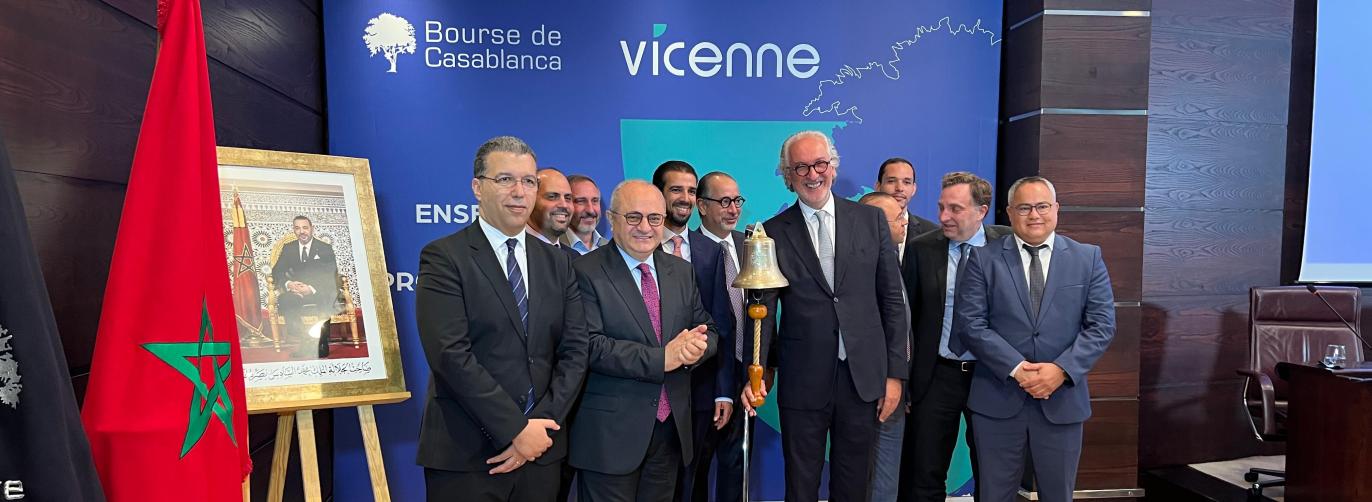
T2S Group Holding entered the Casablanca Stock Exchange with an offer worth approximately 1.1 billion dirhams.
Investors submitted requests worth 48.13 billion dirhams.
Demand exceeded the available offer by nearly 44 times.
More than 111,000 investors participated, while the average allocation rate fell to only 2.29%.
These figures represent more than a successful stock-market debut.
They reveal a structural imbalance.
Morocco appears to have a growing pool of household, institutional and international capital searching for credible investment opportunities.
But the number of companies entering the public market remains too limited to absorb that demand.
The T2S listing is therefore not only a story about one medical-technology company.
It is a signal that Morocco may have more investable capital than listed businesses ready to receive it.
The Demand Was Far Larger Than The Company
T2S offered fewer than five million shares at a price of 223 dirhams each.
Investors requested more than 215 million shares.
The resulting demand was exceptional relative to the size of the transaction.
That level of oversubscription reflects confidence in the company, but it also reflects scarcity.
When attractive listings remain infrequent, large amounts of capital concentrate around every credible new opportunity.
Investors are not simply choosing between dozens of recent public offerings.
They are competing for access to a limited pipeline.
This changes the meaning of oversubscription.
It can demonstrate enthusiasm for the issuer.
But it can also demonstrate that the market does not provide enough investable supply.
A stock exchange cannot deepen through demand alone.
It also needs more companies willing and able to list.
Moroccan Households Are Entering The Market
One of the strongest signals from the T2S operation was the number of individual participants.
Retail investors represented almost 99% of subscribers by number.
This suggests that stock-market participation is expanding beyond a narrow circle of professional institutions and wealthy investors.
Moroccan households are increasingly looking for alternatives to traditional savings products, property and cash deposits.
Equities offer potential access to corporate growth, dividends and long-term capital appreciation.
That shift is strategically important.
Domestic savings can become productive investment when they are directed towards companies seeking capital for expansion.
A household purchasing shares is not merely speculating on price movements.
It is helping finance business growth through the capital market.
But this participation needs protection.
New investors require clear information, realistic expectations and an understanding that strong demand at an IPO does not guarantee permanent returns.
A deeper retail-investor base can strengthen the market.
An inexperienced retail-investor base can also become vulnerable to disappointment and excessive risk.
Financial education must expand alongside participation.
The 2.29% Allocation Rate Creates Frustration
The average investor received only a small fraction of the shares requested.
That is the natural result of an offer receiving nearly 44 times more demand than available supply.
But repeated low allocations can create frustration.
Investors commit money, complete subscription procedures and wait for results, only to receive a very limited number of shares.
The unused funds are then returned without having found another productive destination.
This represents a missed opportunity for the market.
The demand existed.
The capital was available.
The transaction simply did not have enough shares to absorb it.
A stronger listing pipeline would allow this capital to move towards several companies rather than concentrating around one operation.
It would also reduce the pressure surrounding individual IPOs.
The goal should not be to eliminate oversubscription.
Strong demand is positive.
The goal should be to ensure that investors have more than one rare opportunity to consider.
Morocco Needs More Companies Ready For Public Ownership
Many successful Moroccan companies remain privately held.
Some are family-owned businesses built over several generations.
Others are controlled by founders who prefer private financing and limited external disclosure.
Remaining private can offer flexibility.
Owners retain control.
Financial information remains less exposed.
Decision-making can be faster.
But private ownership can also limit access to long-term capital, acquisition financing and wider governance structures.
Listing allows companies to raise funds without depending entirely on bank debt or a small number of shareholders.
It can support regional expansion, technology investment, acquisitions and succession planning.
The challenge is that many companies are not yet ready for the demands of public ownership.
They may lack audited reporting, independent governance, formal internal controls or a clear separation between ownership and management.
The shortage of IPOs is therefore not only a market problem.
It is a corporate-readiness problem.
Family Businesses Face A Succession Opportunity
Morocco has many strong family businesses that may eventually confront a generational transition.
Founders age.
Ownership becomes divided among heirs.
Some family members want to remain active in the company.
Others prefer liquidity.
These moments can create instability if no structure has been prepared in advance.
A stock-market listing can become part of the solution.
It can allow part of the family to sell shares while preserving a strategic holding.
It can professionalise governance.
It can establish a transparent market value.
It can reduce dependence on private negotiations between shareholders.
Listing does not require a family to abandon control.
Many public companies remain majority-owned by founding shareholders.
The difference is that ownership becomes more structured, visible and transferable.
Morocco’s next generation of IPO candidates may therefore emerge not only from young technology companies, but also from mature family businesses preparing for succession.
Banks Cannot Finance Every Stage Of Growth
Moroccan companies traditionally rely heavily on bank financing.
Banks remain essential to the economy.
They finance working capital, equipment, real estate and business expansion.
But debt is not always the appropriate instrument for every stage of growth.
A company entering a new market may need patient capital.
A business investing in research, digitalisation or acquisitions may face returns that arrive over several years.
Heavy debt can weaken cash flow before those investments begin producing results.
Equity absorbs risk differently.
Shareholders participate in both growth and loss.
The company is not required to repay equity according to a fixed schedule.
A stronger stock market therefore complements the banking system.
It does not replace it.
Companies with access to both debt and equity can build more balanced financing structures.
The T2S transaction demonstrates that equity demand exists.
The next task is to develop a larger supply of companies capable of using it responsibly.
T2S Represents A Strategic Sector
T2S is not entering the market as a conventional retailer or property company.
It operates in integrated medical technology.
That gives the listing wider significance.
Morocco is expanding healthcare infrastructure and seeking to strengthen domestic capability in medical equipment, technology and services.
A listed medical-technology group gives investors exposure to a sector linked to structural national demand.
It also demonstrates that the Casablanca market can finance businesses outside its traditional concentration in banks, telecommunications, construction and large industrial groups.
Sector diversification matters.
Investors need access to different economic themes.
Healthcare.
Technology.
Logistics.
Education.
Consumer services.
Renewable energy.
Digital infrastructure.
Food processing.
A broader sector mix can make the market more representative of Morocco’s changing economy.
It can also reduce dependence on the performance of a limited number of large listed groups.
Listing Must Finance Growth, Not Only Shareholder Exit
The T2S operation combined the sale of existing shares with the issuance of new shares.
Approximately 350 million dirhams entered the company through a capital increase, while around 750 million dirhams related to shares sold by existing owners.
Both elements can be legitimate.
Existing shareholders may need liquidity.
A public offering often requires enough freely traded shares to create an active market.
But the balance matters.
Investors are more likely to support listings when the transaction clearly strengthens the company’s future.
Capital raised through new shares can finance expansion, technology, acquisitions and working capital.
A transaction dominated by shareholder exit may create less direct productive investment.
Every IPO should therefore explain clearly where the money goes.
How much enters the company?
How much goes to existing shareholders?
What investments will the new capital finance?
What operational results should investors expect?
Transparency over the use of proceeds helps distinguish growth financing from a simple transfer of ownership.
Governance Is Part Of The Investment Product
A public listing does more than provide capital.
It imposes a new level of discipline.
Listed companies must report financial results.
They must communicate material developments.
They must respect minority shareholders.
They must maintain governance structures capable of separating oversight from daily management.
This can strengthen the company itself.
Clear reporting improves internal decision-making.
Independent directors can challenge strategy.
Formal risk controls can reduce operational surprises.
Public scrutiny can strengthen accountability.
But these benefits appear only when governance is substantive rather than ceremonial.
A company does not become well governed merely because it has entered the stock exchange.
Boards must receive reliable information.
Directors must be capable of questioning management.
Related-party transactions must be transparent.
Minority investors must be treated fairly.
The quality of future IPOs will depend as much on governance credibility as on growth projections.
The Exchange Needs A Visible Pipeline
Investors should not discover the next major IPO only when subscriptions are about to open.
A more visible pipeline would help the market prepare.
Potential issuers could communicate that they are considering a listing.
Advisers could support companies through governance and reporting reforms.
Investors could study sectors before the subscription period begins.
The exchange and market authorities could provide aggregate information about the number and type of businesses preparing for entry.
Confidentiality must be respected.
Not every planned transaction will proceed.
But greater visibility would demonstrate that the market is developing continuously rather than waiting for isolated events.
A credible pipeline can also encourage other companies.
Business owners are more likely to consider listing when they see comparable firms completing the process successfully.
Momentum can become self-reinforcing.
One successful IPO creates attention.
A sequence of successful IPOs creates a market.
SMEs Need A Realistic Route To Listing
The requirements of a main stock-market listing can be demanding for smaller companies.
That is understandable.
Investors need protection.
Financial reporting must be reliable.
Governance standards cannot be optional.
But the market also needs routes suitable for growing mid-sized businesses.
A company should not need to become one of Morocco’s largest groups before public equity becomes realistic.
Alternative market segments can provide a bridge.
Admission standards can reflect company size while preserving transparency.
Research coverage can help investors understand smaller issuers.
Market makers can support liquidity.
Advisers can guide companies through the transition from private to public governance.
The objective is not to lower standards.
It is to create proportional standards that allow credible growth companies to enter earlier.
Morocco’s future corporate champions may need capital before they become national giants.
Liquidity Must Continue After The IPO
A successful subscription does not guarantee an active secondary market.
After listing, shares need sufficient buying and selling activity.
Investors must be able to enter and exit without creating extreme price movements.
Low liquidity can weaken confidence even when the underlying company performs well.
Several factors influence liquidity.
The number of shares available to the public.
The diversity of shareholders.
Regular financial communication.
Analyst coverage.
Institutional participation.
Market-making mechanisms.
The company’s willingness to engage transparently with investors.
T2S attracted more than 111,000 subscribers.
Maintaining their confidence will require clear communication after the excitement of the listing fades.
Quarterly developments, strategy execution and financial performance will determine whether IPO enthusiasm becomes long-term shareholder support.
The real test begins after the first trading day.
Investor Education Must Match Investor Growth
A market attracting large numbers of new individual investors carries a responsibility.
People need to understand valuation, volatility, diversification and risk.
An IPO is not a guaranteed profit.
A heavily oversubscribed share can still decline later.
A strong company can become a poor investment when purchased at an excessive valuation.
A weaker company can appear attractive because of short-term excitement.
Investors should understand the difference between a company’s quality and the price paid for its shares.
Banks, brokers, the exchange, schools and financial media can all support better education.
Basic concepts should be communicated in accessible language.
What is a prospectus?
What is a capital increase?
What does free float mean?
How are dividends decided?
Why can a share price fall even when revenue grows?
A larger investor base will be sustainable only when participation becomes informed rather than purely enthusiastic.
Pension And Insurance Capital Can Deepen The Market
Institutional investors remain central to a mature stock market.
Pension funds, insurers, asset managers and investment funds provide long-term capital.
They can evaluate companies over several years rather than reacting only to short-term price movements.
Their participation can improve liquidity and governance.
But institutional demand also needs sufficient supply.
Large funds cannot allocate meaningful capital when the number of listed opportunities remains narrow.
This can lead to concentration in a small group of major companies.
More listings would allow institutional portfolios to diversify across sectors and company sizes.
It would also give Moroccan savings a stronger route into domestic productive assets.
The T2S operation attracted substantial institutional demand.
That confirms that professional capital is available.
The constraint is increasingly the number of suitable assets.
Morocco Can Channel Savings Into Expansion
A country benefits when domestic savings finance domestic business growth.
The alternative is that savings remain concentrated in deposits, property or foreign assets while companies struggle to access equity.
The stock exchange can connect these two sides.
Households and institutions seek returns.
Companies seek capital.
The market provides the structure through which both can participate.
This is especially important as Morocco finances industrial expansion, healthcare modernisation, digitalisation, infrastructure and African growth.
Public budgets and banks cannot carry every requirement alone.
Equity markets can mobilise additional capital without increasing public debt.
But this requires trust.
Investors must believe that reporting is accurate.
Companies must believe that listing provides more value than burden.
Regulators must enforce standards consistently.
Intermediaries must protect the integrity of the process.
Capital markets grow through confidence built over repeated transactions.
The 48.13 Billion Dirham Question
The T2S IPO offered approximately 1.1 billion dirhams of shares.
Investors asked for more than 48 billion dirhams.
That difference should become one of the most important financial questions in Morocco.
Where will the remaining demand go?
Will it wait for another rare listing?
Will it return to deposits?
Will it move into property or speculative assets?
Or will Morocco create enough credible public companies to absorb a larger share of it?
The T2S transaction proves that investors are willing to participate.
It proves that Moroccan households can mobilise at scale.
It proves that strategic sectors can attract public-market interest.
The next responsibility belongs to the wider corporate and financial system.
Morocco does not appear to lack capital.
It lacks enough listed companies prepared to receive that capital transparently and productively.
One oversubscribed IPO is a success.
A continuous pipeline of investable Moroccan companies would be a transformation.