

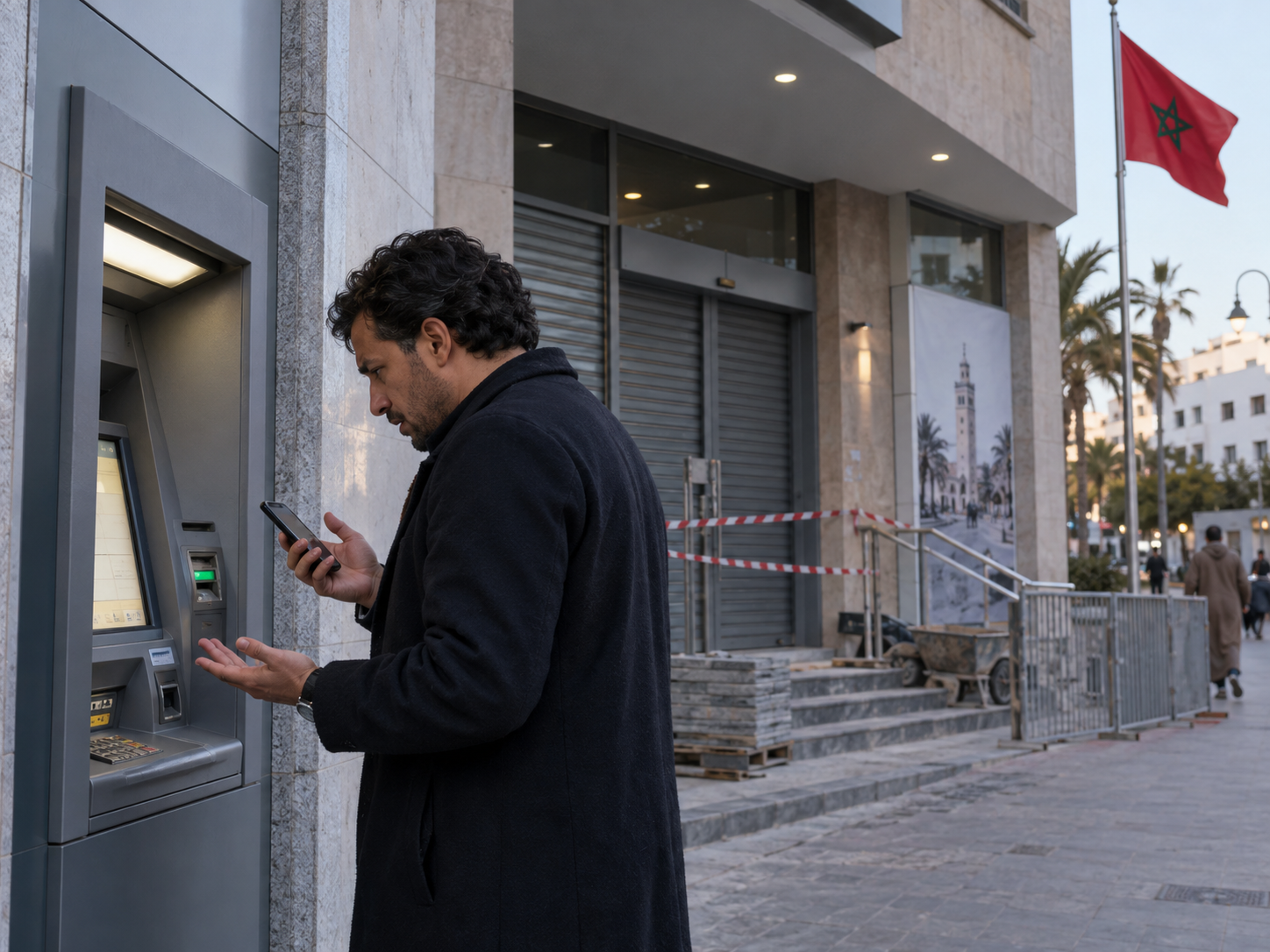
Lower courts awarded compensation after a customer lost access to his card for four days, but Morocco’s Court of Cassation has not yet delivered the final ruling.
An ATM keeps your card. The branch is closed. Nobody is available to help, and the machine refuses to give it back.
For one customer in Casablanca, that ordeal reportedly lasted four days and ended with a MAD 5,000 compensation award.
But the customer did not win simply because an ATM retained his card. According to detailed reporting by Médias24, the lower courts focused on a closed branch, an ATM left operational, inadequate information and no effective support to recover the card within a reasonable time.
The bank has challenged the decision before Morocco’s Court of Cassation. As of September 7, 2026, no final cassation ruling has been reported. The award is not a fixed payout available whenever an ATM keeps a card.
Here is what the case actually means and what customers should do immediately.
THE MAD 5,000 ATM CASE AT A GLANCE
Proceedings: Casablanca
Card retained for: Four days
Branch: Closed for building work while the ATM remained operational
Compensation: MAD 5,000
First instance: Customer won before the Commercial Court of Casablanca
Appeal: Award upheld in February 2026
Cassation: Bank’s appeal reportedly registered in May 2026 and still awaiting a ruling
Does every retained card qualify for MAD 5,000? No
These details come from Médias24 reporting. MTD has not identified a publicly available judgment or case number.
THE CASE BEHIND THE MAD 5,000 AWARD
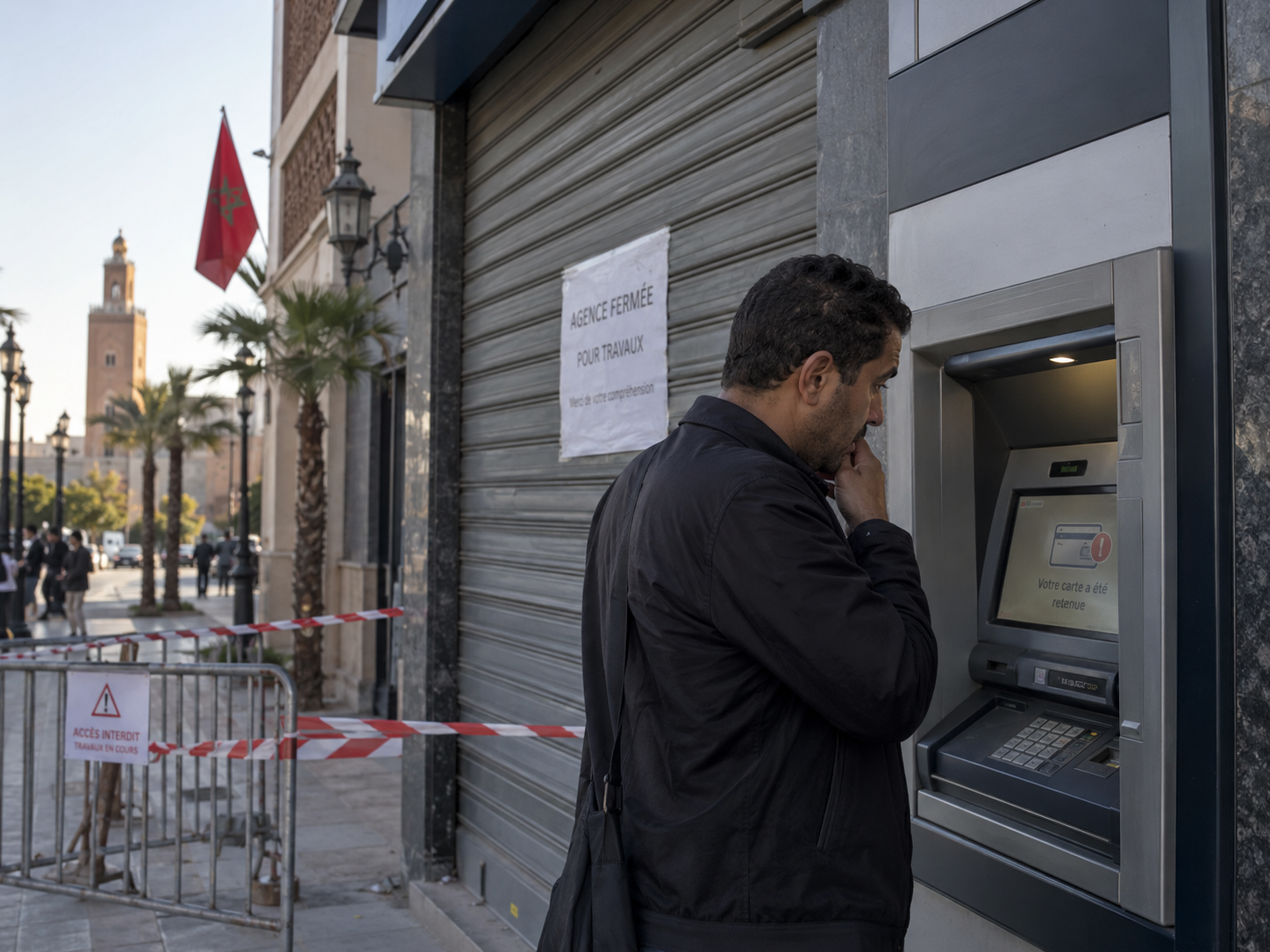
According to Médias24, the ATM was attached to a bank branch that had closed for building work but remained available for customers to use.
When the machine kept his card, the customer reportedly found no clear notice explaining that the branch was closed and its services had been transferred elsewhere.
The customer, a lawyer, asked a judicial officer to document the situation. That record covered the retained card and the reported absence of information at the branch.
He remained without his card for four days.
The Commercial Court of Casablanca awarded him MAD 5,000. An appeal judgment delivered in February 2026 upheld that decision.
The bank then filed a cassation appeal, reportedly registered in May. Médias24 did not identify the bank, publish a case number or say whether court costs were awarded separately.
The Court of Cassation will examine the legal reasoning behind the challenged judgment. Until it rules, the lower courts’ conclusions remain under review.
AN ATM KEEPING A CARD IS NOT AUTOMATICALLY A BANKING FAULT
An ATM may retain a card for technical or security reasons. The machine might detect a problem with the card, receive an instruction from the issuing bank or experience a technical failure.
According to the reported judgment, the Commercial Court did not treat retention alone as proof that the bank was at fault.
The court instead examined how the service had been organised around the ATM.
In this particular case, the branch was closed while the machine remained operational. Customers were reportedly not clearly informed about the closure or transfer of services, and the lower court found that adequate human or technical support had not been arranged to deal with the incident and return the card within a reasonable time.
That distinction is crucial.
The case concerns not only what the ATM did, but also what happened after it kept the card. It does not establish automatic liability every time a machine retains one.
WHY NO SEPARATE FINANCIAL LOSS WAS REQUIRED
A bank card allows its holder to withdraw cash, make payments and manage ordinary financial needs.
According to Médias24’s account of the lower-court reasoning, temporarily losing those functions could itself amount to compensable harm. The customer did not also have to prove that a particular sum of money had been lost.
The court reportedly regarded access to the card as a legitimate facility and its temporary loss as a disruption to the customer’s daily financial activity.
That does not mean every inconvenience deserves compensation.
It means the lower courts considered the four-day loss of access, combined with the reported lack of information and timely assistance, sufficient in this specific dispute.
The bank is contesting that reasoning. It has not yet been definitively confirmed by the Court of Cassation.
WHAT TO DO IN THE FIRST TEN MINUTES
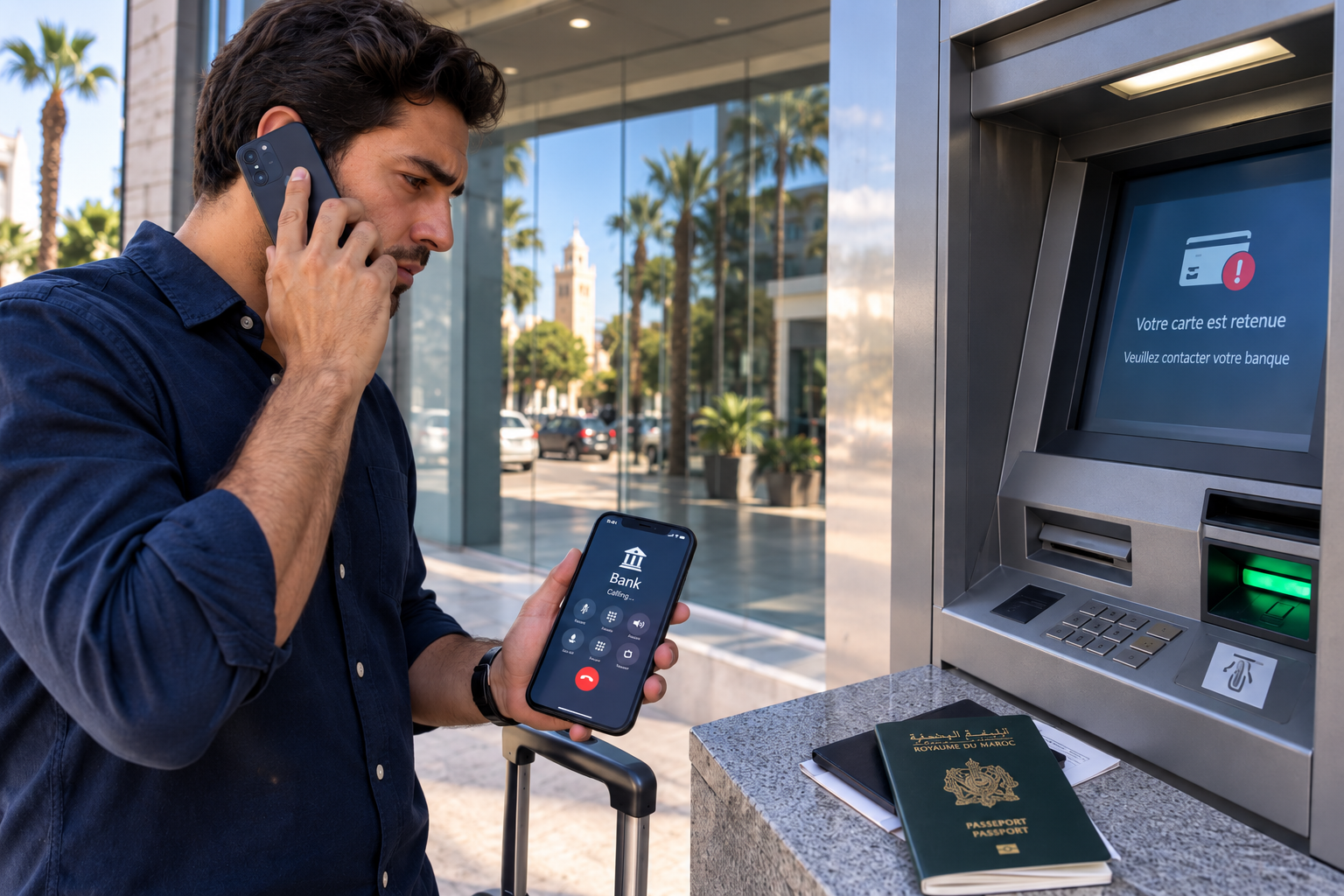
Stay near the ATM briefly if it is safe and reasonable. Check whether the screen displays an error message or official instructions. Do not enter your PIN again.
Record the bank operating the ATM, its location, the date, the exact time and any identification number shown on the machine or receipt.
Contact the bank that issued your card immediately through an official number found in its app, on its website or in your banking documents. The ATM may belong to another bank, but your card issuer should tell you whether the card must be blocked, temporarily frozen or replaced.
Follow the issuer’s instructions rather than assuming that the ATM operator can return the card.
Check the account for withdrawals or payments you do not recognise. Keep monitoring it after reporting the incident.
Do not accept help from strangers, disclose your PIN or provide banking credentials to anyone near the machine.
ATM KEPT YOUR CARD? DO THESE FIVE THINGS
Contact the card issuer
Secure or block the card as instructed
Check the account
Record the ATM details
Keep every complaint reference
HOW TO DOCUMENT WHAT HAPPENED
Photograph the ATM, its identification number and any visible notices or error messages, provided it is safe and you do not capture another customer’s private information.
Write down the exact time and location. Keep any transaction receipt, screenshots of account activity and confirmation that the card was frozen or blocked.
Record when and how you contacted the bank. Save every reference number, written complaint, reply and piece of evidence showing direct costs or losses.
A judicial officer documented the Casablanca customer’s experience. That helped establish the conditions at the branch, but it does not mean every customer needs to take the same step.
Most incidents should first be reported through official banking channels. If substantial loss occurs or the matter develops into a serious dispute, independent professional advice may help determine what further evidence is appropriate.
HOW TO FILE A BANKING COMPLAINT IN MOROCCO
Bank Al-Maghrib’s published guidance sets out three successive routes: complain to the bank, seek mediation if the dispute remains unresolved, and approach Bank Al-Maghrib as a later recourse.
Start with the bank. If a telephone call or branch visit does not solve the problem, submit a written complaint through the bank’s complaints department, one of its branches or its designated website or mobile-app channel.
Ask for proof that the complaint was received.
Bank Al-Maghrib’s official guidance says a credit institution has 10 working days to decide whether a complaint is inadmissible and 40 working days to process an admissible complaint and send a response. The customer should be informed if the processing period is extended.
If no satisfactory answer is received, the customer may approach the Centre Marocain de Médiation Bancaire, or CMMB, after first using the bank’s internal complaints process.
Disputes involving payment methods fall within the CMMB’s stated areas of intervention. Its institutional mediation service covers disputes below MAD 1 million and is free. Mediation seeks an amicable solution. It does not guarantee compensation, and the mediator does not intervene once the dispute has been taken to court.
Applications can be submitted using the methods published on the CMMB’s official website. Customers should include identification, account details, a description of the dispute, the original complaint and supporting documents.
Bank Al-Maghrib may be approached after the available routes through the bank and the CMMB have been exhausted.
WHAT THE COURT OF CASSATION COULD CLARIFY
The pending decision could clarify how bank responsibility should be assessed when an ATM remains operational beside a closed branch, customers receive inadequate information and timely support is unavailable.
It may also address whether temporary loss of access to a bank card can constitute harm without proof of a separate financial loss.
The outcome should not be predicted. Nor should the case be presented as a binding rule for every future dispute before the Court of Cassation has ruled and the precise scope of its decision is known.
ONE RETAINED CARD, ONE VERY SPECIFIC CASE
A retained card can become more than a small technical inconvenience when a customer is left for days without effective access, information or assistance.
That is why the Casablanca case matters. It is also why its facts must not be oversimplified.
The MAD 5,000 award arose from one particular dispute, was made by lower courts and remains under challenge.
If an ATM keeps your card, secure the account first, document what happened and use the bank’s official complaint channels. Do not assume that one reported judgment guarantees the same compensation in every case.