

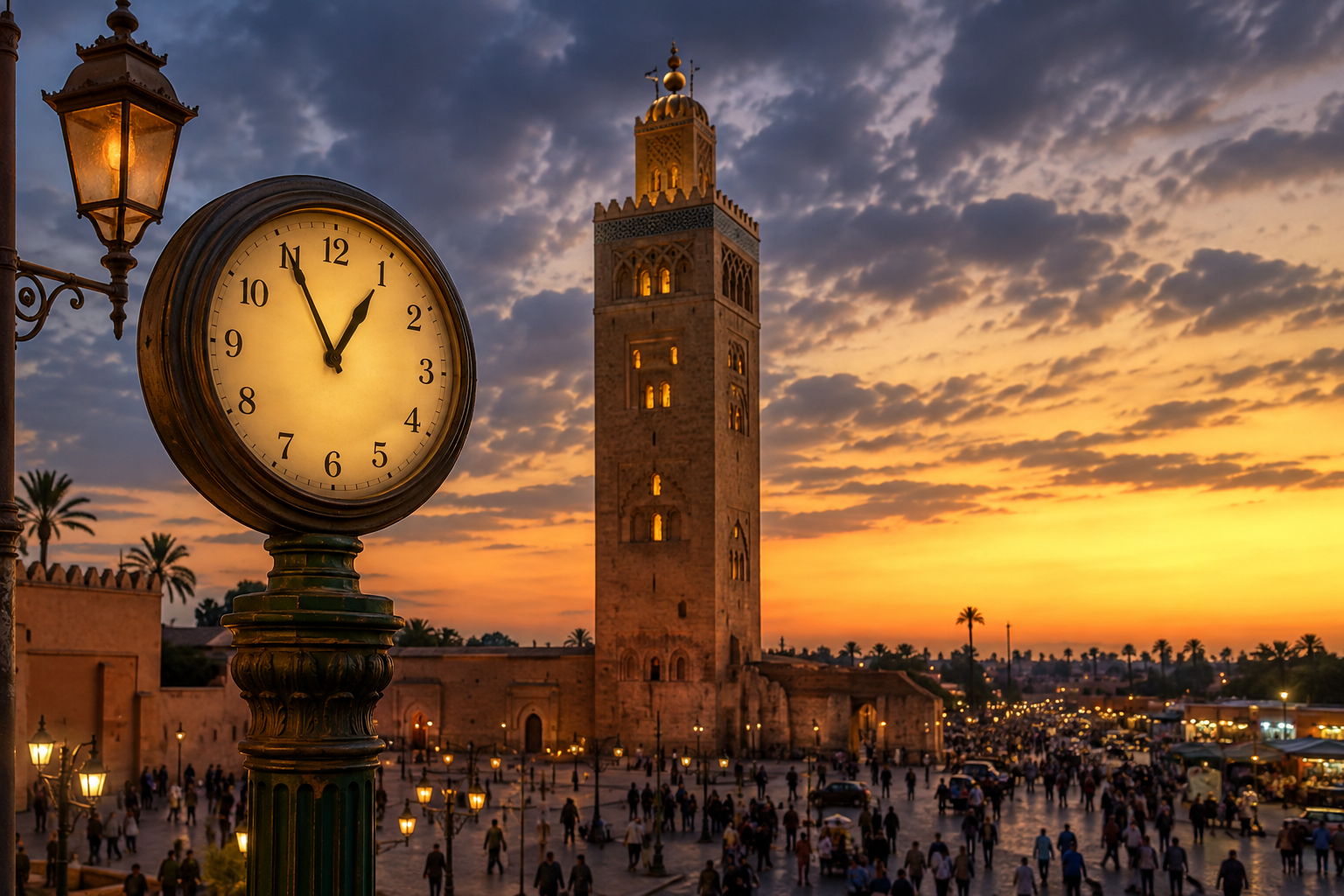
At 2am on September 20, Morocco’s clocks will move back to 1am as the country ends the permanent GMT+1 system introduced in 2018.
Morocco is about to gain an extra hour.
When the clock reaches 2am on Sunday, 20 September 2026, it will move back to 1am. Clocks go backwards by 60 minutes, giving people one additional hour that night.
This is not the familiar temporary change made around Ramadan. Under a decree published in June, GMT will once again become Morocco’s legal standard time, ending the permanent GMT+1 system introduced in 2018.
MOROCCO’S TIME CHANGE AT A GLANCE
| Change date | Sunday 20 September 2026 |
| Change time | 2am becomes 1am |
| Direction | Clocks move back by 60 minutes |
| Time zone before the change | UTC+1 |
| New legal time | GMT, practically UTC+0 |
| Legal basis | Decree No. 2.26.530 |
| System repealed | Permanent GMT+1 under Decree No. 2.18.855 |
| Extra time that night | One hour |
| Type of change | New legal standard, not the former temporary Ramadan adjustment |
WHEN EXACTLY DO MOROCCO’S CLOCKS GO BACK?
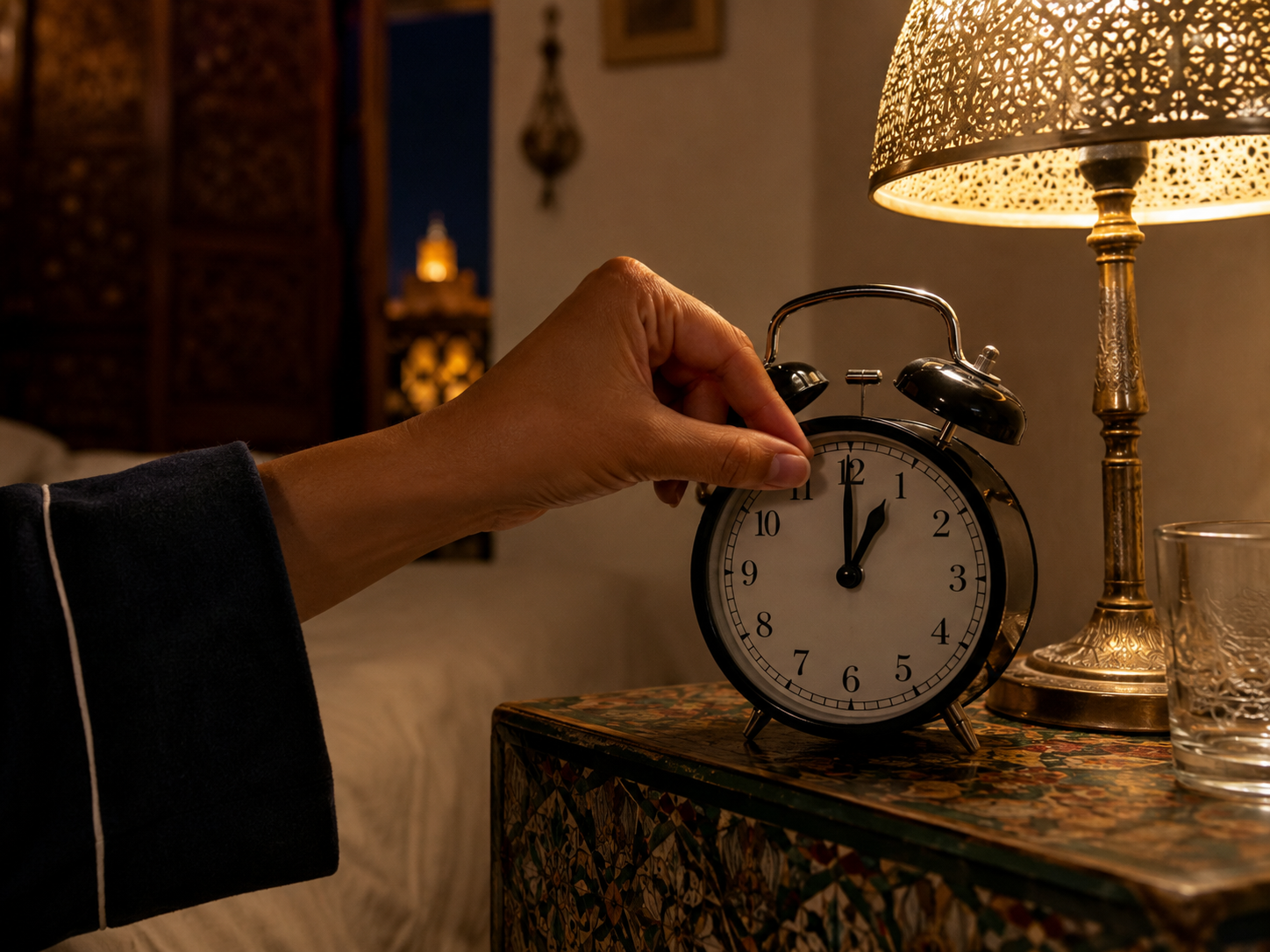
The change takes place in the early hours of Sunday, 20 September.
As soon as clocks reach 2am, they move back to 1am. Morocco then changes from UTC+1 to Greenwich Mean Time, which corresponds to UTC+0 for everyday time comparisons.
The simplest instruction is: at 2am, turn the clock back to 1am.
Anyone sleeping through the change will gain an extra hour. People working, travelling or attending an appointment during the night should be more careful, because the hour between 1am and 2am will occur twice.
The decision was not made today. Head of Government Aziz Akhannouch announced the return to GMT on 25 June, following a meeting of the Government Council.
Decree No. 2.26.530 was then published in Official Bulletin No. 7521 on 29 June. It was signed by Akhannouch and countersigned by Amal El Fallah Seghrouchni, Minister Delegate to the Head of Government in charge of Digital Transition and Administrative Reform. The official Arabic decree records the signature as Amal El Fallah.
THIS IS NOT ANOTHER RAMADAN CLOCK CHANGE
Moroccans have become accustomed to changing their clocks around Ramadan.
Since permanent GMT+1 was introduced in October 2018, Morocco generally removed the additional hour before Ramadan and restored it after the holy month. Those changes were temporary exceptions within a system that otherwise kept Morocco one hour ahead of GMT.
The September change is different.
Article 2 of the new decree repeals Decree No. 2.18.855 of 26 October 2018, which established the permanent additional hour. From 20 September, GMT becomes Morocco’s legal standard time again.
That is what “for good” means here. The change is not presented as a temporary adjustment lasting several weeks. It ends the permanent GMT+1 arrangement created in 2018.
Future governments always retain the power to change laws and regulations. The precise position is that, under the decree taking effect on 20 September, GMT once again becomes Morocco’s legal standard time.
The decree does not set out a separate policy for future Ramadan clock changes. Residents should therefore rely on official announcements rather than assume that the former system will continue.
WHY MOROCCO IS ENDING GMT+1
The government says the decision responds to citizens’ expectations and concerns about the additional hour.
Speaking after the Government Council meeting on 25 June, Akhannouch said the measure followed discussions within the governing majority and was intended to address problems associated with GMT+1.
The system had prompted recurring public debate, particularly over darker winter mornings and the way school and working hours aligned with daylight.
Changing the legal time does not guarantee that every concern involving sleep, education, traffic or daily routines will disappear. Nor has the government presented the measure as a solution to every problem connected to the previous system.
Its direct effect is clear: Morocco’s official time moves back by one hour. For many families, workers and pupils, the most noticeable difference is likely to be more daylight earlier in the winter morning.
THE TIME DIFFERENCE WITH EUROPE WILL CHANGE TWICE
The Morocco time difference with Europe will change on 20 September, then change again when participating European countries end summer time on Sunday, 25 October 2026.
For five weeks, Morocco will already be on GMT while much of Europe remains on summer time.
Between 20 September and 24 October, mainland France, mainland Spain, Belgium, the Netherlands and Germany will be two hours ahead of Morocco. The United Kingdom and mainland Portugal will be one hour ahead.
When Europe moves its clocks back on 25 October, those differences will narrow.
MOROCCO AND EUROPE: THE NEW TIME DIFFERENCE
| Location | September 20 to October 24 | From October 25 |
|---|---|---|
| Morocco | Reference time, GMT | Reference time, GMT |
| United Kingdom | One hour ahead of Morocco | Same time as Morocco |
| Mainland Portugal | One hour ahead of Morocco | Same time as Morocco |
| Mainland Spain | Two hours ahead of Morocco | One hour ahead of Morocco |
| France | Two hours ahead of Morocco | One hour ahead of Morocco |
| Belgium | Two hours ahead of Morocco | One hour ahead of Morocco |
| The Netherlands | Two hours ahead of Morocco | One hour ahead of Morocco |
| Germany | Two hours ahead of Morocco | One hour ahead of Morocco |
These comparisons cover the named European mainland areas. The Canary Islands do not use the same time as mainland Spain. Portugal has more than one time zone, while European overseas territories may follow different arrangements.
Families, companies and colleagues divided between Morocco and Europe should check the difference on both 20 September and 25 October.
WHAT HAPPENS TO PHONES, CLOCKS AND CALENDARS?
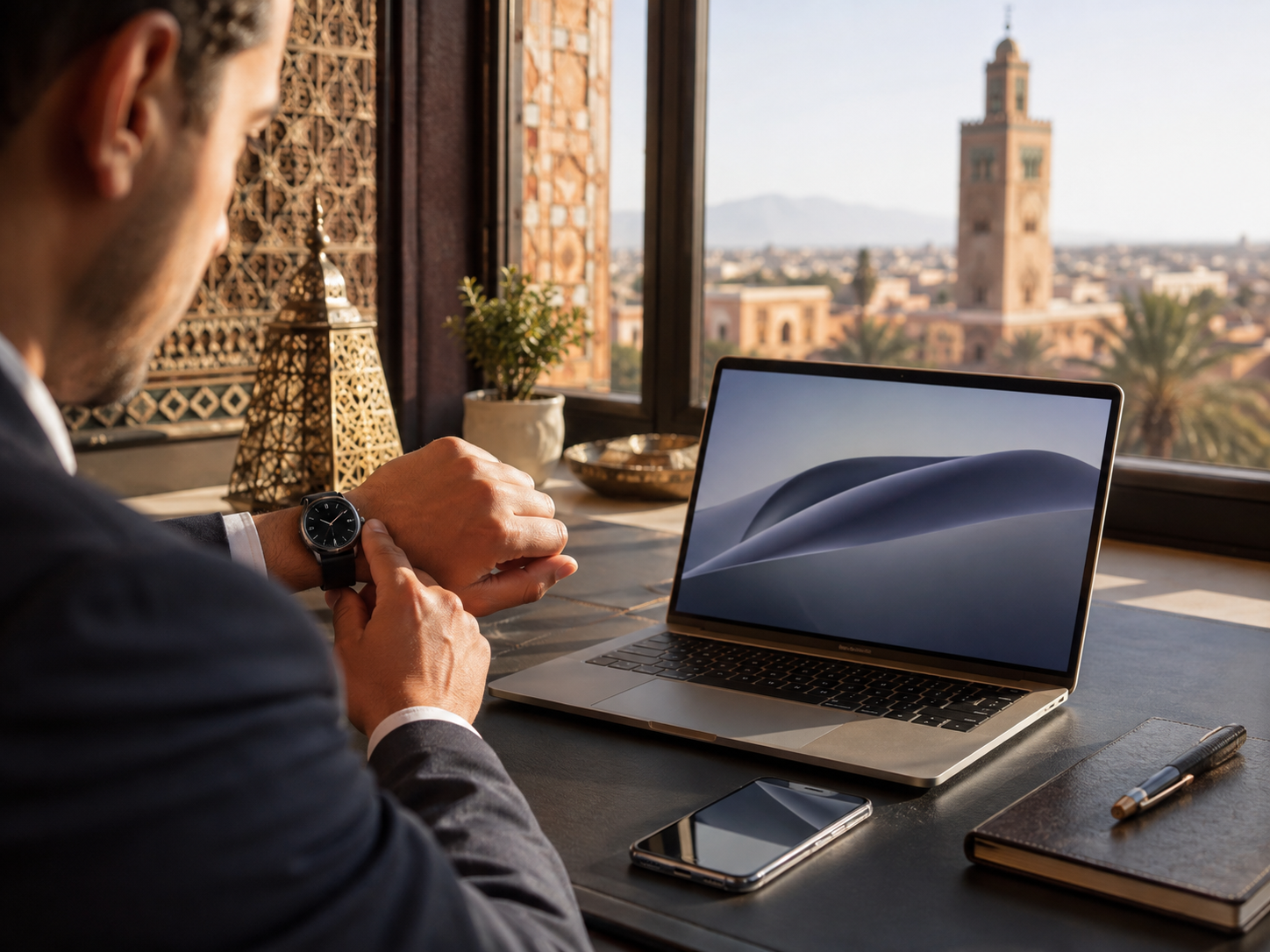
Most modern smartphones should update automatically if automatic date, time and time-zone settings are enabled and the device has current time-zone information.
But an automatic change is not guaranteed on every device.
Phones and computers configured manually may continue displaying UTC+1. Smartwatches, vehicle clocks, ovens, alarm clocks and other household devices may also need to be changed by hand.
Digital calendars usually manage international appointments correctly when events are linked to the proper time zone. Confusion is more likely when somebody records only “10am” without specifying whether that means Morocco, London or Paris time.
Businesses using booking, scheduling, payroll or transport systems should ensure that their software uses updated time-zone information for Morocco. A fixed UTC+1 setting will no longer represent Morocco’s legal time after the switch.
Residents should check their phones, alarms and calendars before going to bed on Saturday and again after waking on Sunday.
WILL MY PHONE CHANGE AUTOMATICALLY?
Usually yes, if automatic date, time and time-zone settings are enabled. However, travellers and residents should still check phones, alarms, calendars, computers, smartwatches, cars and household clocks on September 20.
FLIGHTS, TRAINS AND INTERNATIONAL CALLS
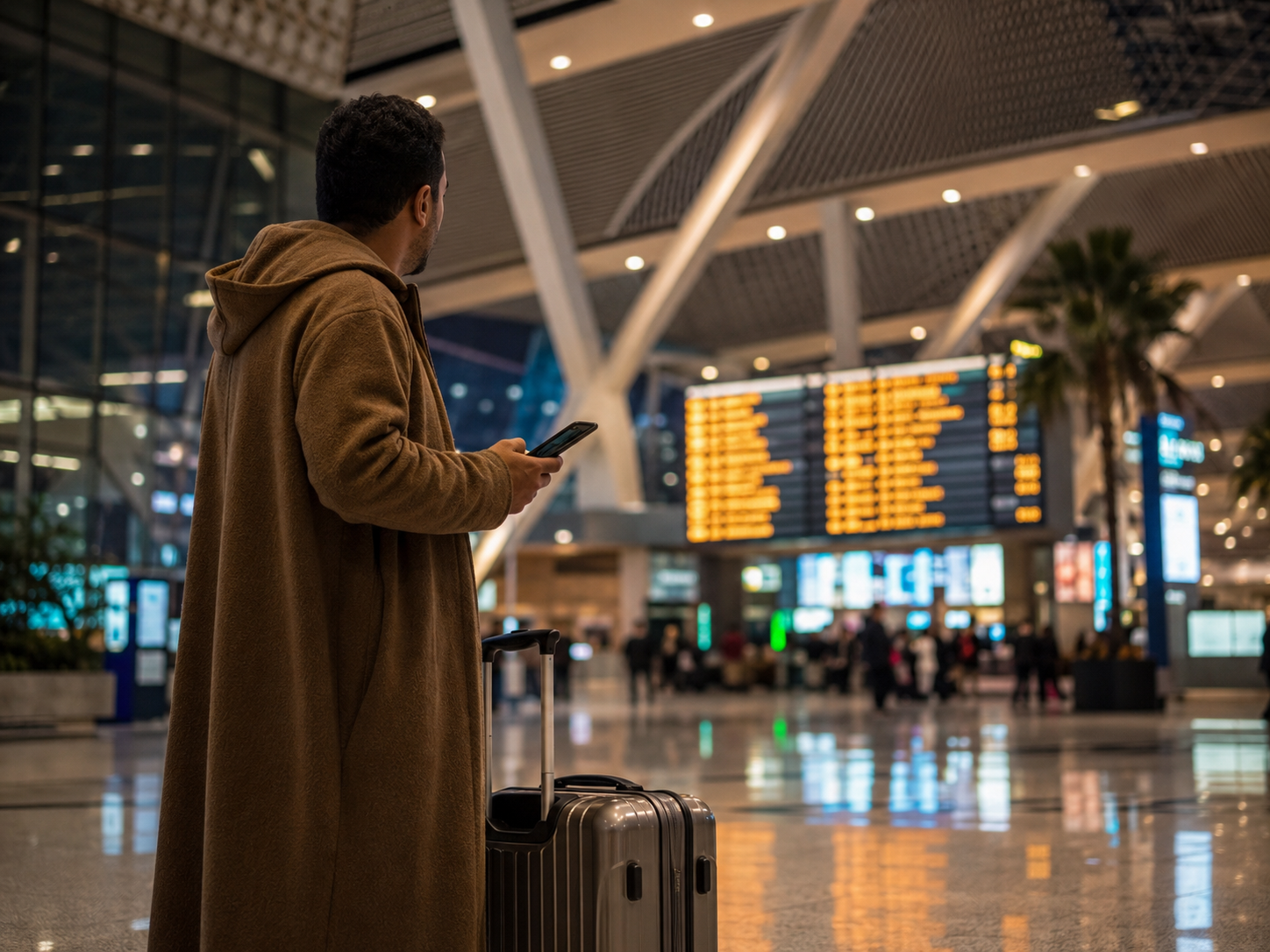
Travel departure and arrival times are normally displayed in the local time of the relevant airport, station or port.
Existing tickets remain valid, but passengers travelling close to the transition should reconfirm the latest departure information directly with their airline, airport, ONCF or ferry operator.
International connections deserve particular attention. A journey may begin under Morocco’s new GMT time while an onward connection in Europe is still operating under European summer time.
Online meetings should be linked to recognised locations or time zones, rather than entered using a fixed UTC offset. Anyone arranging a call between Morocco and Europe should remember that the difference changes on 20 September and then changes again on 25 October.
Families abroad should check before calling home. A call made at the usual European time could reach relatives in Morocco one hour earlier than expected.
FIVE THINGS TO CHECK BEFORE SEPTEMBER 20
Turn on automatic time-zone settings. Make sure connected devices are permitted to update the time automatically.
Check work and school schedules. Confirm arrangements for shifts, classes, transport and activities taking place during the change.
Reconfirm travel departure times. Check directly with the airline, airport, railway or ferry operator.
Review international calendar invitations. Make sure every meeting is connected to the correct location and time zone.
Tell relatives abroad about the new difference. Morocco and Europe will not move their clocks on the same date.
ONE HOUR BACK, A NEW DAILY RHYTHM
One hour may look small on a clock. In daily life, it influences when mornings become light, when families wake, when children leave for school and when Morocco connects with Europe.
For most people, preparing will take only a few minutes: check the phone, reset any manual clocks and verify important appointments or journeys.
The instruction for 20 September could not be simpler. When 2am arrives, Morocco returns to 1am.
The bigger change begins after sunrise, when an entire country starts organising its day around GMT again.
 Jamal Mahdad, Founder & Editor-in-Chief