
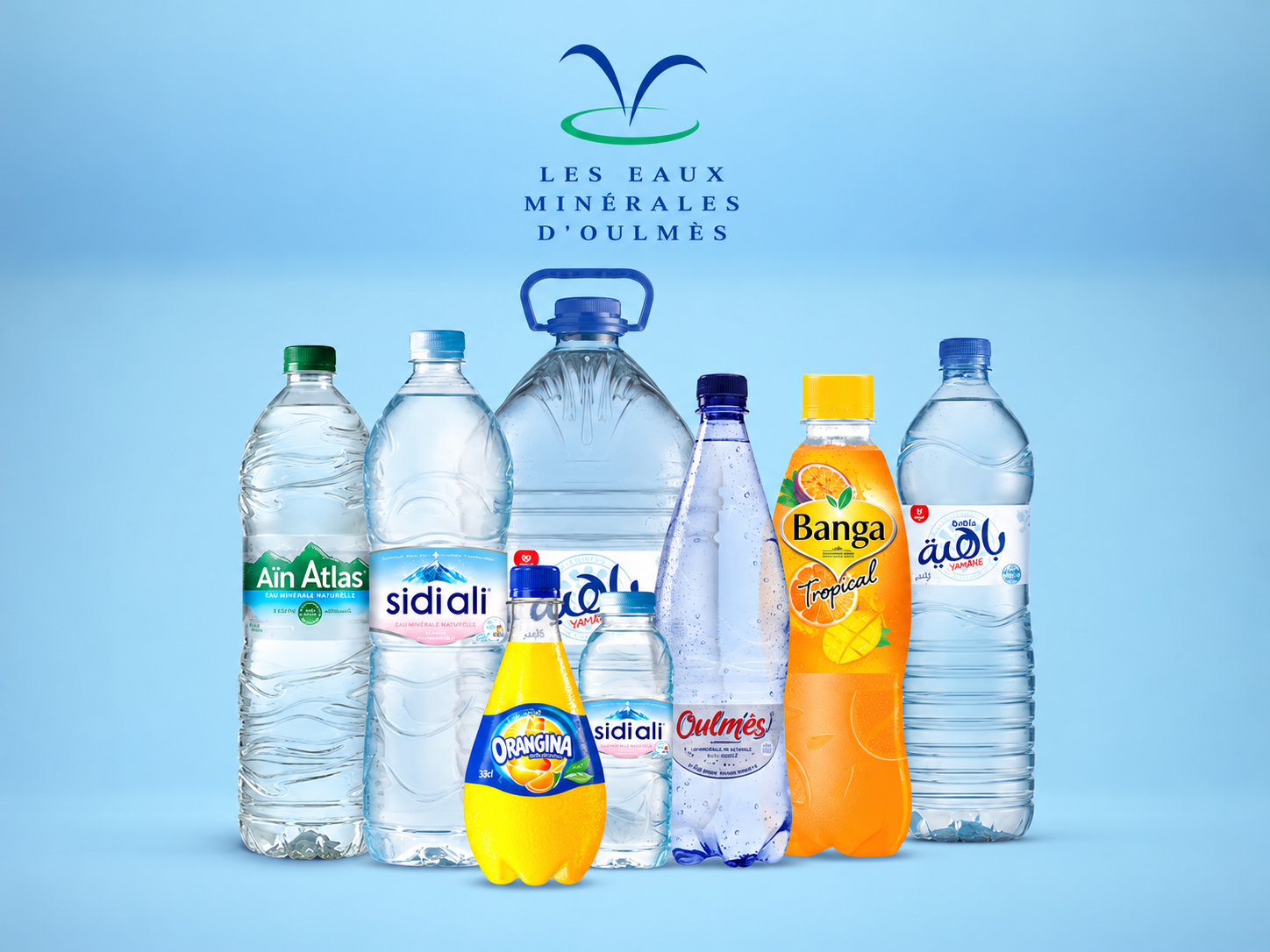
With 120,000 retail outlets, seven production units and a portfolio of household brands, Les Eaux Minérales d’Oulmès has built one of Morocco’s established beverage distribution businesses.
CASABLANCA —From Sidi Ali water bottles on supermarket shelves to Oulmès sparkling water served in restaurants, Les Eaux Minérales d’Oulmès has built a consumer business generating MAD 3.25 billion in annual sales, supported by an extensive manufacturing and distribution network across Morocco.
The Casablanca-listed company, part of the Holmarcom group, operates brands including Sidi Ali, Oulmès, Bahia and Aïn Atlas, combining mineral water, table water and other hydration products within a diversified beverage portfolio.
Its 2025 annual report records sales of MAD 3.251 billion, up from MAD 2.940 billion a year earlier, while net income more than doubled to approximately MAD 112 million.
The figures illustrate the scale of a business whose strength lies not only in consumer recognition but also in its ability to manufacture, distribute and replenish products across thousands of retail locations.
The company is chaired by Mohamed Hassan Bensalah, with Miriem Bensalah-Chaqroun serving as vice-chairwoman and managing director. Naoufel Jellal is deputy managing director, part of the executive leadership responsible for the group’s development.
From Familiar Brands to 120,000 Retail Outlets
Founded in 1933 and listed on the Casablanca Stock Exchange since 1943, Les Eaux Minérales d’Oulmès has developed a portfolio spanning several categories of bottled water.
Sidi Ali competes in natural mineral water, Oulmès is associated with sparkling mineral water, while Bahia serves the table water market. Aïn Atlas extends the company’s presence in natural mineral water.
The brands address different consumer needs and price segments, allowing the company to serve households, retailers, hotels and restaurants.
The scale of its distribution operation is particularly significant.
According to company figures drawn from its 2025 annual report, Les Eaux Minérales d’Oulmès supplies approximately 120,000 points of sale through nine distribution centres.
The business operates seven bottling and production units, including a facility producing PET preforms used in plastic bottle manufacturing.
It reported approximately 1.53 billion units in its annual production and commercial indicators, illustrating the volumes involved in maintaining national product availability.
For a bottled water producer, distribution is central to competitiveness. Products must reach customers consistently, often in high volumes, while transport, packaging and storage costs influence margins.
An established network therefore provides more than geographical coverage. It supports regular product availability and creates a commercial infrastructure through which new products can be introduced.
Sidi Ali’s Brand Recognition and the Economics of Scale
Brand recognition remains an important part of the company’s competitive position.
In June 2026, Sidi Ali was again recognised as the most admired Moroccan beverage brand in the Brand Africa 100 ranking for Morocco.
The consumer-perception award reflects the brand’s visibility and reputation, although it is not a measure of market share or sales leadership.
The distinction came as the wider company continued developing its portfolio and consumer engagement initiatives.
Its business combines the familiarity of established brands with an industrial model operating at substantial scale.
The company employed 3,874 people according to its 2025 annual report, with operations linked to water sources, bottling facilities, packaging and nationwide distribution.
Its industrial infrastructure and logistics network are important in a sector where transport costs can be significant relative to the value of individual products.
The company also faces longer-term operational considerations, including water-resource management, packaging, energy consumption and the cost of maintaining reliable supply.
These factors are relevant to the economics of bottled water production, particularly as manufacturers seek to expand without allowing distribution and industrial costs to erode profitability.
Les Eaux Minérales d’Oulmès has invested in sustainability and industrial projects, including a solar power facility inaugurated at its Bouskoura site in December 2025.
Such investments form part of its efforts to improve the environmental profile and operational efficiency of its production activities.
Naoufel Jellal and the Next Phase of Growth
The company’s development is supported by an executive team combining commercial, industrial and financial expertise.
Naoufel Jellal, deputy managing director, has been among the public representatives of its management and sustainability initiatives.
In February 2026, the company was recognised by the Best Places to Work programme as a leading employer in Africa, an award Jellal described as recognition of the organisation’s employees and management practices.
The group has also expanded beyond its domestic market through operations in Benin, providing an international dimension to a business built primarily around Moroccan consumers.
Its latest financial performance offers a picture of both the opportunities and pressures facing the management team.
For the first half of 2026, the company’s standalone revenue increased by 8.8% to approximately MAD 1.62 billion, while standalone operating profit rose by 9.1%.
At the consolidated level, however, net income attributable to shareholders declined by 35.7% to approximately MAD 20.5 million, according to the reported interim results.
The divergence illustrates the importance of distinguishing performance at the Moroccan company level from results that incorporate the wider group.
For Les Eaux Minérales d’Oulmès, further progress will depend on maintaining domestic brand strength, managing industrial and distribution costs and developing opportunities in additional markets.
Its extensive retail network provides a platform for that strategy, but sustained profitability will depend on efficient operations as well as sales growth.
Sidi Ali and Oulmès may be familiar names to Moroccan consumers. Behind them stands a business whose commercial advantage has been built over decades through manufacturing scale, nationwide distribution and the ability to keep its brands within reach of customers across the country.