
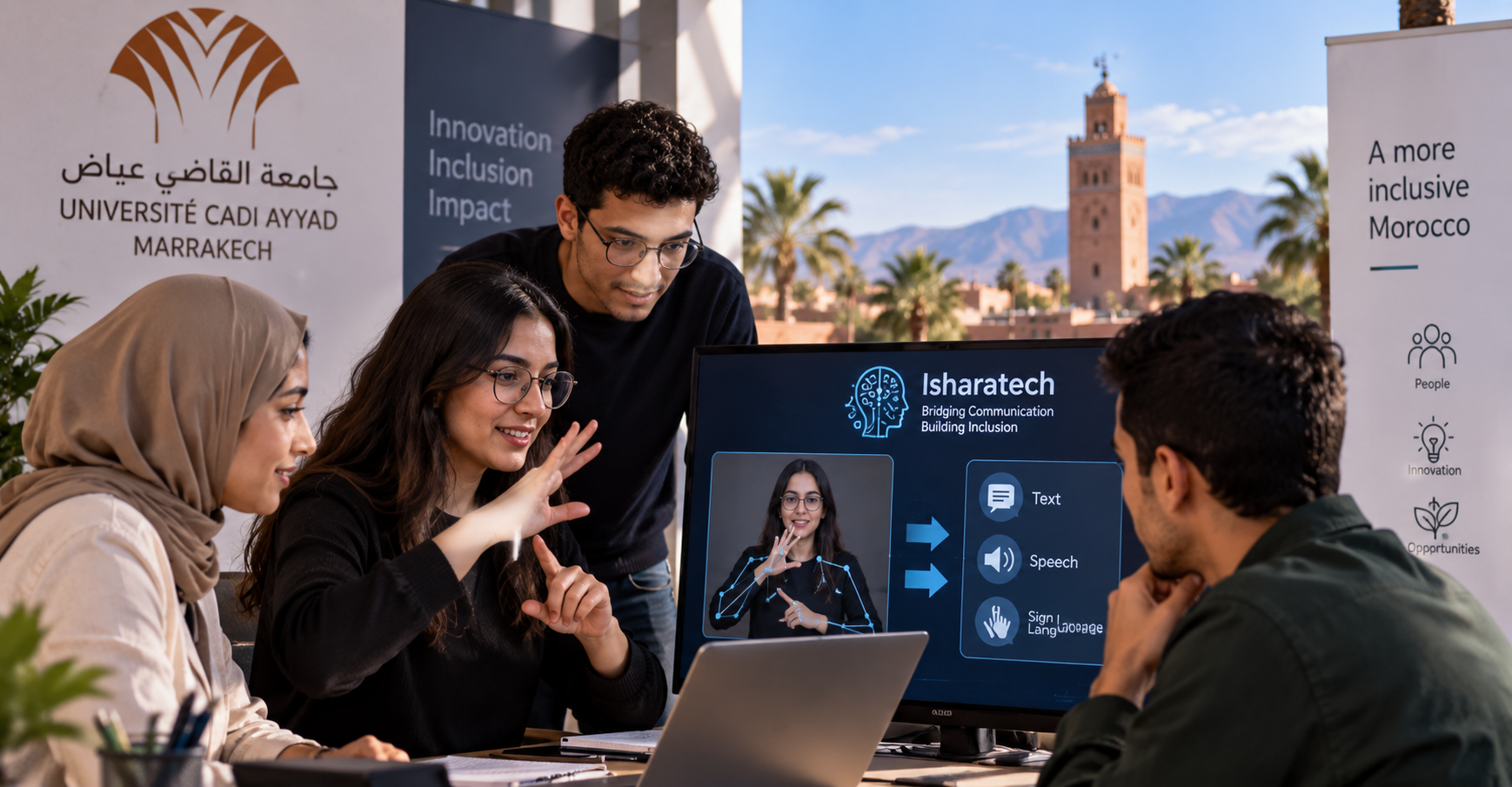
A student venture from Université Cadi Ayyad is developing AI-assisted communication between signing, text and speech, with ambitions that extend from Marrakech to a regional competition in Cairo.
Students in Marrakech are working towards a simple goal with a demanding technical challenge: allowing someone who uses sign language to hold a conversation with someone who does not.
Their venture, Isharatech, is associated with Université Cadi Ayyad and has just earned two distinctions at the INJAZ Al-Maghrib Company Program national finals. At the competition’s 18th edition, held in Casablanca on 29–30 September, it won the university-category national title and Inwi’s separate i-TECH prize.
Making an Everyday Exchange Easier
Inwi describes Isharatech as an artificial-intelligence platform offering real-time translation between sign language, text and voice. Its stated purpose is to help people communicate when they do not share a sign language. The translation performance has not been independently verified for this report.
The potential benefit is easy to recognise. A question at a reception desk or a conversation with a colleague could become less difficult if each person could communicate in a form the other understands. For that to work, the technology would need to preserve the meaning of the message and make the reply accessible too. These are possible applications, not documented Isharatech deployments.
The university places the winning team at its Faculty of Sciences Semlalia in Marrakech.
Kaoutar Oumarghane, one of the participants who has publicly discussed Isharatech, identifies herself as a master’s student in metrology and quality engineering.
Her account of an earlier competition describes the work behind the presentation: explaining the project to a jury, receiving feedback and working under pressure with teammates. In a subsequent post celebrating a regional win, she credited the group’s shared effort. The national awards mark a further step in that student venture’s development.
What Would Make It Dependable?
For an intended user, the important question is whether the system understands their language.
Sign languages have distinct grammar and vocabulary; recognising an individual sign is also different from translating continuous signing in a conversation.
The public information reviewed does not yet identify the languages Isharatech supports, the extent of its translation capabilities or its accuracy. Its availability, cost and equipment requirements also remain unclear, as does the involvement of Deaf users in design and evaluation. These are gaps in the available evidence, not proof that the team has not carried out testing.
For those who use sign language, evaluation in everyday conditions would help establish where the platform is useful and where other communication support remains necessary. Not every deaf or hard-of-hearing person signs, and no single tool can be assumed to meet everyone’s needs.
Isharatech is expected to represent Morocco at a regional competition in Cairo in November, alongside school-category winner LAMSA. That offers another stage for the students’ work. The more consequential test will be an ordinary exchange: whether two people can use what they have built to understand each other.