

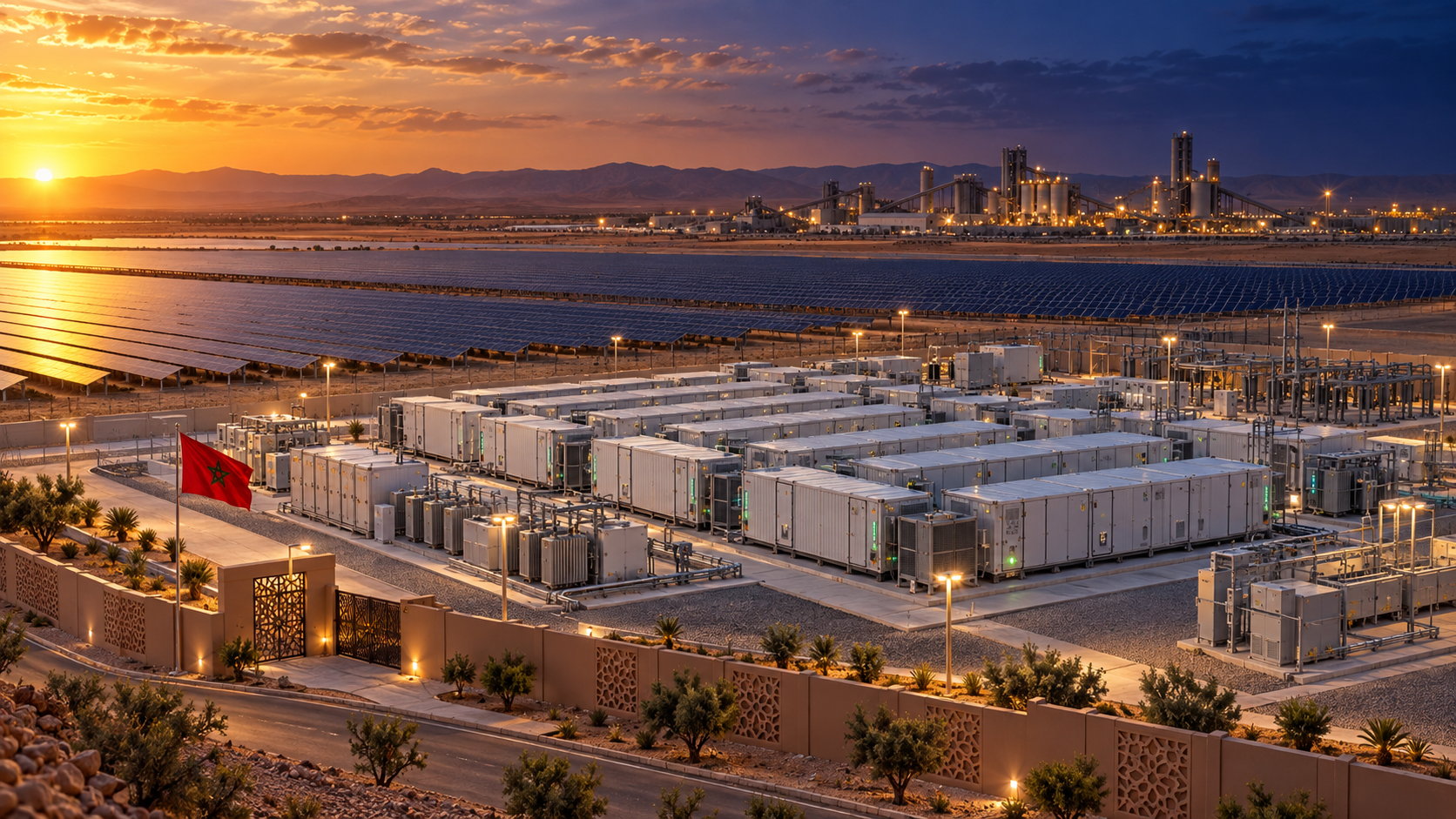
OCP Green Energy has energised a 25 MW / 125 MWh battery system in Benguerir, allowing daytime solar electricity to be stored for use when industrial demand rises.
What happens to solar power when the sun goes down or electricity demand rises?
Morocco has spent years learning how to generate more electricity from sunlight. Now it is tackling the next challenge: keeping that electricity available after solar production falls.
At OCP’s Benguerir site, a giant new battery is designed to do exactly that. It can store 125 megawatt-hours of electricity and deliver up to 25 megawatts at a time, enough stored energy for five hours at maximum rated output.
This is an important step for large-scale energy storage in Morocco. But it will not directly power homes or immediately reduce household electricity bills.
BENGUERIR BATTERY AT A GLANCE
Developer: OCP Green Energy
Location: Benguerir
Technology: Lithium iron phosphate, LFP
Power capacity: 25 MW
Energy capacity: 125 MWh
Maximum rated duration: Five hours
Estimated investment: Approximately MAD 170 million
Intended use: Store solar electricity for later industrial demand
Current status: Construction completed and system energised, with performance testing under way as part of commissioning
The battery serves an OCP industrial site. It does not directly supply Moroccan households.
MOROCCO HAS ENERGISED A GIANT INDUSTRIAL BATTERY
The Battery Energy Storage System, known as a BESS, was developed by OCP Green Energy, the renewable electricity generation and storage subsidiary of OCP Group.
OCP Green Energy has completed construction and energised the system. Performance tests are now being carried out as part of the commissioning process, before full operation is confirmed.
The project marks the start of OCP Green Energy’s gradual rollout of large-scale battery storage. It follows the first phase of its solar programme, comprising 202 megawatts peak across Benguerir, Foum Tizi and Oulad Farès in Khouribga.
The installation has been described as Morocco’s first large-scale LFP battery storage system. That is more accurate than calling it the country’s first battery, since smaller batteries and other storage technologies already exist.
HOW FIVE HOURS OF SOLAR STORAGE WORKS
The difference between 25 MW and 125 MWh sounds technical, but the idea is simple.
Megawatts measure power, meaning how much electricity the battery can deliver at one moment. Megawatt-hours measure energy capacity, meaning how much electricity it can hold.
Think of power as the size of a tap and energy capacity as the size of the tank.
A battery rated at 25 MW with 125 MWh of storage can theoretically deliver 25 MW for five hours. It could also release less power over a longer period, depending on how it is operated.
The battery does not literally store sunlight. Solar panels convert sunlight into electricity, which can then be used immediately or stored for later.
WHY SOLAR POWER NEEDS A BATTERY
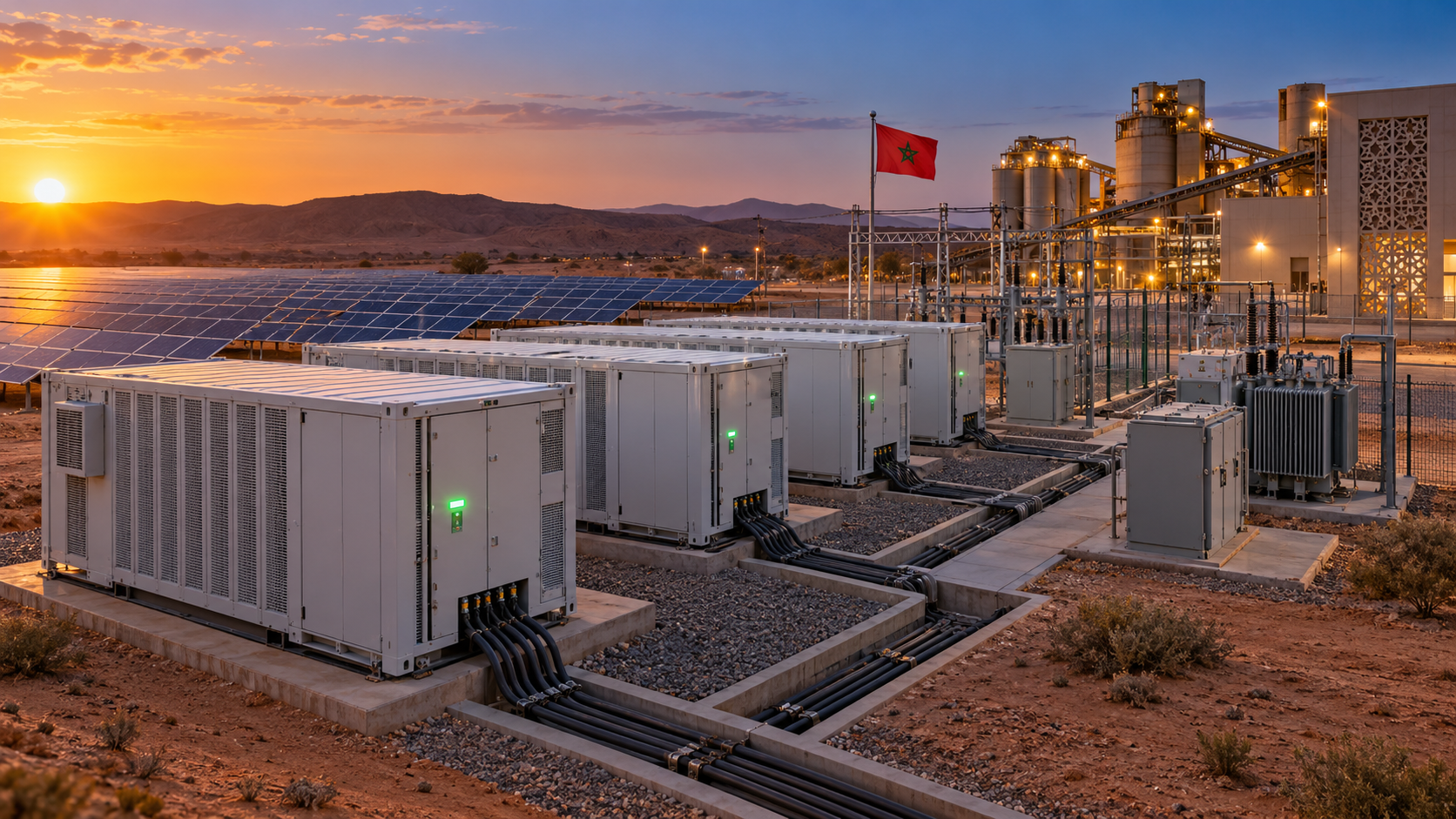
Solar panels do not produce electricity at the same level throughout the day. Output changes with the position of the sun, cloud cover and the arrival of evening.
Industrial operations may still need substantial power when solar generation is falling. The strongest hours of sunshine do not always match the hours of greatest demand or highest electricity prices.
Storage helps bridge that gap. Electricity generated when solar supply is abundant can be saved and released when the industrial site needs it most.
The battery can also respond quickly to changes in the electrical system, helping reduce short-term fluctuations and providing support functions such as frequency control.
It cannot eliminate every challenge created by variable renewable energy. Grid connections, forecasting, backup supply and careful management remain necessary.
WHAT CHANGES AT THE BENGUERIR SITE
The battery is connected to the Benguerir solar installation and designed for one charging and discharging cycle per day.
OCP expects it to reduce the site’s electricity costs during peak hours by approximately 25 percent. The forecast is based on shifting stored solar electricity into periods when demand and electricity prices are higher.
It does not mean OCP Group’s total electricity bill will fall by 25 percent. It has no direct bearing on national tariffs or household bills.
The real savings will depend on solar output, charging patterns, energy prices and operational performance. They can only be fully assessed after the system has operated for a sustained period.
The project represents an estimated investment of around MAD 170 million. It also secured $20 million in financing from the Clean Technology Fund, backed through the African Development Bank. The two figures should not be added together as separate spending, since the financing supports the project itself.
WHY OCP CHOSE LFP TECHNOLOGY
The system uses lithium iron phosphate batteries, commonly known as LFP.
This lithium-ion chemistry is widely chosen for stationary storage because of its durability, thermal stability and long operating life. OCP says the Benguerir system was designed for daily use over approximately 25 years.
LFP can offer safety advantages for large installations, but no battery technology is risk-free. Monitoring, temperature control, maintenance and fire-safety measures remain essential.
Technology supplier Envision was selected following an evaluation process, with the contract signed at the end of 2025.
MOROCCAN TEAMS BUILT THE INTEGRATION, NOT EVERY COMPONENT
One of the project’s most valuable features is the role played by Moroccan expertise.
According to OCP, Moroccan teams handled the engineering studies, project supervision and civil and electrical integration. That work includes connecting the battery to the solar plant and existing infrastructure, then ensuring that the components operate together safely.
It gives local engineers practical experience with a technology that is becoming increasingly important around the world.
But integration is not the same as manufacturing every component. Envision supplied the battery system, and OCP has not claimed that all cells or equipment were made in Morocco.
That distinction matters. Installation, system integration, materials development and battery-cell manufacturing are separate parts of the value chain. Progress in one is not proof that Morocco already controls them all.
COULD MOROCCO BUILD MORE OF THE BATTERY VALUE CHAIN?
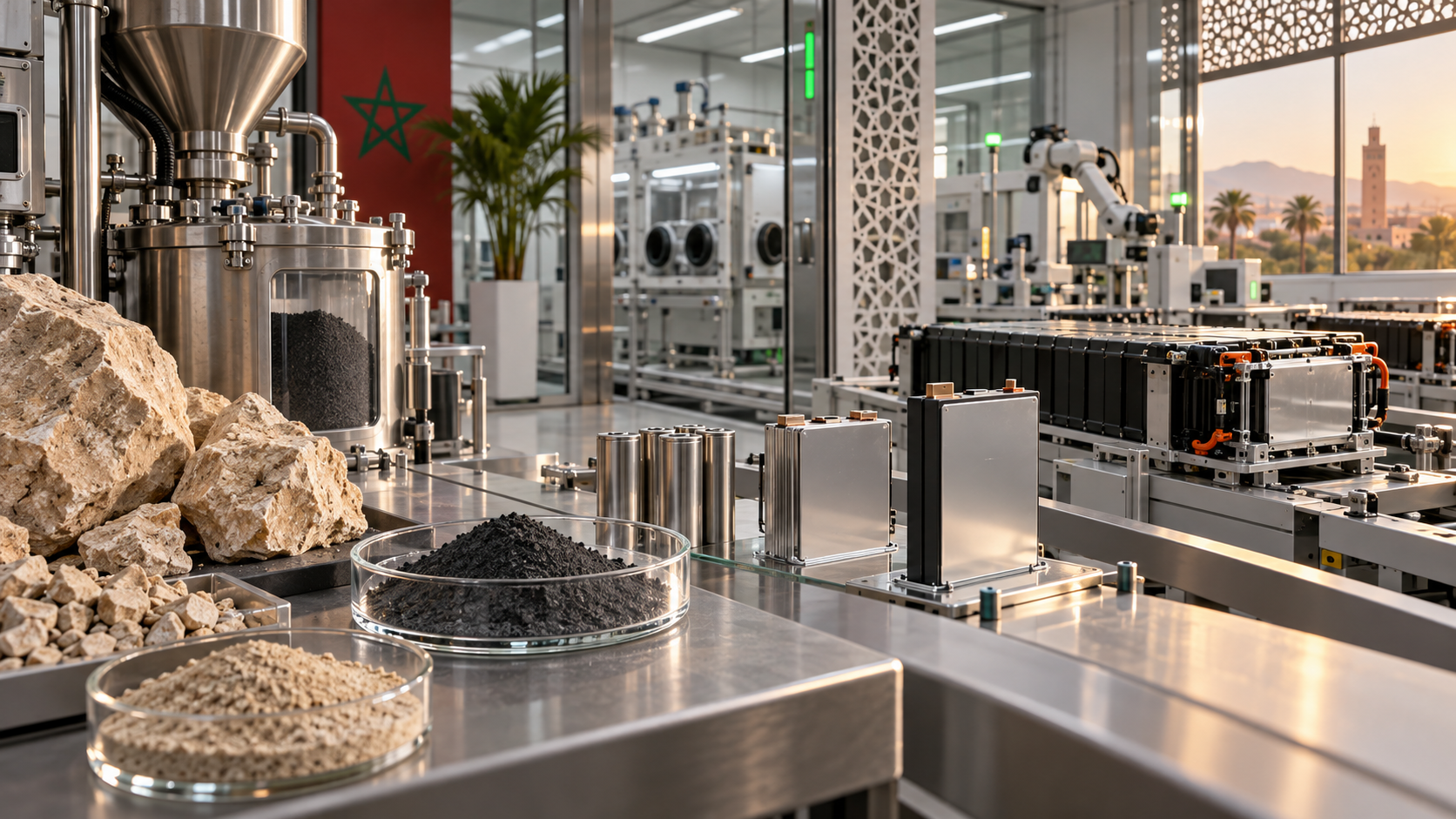
OCP is working with Mohammed VI Polytechnic University, UM6P, on LFP-related materials derived from phosphoric acid.
The research draws on Morocco’s phosphate expertise and could eventually support local production processes, intellectual property and a broader battery-material ecosystem.
The opportunity extends beyond electricity storage. Demand for batteries is rising across renewable energy, electric transport and industrial power systems.
However, research and scale-up plans are not the same as established mass production. Commercial plants, competitive costs and reliable output will determine how much of the value chain Morocco can ultimately build at home.
WHAT THIS MEANS FOR ORDINARY MOROCCANS
The Benguerir battery is not connected directly to Moroccan homes, and it does not guarantee lower residential electricity prices.
Its wider importance lies in what Morocco can learn from it.
The project shows how renewable electricity can be stored and used more reliably at a major industrial site. It also gives Moroccan engineers and operators direct experience in designing, integrating and managing large-scale storage.
If similar projects expand, they could strengthen local skills, attract investment and help more industries use renewable power effectively.
One battery does not transform a national energy system. But every transformation needs a working first step.
MOROCCO IS LEARNING TO KEEP THE SUN
Generating solar electricity is only the beginning. A modern energy system must also move that electricity across time, from the hours when it is produced to the hours when it is needed.
Benguerir will now test whether large-scale storage can perform that job reliably, safely and economically under real industrial conditions.
Morocco already knows how to turn sunshine into electricity. Benguerir is teaching it how to make that power wait.