

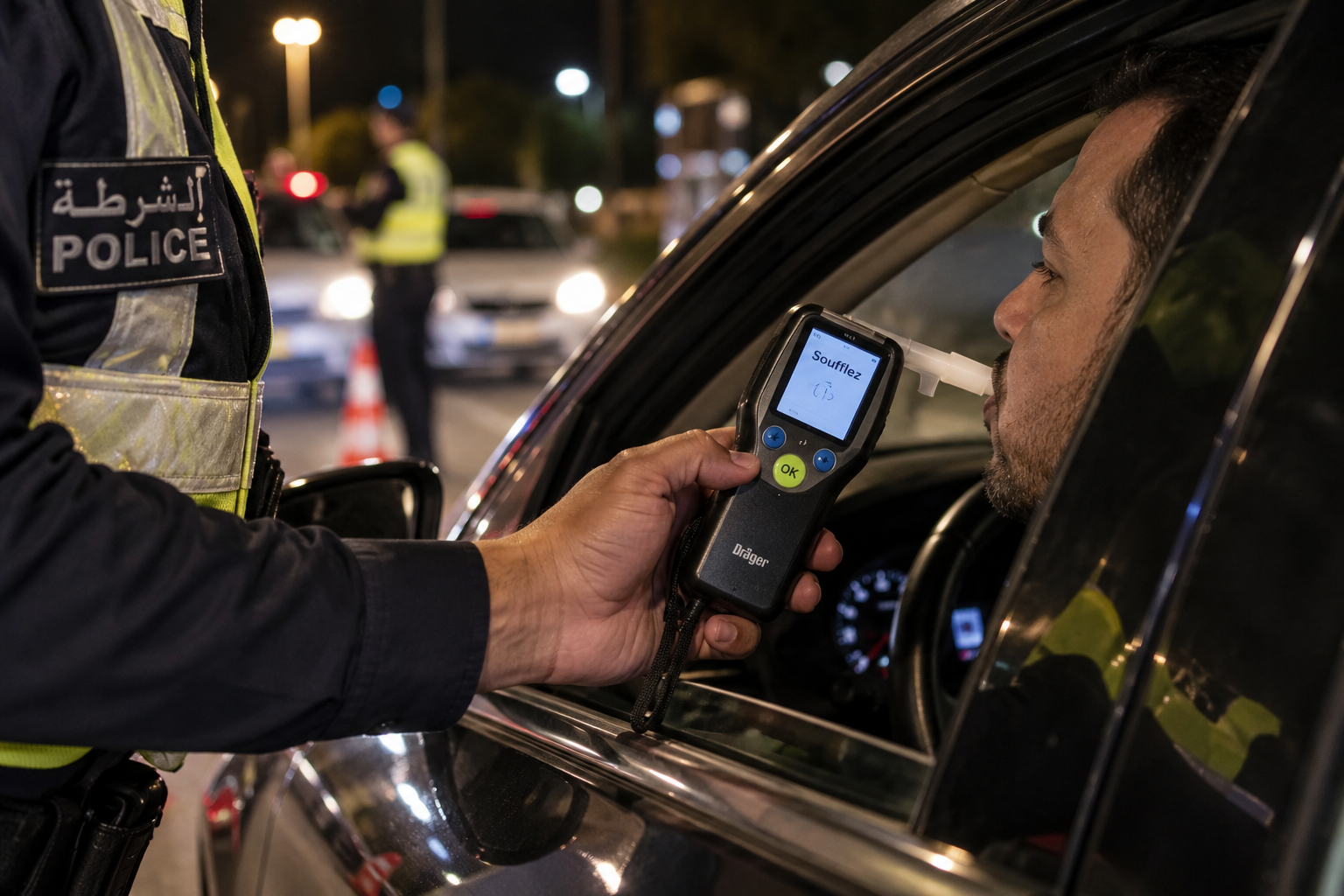
Morocco already has drink-driving laws, testing powers and a national road-safety strategy. International evidence suggests that visible enforcement can strengthen deterrence. Could targeted night-time checks, combined with practical alternatives to driving, prevent more serious crashes?
How can people travelling home at night be better protected from drivers impaired by alcohol?
Morocco is not starting from zero. Driving under the influence is prohibited, roadside alcohol testing is provided for in law, and drink-driving is among the priority offences identified within the country’s road-safety enforcement strategy.
The World Health Organization has highlighted Morocco’s move towards more data-led road policing, with enforcement increasingly focused on locations identified through crash evidence and on priority risks including speeding, drink-driving, mobile-phone use and failure to use seatbelts or motorcycle helmets.
International evidence supports another important principle: enforcement can influence behaviour before an offence takes place. When motorists believe there is a credible possibility of being tested, some may decide not to drive after drinking at all.
That raises a practical public-interest question: could more visible and sustained alcohol testing on carefully selected night-time routes strengthen an enforcement system Morocco already has?
Morocco Already Has the Framework
Morocco’s road-safety legislation provides for alcohol screening and subsequent testing procedures where required.
The official threshold established under the regulatory framework is 0.10 milligrams of alcohol per litre of exhaled air, corresponding to 0.20 grams per litre of blood.
The issue extends beyond alcohol. NARSA also warns about the dangers of driving after using drugs and about medicines that can cause drowsiness, reduced concentration, slower reactions or impaired vision. Its guidance is clear that safe driving requires the driver to remain fully capable of controlling the vehicle.
The National Road Safety Agency plays a central coordinating role in road safety, while road controls are carried out by the relevant security services, including National Security and the Royal Gendarmerie within their respective areas of responsibility.
In July 2026, the WHO described Morocco’s road-safety governance as offering lessons internationally. It highlighted the country’s use of crash data to identify enforcement locations and priority violations under the 2022–2024 National Road Control Plan.
What remains difficult to establish from publicly available information is how frequently alcohol screening takes place during night-time hours, how many motorists are tested nationally and how those checks are distributed between cities, roads and days of the week.
That information gap should not be interpreted as evidence that checks are absent. It means the intensity and geographical coverage of current night-time testing cannot readily be assessed from published national data.
The Best Result Is a Dangerous Journey That Never Begins
The strongest argument for visible breath testing is not how many drivers police can catch.
It is how many people decide not to drive after drinking in the first place.
The WHO recommends visible and sustained enforcement because deterrence depends partly on the perceived likelihood of detection.
The public message can be remarkably simple: if a group is going out by car, decide beforehand who will drive home — and that person does not drink alcohol.
The decision is made at the beginning of the evening, when judgement is clear, rather than several hours later.
For many urban journeys in Morocco, there are alternatives. Petit taxis provide a practical and generally affordable option for short journeys in many cities, alongside larger taxis, public transport where available, friends, family and other transport services.
A relatively modest journey home may be a far better choice than accepting the human, legal and financial consequences that can follow impaired driving.
The message does not need to be moralistic.
Enjoy the evening. Choose the driver beforehand. If nobody is staying sober, leave the car and arrange another way home.
Research reviewed by Britain’s College of Policing found that sobriety checkpoints reduce alcohol-related crashes and injuries. A 2009 meta-analysis covering 40 studies estimated that, after accounting for bias, around 14 crashes were prevented for every 100 that would otherwise have occurred.
That figure should not be transferred directly to Morocco. Traffic patterns, transport alternatives, policing structures and driver behaviour differ between countries.
But the research supports the broader principle that a credible expectation of being stopped and tested can change behaviour.
The Person at Risk May Not Have Been Drinking
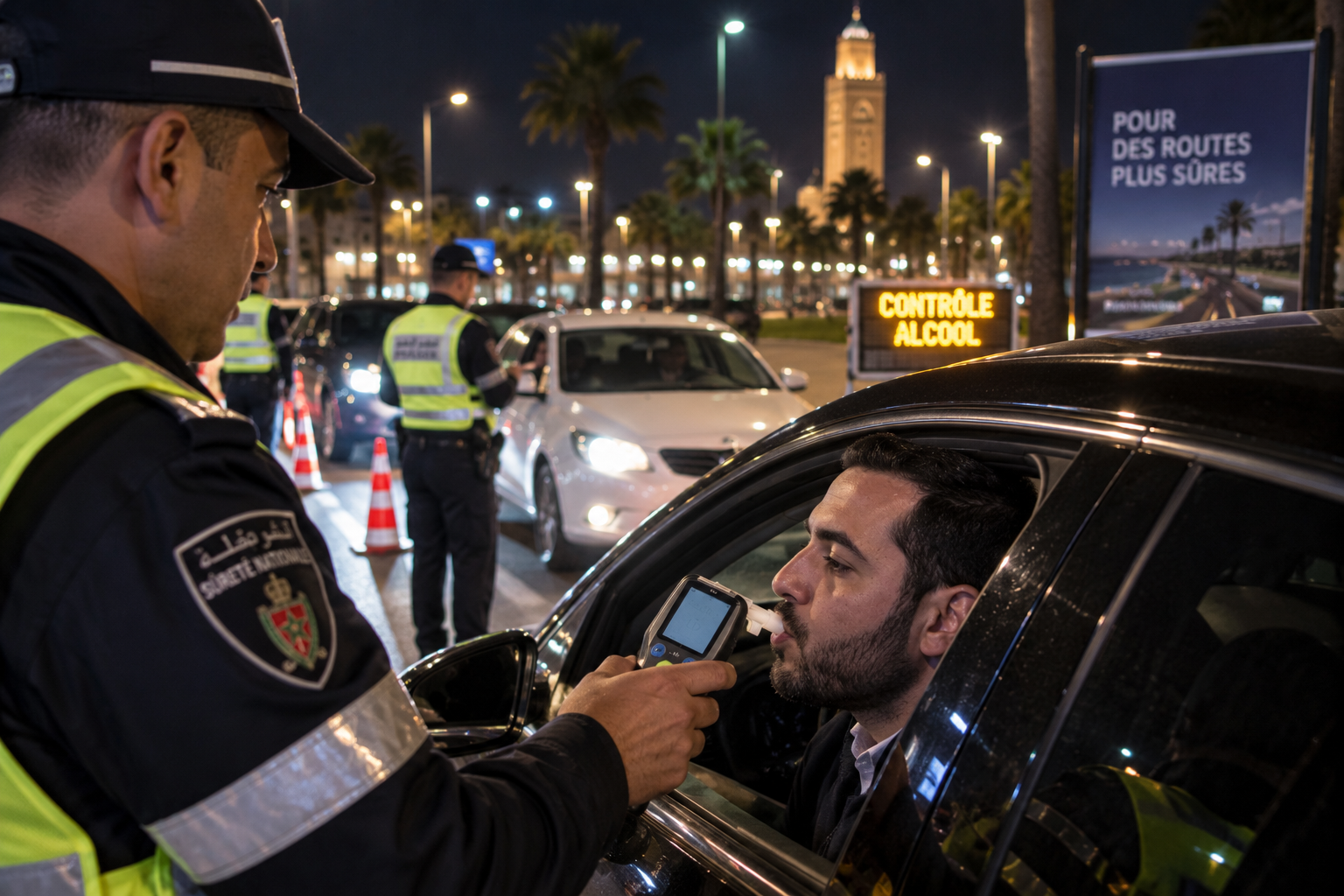
Drink-driving is sometimes framed as a driver taking a risk with their own life.
Road safety is much wider than that.
The person harmed may be a passenger who has consumed no alcohol. It may be another driver travelling home, a motorcyclist, a cyclist or a pedestrian.
It may be a child walking or crossing a road near a home, park or school.
Children, pedestrians and motorcyclists have little physical protection when a driver loses control or reacts too slowly. Morocco’s road-safety strategy already gives particular attention to vulnerable road users, including pedestrians, motorcycle riders and children.
That is why impaired driving is a public-safety issue rather than a judgement about alcohol consumption or nightlife.
The relevant question is what happens when someone whose judgement, coordination or reaction time has been impaired takes control of a vehicle on a public road.
The same safety principle applies beyond alcohol. Drugs can impair perception, judgement and reactions, while some medicines can cause drowsiness, dizziness or other effects that make driving unsafe.
A clear public message therefore does not need to catalogue every substance. It can simply say: if anything has impaired your ability to drive safely, do not drive.
A Targeted Moroccan Pilot Could Test What Works
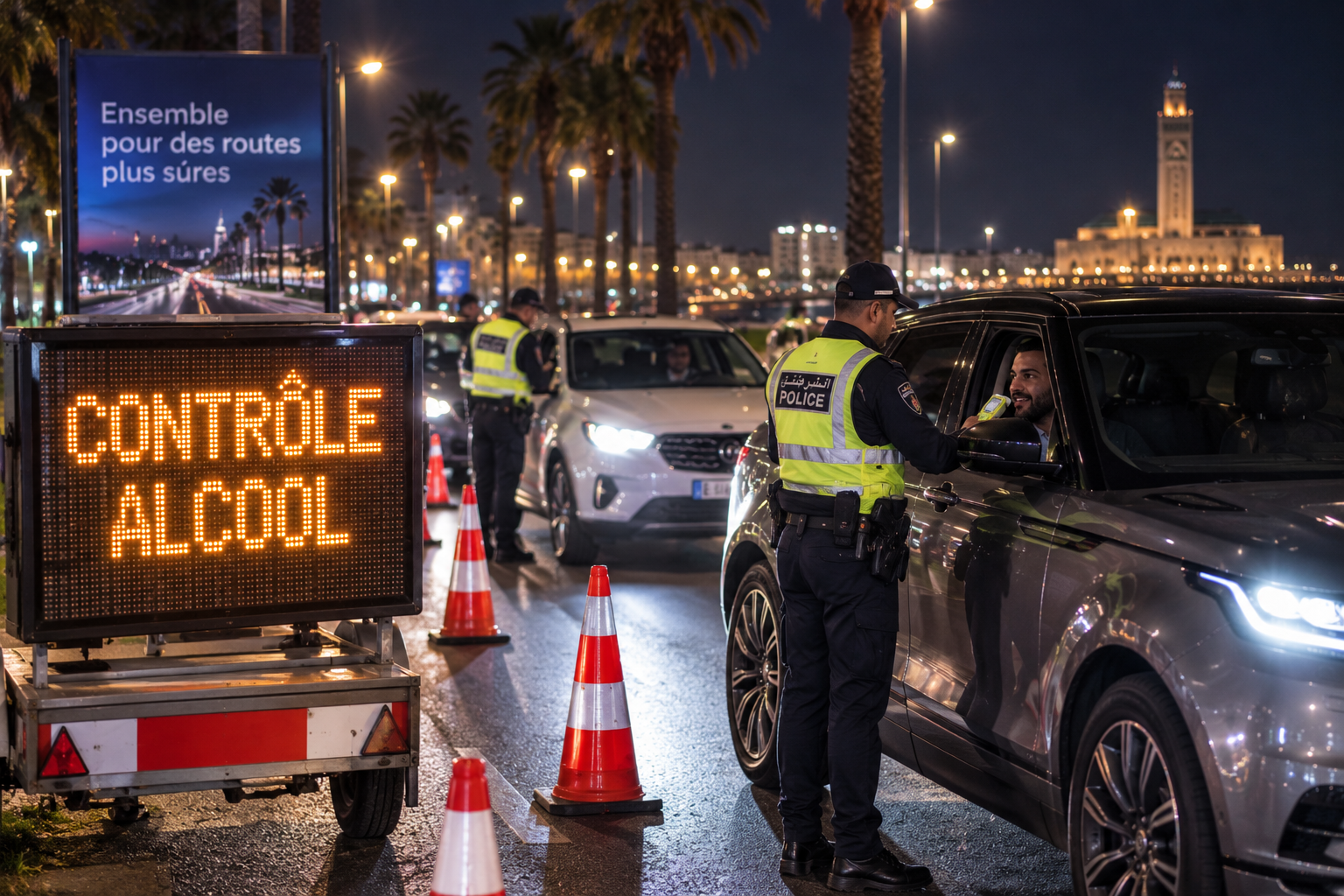
More enforcement would not have to mean indiscriminate roadblocks at every entrance to every city.
A better approach would be a limited, evaluated pilot in selected areas.
Locations and operating hours could be chosen using local crash, traffic and enforcement data.
These might include particular city approach roads, corridors serving nightlife areas or other routes where evidence indicates elevated risk.
Friday and Saturday nights could be included where local patterns justify them, without assuming that impaired driving is confined to weekends.
The overall enforcement programme could be visible enough to create deterrence while individual locations and times remain unpredictable.
Safe stopping areas, appropriate signage, trained officers, reliable equipment and objective procedures for selecting motorists would be essential. Where urban and interurban jurisdictions meet, coordination between National Security and the Royal Gendarmerie could help provide continuity.
Public communication should accompany enforcement.
One message could encourage groups to choose a sober driver before going out. Another could remind people that taking a taxi or arranging another journey home is a simple way to remove the risk entirely.
Restaurants, hotels and entertainment venues could reinforce the same principle without being treated as part of the problem: plan the journey home before the evening begins.
There are practical constraints. Roadside operations require personnel, equipment and safe locations. Poorly positioned checkpoints can create congestion or introduce additional risks.
That argues for targeted, data-led enforcement rather than blanket controls.
Success Should Be Measured in Safer Roads, Not More Fines
Morocco continues to face a substantial road-safety challenge. NARSA’s provisional figures for 2025 recorded more than 160,000 injury-producing crashes, more than 10,000 serious injuries and 4,577 deaths.
Those figures describe the overall burden of road crashes. They do not establish how many were caused by alcohol or drugs, and night-time collisions should never automatically be classified as impairment-related.
Any pilot should therefore be evaluated carefully.
Authorities could measure the number of drivers screened, confirmed positive results and serious or fatal crashes during targeted periods. Results could be compared with baseline periods and similar routes while accounting for traffic volumes, seasonal changes and possible displacement to other roads.
Operational costs and public awareness could also be measured.
The number of fines alone would say little about whether the policy was working.
Indeed, the strongest long-term result might be fewer positive tests.
That could mean more people are making the safer decision before the journey begins: one person stays sober, somebody takes a taxi, or the car simply remains parked.
Morocco already has the legislation, institutions and increasingly data-led road-safety approach needed to examine the idea seriously.
More visible night-time testing would not replace that system. It could be tested as part of it.
The objective is not more checkpoints for their own sake.
It is fewer moments in which an impaired driver and an innocent road user meet on the same stretch of road.