
Morocco is making Amazigh more visible in everyday public life, from police and healthcare vehicles to government offices, administrative services and digital platforms.
The Ministry of Digital Transition and Administrative Reform has reported further progress in integrating the language into public institutions during the first half of 2026.
According to the ministry, 26 sectoral implementation plans have been completed, while eight additional administrations have requested technical support.
The programme includes expanded public signage, employee training, administrative translations and new digital tools.
For Morocco, the initiative represents another step towards turning the constitutional recognition of Amazigh into services citizens can use.
Amazigh Is Appearing on More Public Vehicles
Some of the most visible changes are taking place across government services.
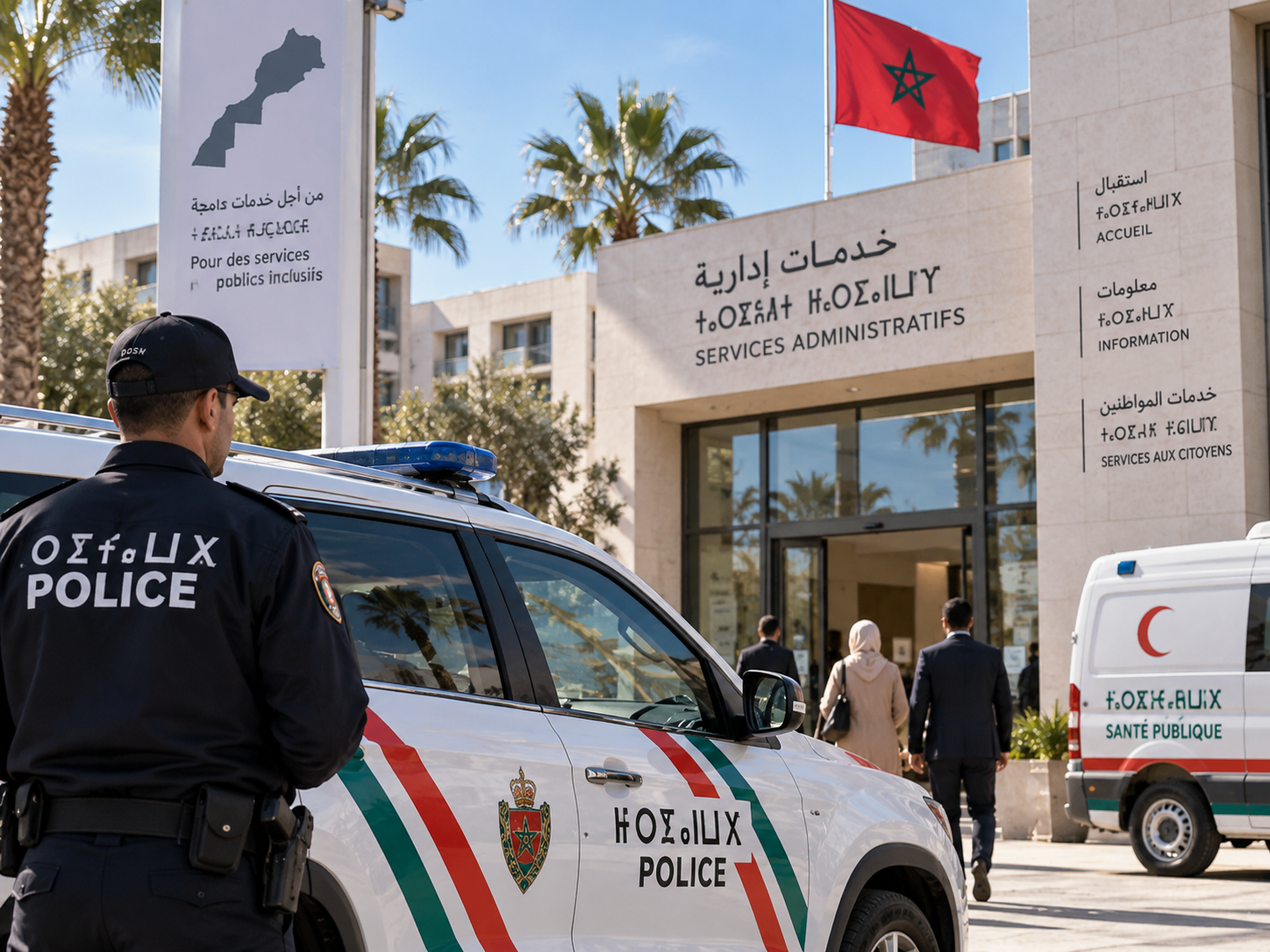
According to the ministry's report, Amazigh inscriptions have been introduced on 403 vehicles and transport units belonging to Morocco's General Directorate of National Security (DGSN).
Another 512 vehicles and units belonging to the Ministry of Health and Social Protection have also been included.
The initiative extends to public signage, administrative buildings and information panels.
Amazigh has also been integrated into signage at the Ministry of Endowments and Islamic Affairs.
These measures make the language more visible in places where citizens regularly interact with public institutions.
They also demonstrate how language policy can be reflected in everyday administrative settings.
120 Public Employees Trained in Amazigh
Visibility is only one part of the programme.
The government is also working to strengthen communication between public employees and Amazigh-speaking citizens.
In cooperation with the Royal Institute of Amazigh Culture (IRCAM), the ministry organised training for 120 public employees.
The courses covered communication in Amazigh, writing in the Tifinagh script and the use of standardised administrative terminology.
The ministry also reported work on the Al-Mouin administrative dictionary, involving 7,949 terms translated into Amazigh from an Arabic-French reference.
The objective is to help public institutions use more consistent terminology when communicating with citizens.
These initiatives support the gradual development of Amazigh-language services within Morocco's administration.
Government Websites and Digital Services
The programme is also extending into digital government.
A ministry study on integrating Amazigh into official public websites produced a roadmap containing 10 projects.
The aim is to improve access to government information and services for Amazigh-speaking citizens.
Authorities have also continued providing Amazigh interpretation during parliamentary sessions and government communication activities.
In education, the ministry has worked with the Ministry of National Education to develop an online platform for learning Amazigh remotely.
These measures are at different stages of implementation, with their wider impact depending on how broadly the services become available.
An Official Language Since 2011
Amazigh was recognised as an official language of Morocco alongside Arabic under the country's 2011 Constitution.
Article 5 also recognises Amazigh as a shared heritage of all Moroccans.
In 2019, Morocco adopted Organic Law 26.16, establishing the framework for gradually introducing Amazigh into education, administration and other priority areas of public life.
The measures reported in 2026 form part of that continuing implementation.
They build on earlier efforts to expand Amazigh teaching, improve administrative communication and strengthen the language's presence in public institutions.
The long-term objective is to ensure that official recognition is reflected in practical services.
From Recognition to Everyday Access
The latest government figures show progress across several areas.
More public vehicles now display Amazigh inscriptions.
Public employees are receiving language training.
Administrative terminology is being developed.
And digital services are being prepared to support wider access.
The next stage will be ensuring that these measures translate into consistent assistance for citizens across public institutions.
For Morocco, the significance extends beyond signage and administrative procedures.
The programme brings together cultural heritage, public-service accessibility and administrative modernisation.
More than a decade after Amazigh gained official constitutional status, Morocco is continuing to bring the language into the places where citizens interact with the state every day.