

Pet owners in urban areas can reserve an appointment with a participating private veterinarian during September, but eligibility and booking conditions apply.
Dog and cat owners in Morocco have until September 30 to use a free national rabies-vaccination campaign.
The vaccinations are being provided by participating private veterinarians, but owners cannot simply arrive at a clinic. An appointment must be booked first.
The official Stop Rage platform shows participating practices and their available times. Pets must also meet the campaign’s age, ownership and health conditions.
FREE RABIES VACCINATION: WHAT TO KNOW
| Question | Verified answer |
|---|---|
| Who organises the campaign? | ONSSA, in partnership with the Ordre National des Vétérinaires |
| When does it run? | September 1 to 30, 2026 |
| Which animals are covered? | Owned dogs and cats in urban areas that meet the campaign conditions |
| Minimum age | Three months |
| Where is vaccination provided? | Participating private veterinary clinics |
| Is an appointment required? | Yes |
| Where should owners book? | stoprage.veterinaires.ma |
| What must owners bring? | An identity document and the appointment number or QR code |
| What else should they bring? | The animal’s vaccination booklet or another health document, if available |
| What is confirmed as free? | The rabies vaccination offered through the campaign |
FREE VACCINATIONS ARE AVAILABLE THROUGHOUT SEPTEMBER
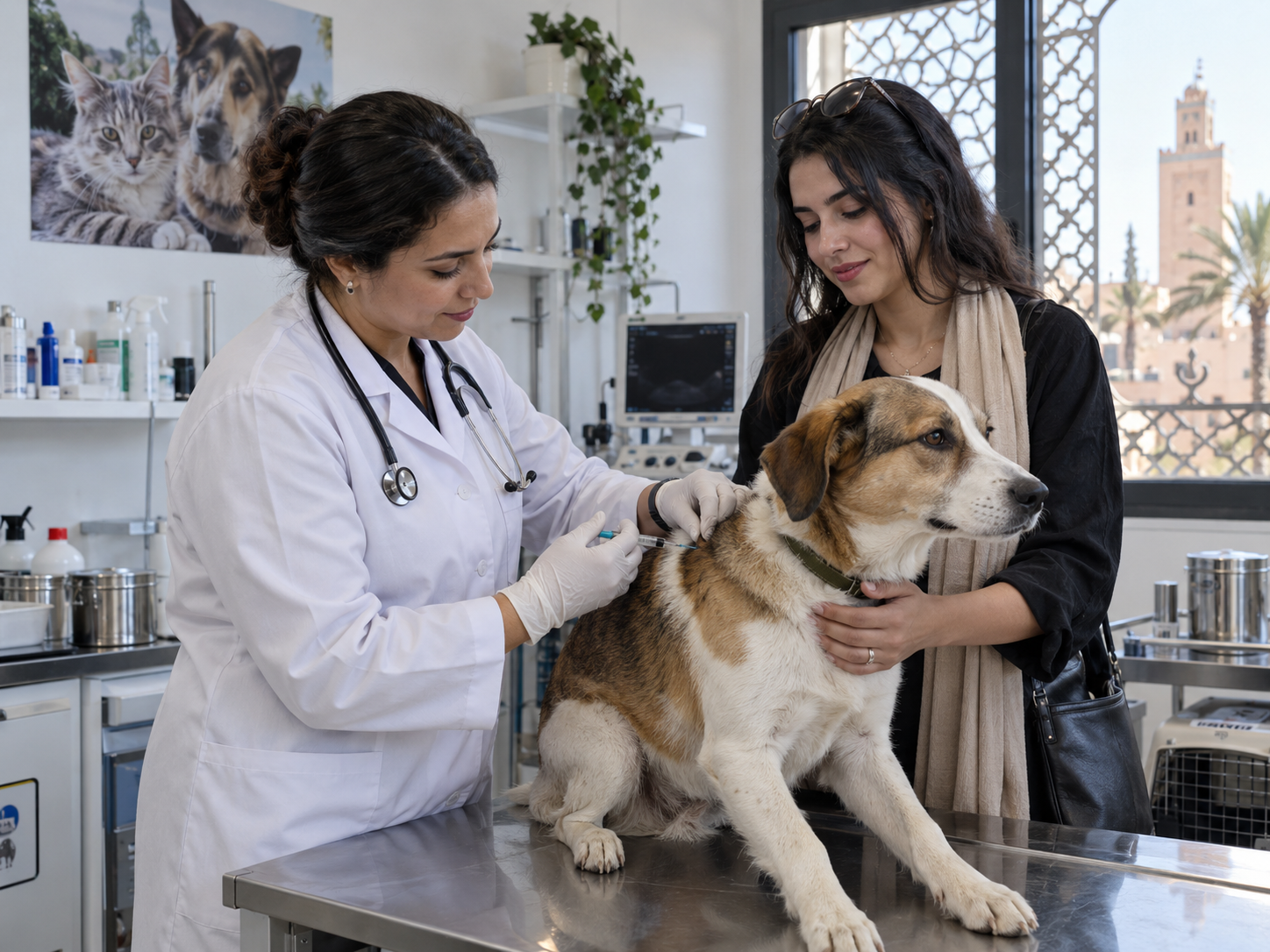
“Action Stop Rage” is being organised by Morocco’s National Food Safety Office, ONSSA, in partnership with the Ordre National des Vétérinaires, ONV.
The campaign runs from September 1 through September 30, 2026. Vaccinations are being administered by participating private veterinarians during appointment periods published for their practices.
The initiative aims to increase protection among owned dogs and cats, support animal health and reduce the risk of rabies being transmitted to people.
Not every veterinary clinic is participating, and availability is not guaranteed in every city. Owners should use the official directory to find a participating practice and check whether it has an available appointment.
WHICH DOGS AND CATS ARE ELIGIBLE?
The campaign covers owned dogs and cats in urban areas.
Officially, the animal must be at least three months old and in a general state of health that permits vaccination.
The reference to urban areas describes the target population announced by ONSSA and the ONV. In practice, owners should enter their location on the Stop Rage platform and use its current directory to see where participating clinics and appointment periods are available.
The attending veterinarian has the final responsibility for deciding whether vaccination is medically appropriate on the day.
Owners should disclose any illness, injury, pregnancy, medication or previous vaccine reaction. A sick or medically vulnerable animal may require an assessment or a later vaccination date.
The published conditions do not provide separate eligibility rules for pets with an earlier or expired rabies vaccination. Owners who are uncertain should check with the selected clinic.
A health booklet is not stated to be compulsory. The official instructions ask owners to bring the animal’s vaccination booklet or another health document if one is available.
The campaign is specifically described as being for dogs and cats with owners. Owners should not assume that unowned or free-roaming animals can be registered through the same appointment system.
HOW TO BOOK THE FREE APPOINTMENT
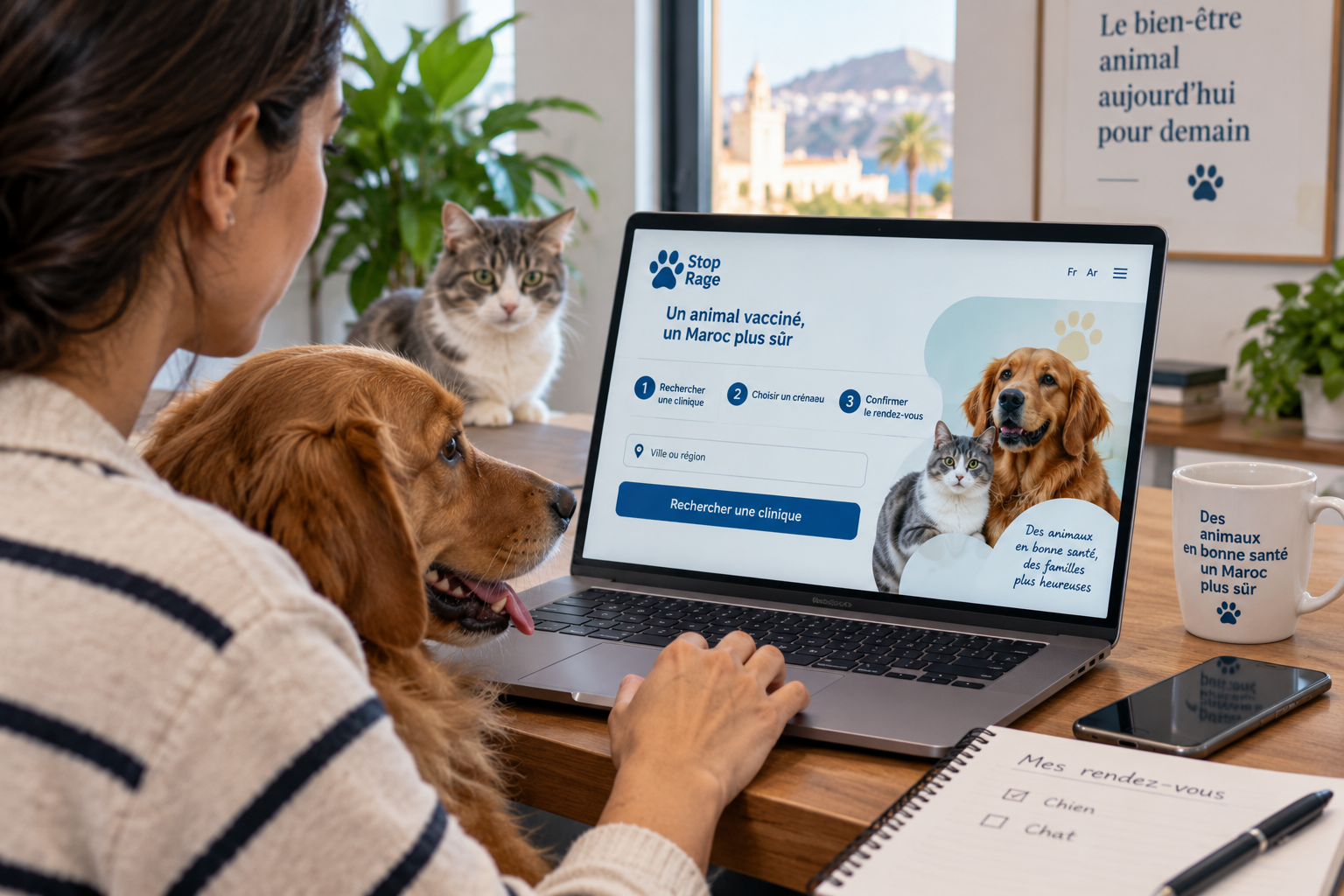
Open the official platform at stoprage.veterinaires.ma.
Use the public directory, available in French and Arabic, to search for a participating practice. The listings show the clinic’s location, contact details where provided and its published vaccination periods.
Select a clinic and press “Prendre rendez-vous”.
The platform will ask you to verify an email address, either through Google or by entering a code sent by email. You must then provide the owner’s full name, CIN number and telephone number.
Add every animal you want vaccinated. The form requests the species and age, while the animal’s name is optional. More than one eligible pet can be included in the same booking process.
Choose an available date and time, check the information carefully and confirm the appointment.
A confirmation is sent by email. Save the appointment number or QR code because it must be shown at the clinic.
If no suitable time is available, try another participating practice or check again for a later date. Campaign information can also be requested from provincial veterinary services. Always confirm the appointment before travelling.
WHAT TO BRING TO THE VETERINARY CLINIC
Owners must bring:
An identity document.
The appointment number or QR code received by email.
Owners should also bring, when available:
The pet’s vaccination booklet or another animal health document.
Information about previous vaccinations, illnesses, medication and earlier vaccine reactions.
A secure carrier for a cat, or an appropriate lead or harness for a dog.
Dogs should be firmly controlled, with a muzzle used when necessary. Contact the clinic before travelling if any booking information is unclear or the animal’s health has changed.
BEFORE YOU LEAVE HOME
Confirm that your pet meets the campaign conditions.
Book an available appointment through the official platform.
Save the appointment number or QR code.
Bring identification and any available animal health records.
Transport the animal safely.
WHAT DOES “FREE” ACTUALLY COVER?
The campaign confirms free vaccination against rabies for eligible dogs and cats attending a participating practice with an appointment.
The published information does not say that unrelated consultations, medicines, diagnostic tests, microchipping, treatment for another condition, a new health booklet or travel documentation are included.
Owners should ask the clinic before agreeing to any service outside the free vaccination campaign.
If the veterinarian identifies a separate medical problem, any proposed examination or treatment should be explained and discussed independently.
The campaign also does not replace rules concerning pet identification, registration or international travel. A vaccination received through Stop Rage is not, by itself, proof that every requirement for taking an animal abroad has been met.
HOW TO PREPARE YOUR PET FOR THE VISIT
Cats should travel in a closed, secure carrier. Dogs should be kept under control with a suitable lead or harness.
Avoid close contact with unfamiliar animals in the waiting area. Tell the clinic in advance if your pet is highly anxious or difficult to handle.
Inform the veterinarian about illness, pregnancy, medication and previous reactions before vaccination.
Follow the clinic’s instructions about arrival time, food and water. Do not withhold food or water unless the veterinarian specifically advises it.
Never give an animal a sedative without veterinary direction.
WHY RABIES VACCINATION MATTERS
Rabies is a vaccine-preventable viral infection that affects the central nervous system of mammals, including dogs, cats and humans.
It is generally transmitted through infected saliva, most commonly by a bite. Scratches and saliva reaching broken skin, the eyes or the mouth can also create a possible exposure.
The World Health Organization says vaccinating dogs is the most cost-effective strategy for preventing dog-mediated rabies in people because it tackles transmission at its source.
Vaccinating owned dogs and cats helps protect animals while strengthening protection for families and communities.
WHAT TO DO AFTER A BITE OR SCRATCH
A possible human exposure requires immediate action, regardless of whether the animal has an owner, appears healthy or is believed to have been vaccinated.
Wash the wound thoroughly with soap and water for at least 15 minutes, in line with World Health Organization guidance. Then seek professional medical assessment without delay.
Do not wait to see whether the animal develops symptoms. Do not try to capture an unfamiliar or aggressive animal yourself. Follow the instructions of the relevant health and veterinary authorities.
BITTEN OR SCRATCHED? DO NOT WAIT
Wash the wound immediately with soap and water.
Continue washing thoroughly for at least 15 minutes.
Seek urgent professional medical assessment.
Do not treat the animal’s vaccination appointment as human medical care.
A free pet-vaccination appointment is not treatment for a person who has already been bitten or scratched.
BOOK FIRST, THEN VISIT THE CLINIC
The September campaign gives pet owners a practical opportunity to protect their dogs, cats, families and communities.
Start by checking the conditions, finding a participating veterinarian and reserving an available appointment. Then keep the confirmation ready and take your pet to the clinic safely.
 Jamal Mahdad, Founder & Editor-in-Chief