
More than 14 million tourist arrivals were recorded during the first eight months of 2026, but the figures must not be confused with unique visitors, airport passengers or tourism revenue.
Morocco has crossed a tourism threshold it had never reached before.
More than two million tourist arrivals were recorded in August 2026, the first time the country has passed that mark in a single month.
That historic August pushed the cumulative total for the year to 14.1 million arrivals. It is an impressive result for Morocco tourism 2026, but it is also a figure that needs careful explanation.
It does not mean 14.1 million different foreign holidaymakers visited Morocco. It is not the same as the number of passengers using the country’s airports. And it does not reveal how long every traveller stayed or how much individual tourism businesses earned.
Here is what Morocco’s new record actually tells us.
MOROCCO CROSSES TWO MILLION IN A SINGLE MONTH
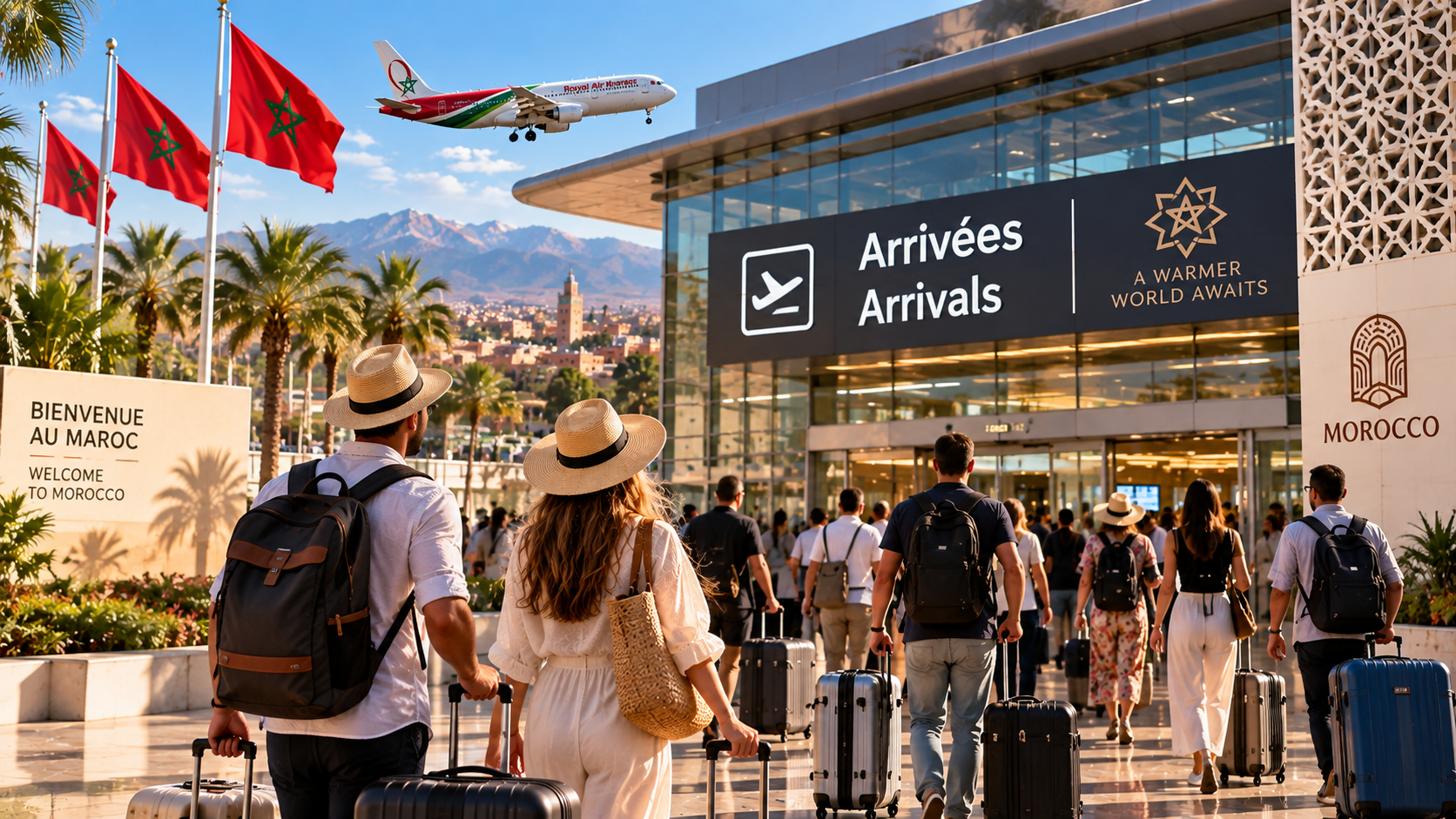
August 2026 was the strongest month ever recorded by Morocco’s tourism industry.
The Ministry of Tourism, Handicrafts and Social and Solidarity Economy said more than two million tourist arrivals were registered during the month, an increase of 3% compared with August 2025.
Across the first eight months of 2026, Morocco recorded 14.1 million arrivals. That was 4.5% higher than during the same period of 2025 and represented approximately 608,000 additional arrivals.
The comparisons matter. The 4.5% figure compares January through August in both years. The 3% figure compares August 2026 with August 2025.
Neither is a final result for 2026.
Morocco received a record 19.8 million tourist arrivals during the whole of 2025. The latest eight-month figure cannot be compared directly with that 12-month total or extended mechanically to produce a year-end forecast. Tourism is seasonal, and August is one of Morocco’s busiest travel months.
MOROCCO TOURISM 2026 AT A GLANCE
| Measure | Official figure | Reporting period | What it means |
|---|---|---|---|
| Tourist arrivals | 14.1 million | January to August 2026 | Arrivals recorded at Morocco’s border entry points |
| Year-on-year growth | 4.5% | Compared with January to August 2025 | Approximately 608,000 additional arrivals |
| August arrivals | More than 2 million | August 2026 | Morocco’s first month above this threshold |
| August growth | 3% | Compared with August 2025 | A comparison between the same month in consecutive years |
| Travel receipts | MAD 79.009 billion | January to July 2026 | Foreign-currency travel receipts, not arrivals or profits |
| Tourist arrivals in 2025 | 19.8 million | Full year 2025 | Morocco’s current annual record |
| Tourism target | 26 million | Full year 2030 | Morocco’s official national objective |
Figures checked on 5 September 2026. Reporting periods and statistical definitions differ.
WHO IS INCLUDED IN THE 14.1 MILLION?
The crucial word in the new record is “arrivals”.
Morocco’s established border-arrivals statistics combine two principal categories: foreign tourists, commonly identified in official reports as touristes étrangers de séjour, or TES, and Moroccans living abroad, known as MREs.
The 14.1 million total should therefore not be described as 14.1 million foreign tourists. Members of the Moroccan diaspora are included in the overall arrivals series.
That distinction is particularly important during the summer, when large numbers of MRE families return through Morocco’s airports, ports and land entry points.
The Tourism Observatory describes its APF statistics as international tourist arrivals recorded at border posts, with detailed reports normally examining country of residence and principal entry point.
Because the series counts recorded arrivals rather than publishing a deduplicated total of individuals, it should not be interpreted as a count of unique people.
The August announcement did not provide a breakdown between foreign tourists and MRE arrivals. It also did not publish period-matched figures by country of residence, destination or mode of entry.
The announcement did not explain in sufficient detail how every cruise excursionist, same-day visitor or transit traveller is treated. Those groups should not be assigned to the total without further official clarification.
WHAT THE 14.1 MILLION FIGURE DOES NOT MEAN
It does not necessarily mean 14.1 million unique people.
It should not automatically be described as foreign tourists only.
It is not the same as airport passenger traffic.
It does not show how many nights every visitor stayed.
It does not prove that every destination or business grew equally.
THIS IS NOT THE SAME AS AIRPORT PASSENGER TRAFFIC
Moroccan airports handled 22,282,997 commercial passengers during the first seven months of 2026, according to ONDA statistics.
That figure may appear to conflict with the 14.1 million tourism total, but the two datasets measure different activity over different periods.
ONDA’s total included 19,894,489 international passengers and 2,388,508 domestic passengers between January and July.
Airport traffic includes passengers travelling into, out of and within Morocco, so it cannot be treated as a count of unique international visitors. It includes Moroccan residents flying abroad and domestic passengers who have not crossed an international border.
Tourism-arrival statistics measure entries at Morocco’s border posts and are not limited to airports. Visitors can also enter through ports and land crossings.
The two totals must not be added together. Airport passenger traffic through July and tourist arrivals through August answer entirely different questions.
ARE TOURISM EARNINGS GROWING TOO?
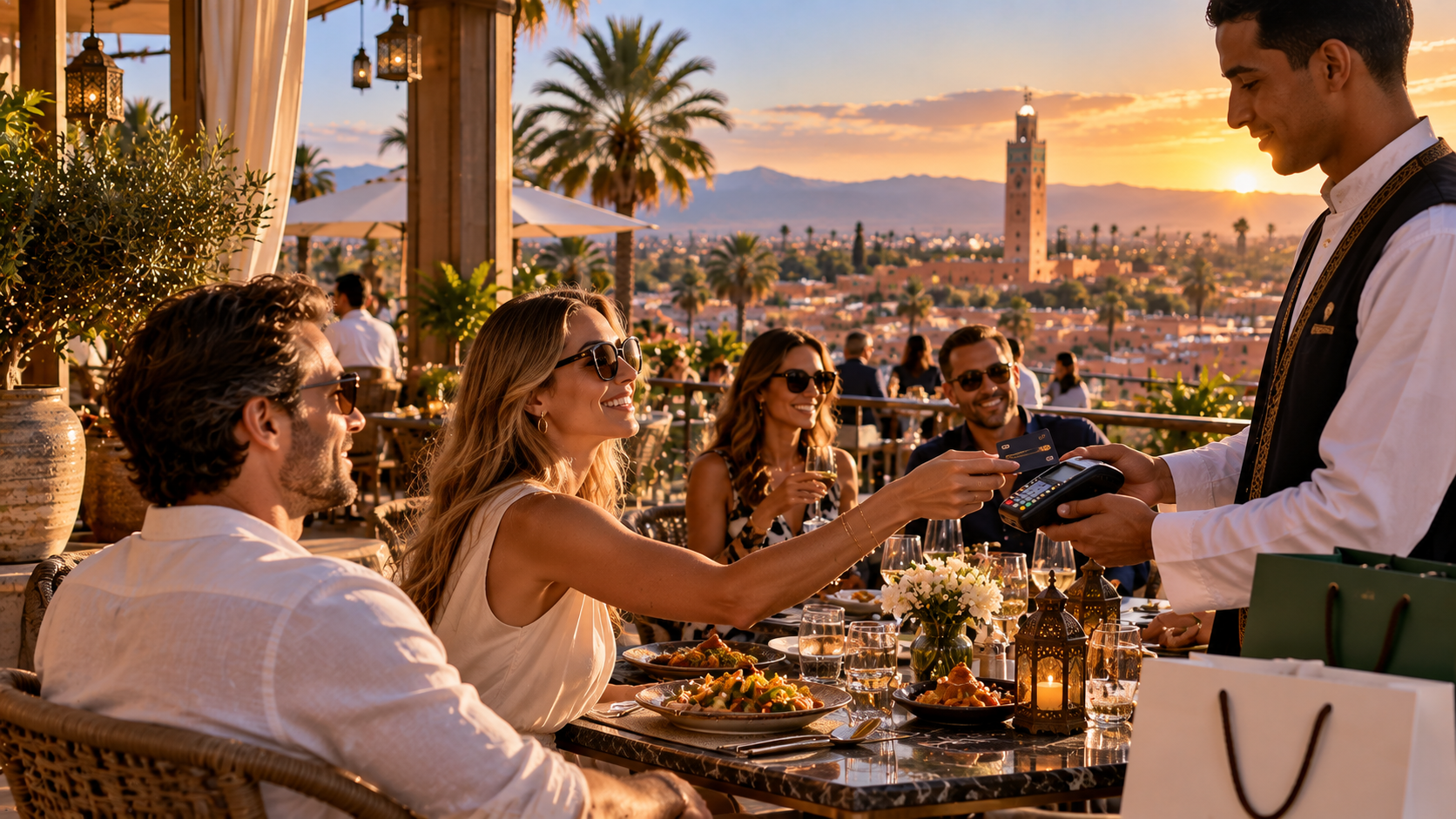
The latest foreign-exchange figures provide another encouraging signal.
The Office des Changes recorded MAD 79.009 billion in travel receipts during the first seven months of 2026. That was 13.4% higher than the MAD 69.648 billion registered over the corresponding period of 2025.
The receipts figure ends in July, one month earlier than the arrivals total.
Travel receipts are also not the same as hotel revenue, tourism-sector profit or money earned equally by every operator. They measure foreign-currency receipts classified as travel income by the Office des Changes.
Their increase may reflect several factors, including visitor volume, prices, exchange rates, length of stay and spending patterns. The published headline figures do not reveal the contribution made by each factor.
It would be misleading to divide MAD 79.009 billion by 14.1 million arrivals to calculate average tourist spending. The periods and statistical definitions do not match, and the available totals cannot support that calculation.
The responsible conclusion is simpler: both arrivals and travel receipts were higher than a year earlier, although they measure different parts of Morocco’s tourism economy.
WHERE DOES THE GROWTH COME FROM?
The August announcement confirms strong national growth, but it does not identify exactly where the additional arrivals came from.
No complete August breakdown was published showing the contribution of foreign tourists compared with MRE travellers. Nor was there a corresponding division by source country, destination, airport, port or land crossing.
It would therefore be premature to claim that Marrakech, Agadir, Casablanca or any other destination caused the national increase.
Morocco has expanded its international air connections, while ONDA recorded growth in both international and domestic airport traffic through July. Ferry and road travel also remain important, especially during the summer return of Moroccans living abroad.
These developments help explain why Morocco can receive visitors at greater scale. But the precise composition of the August record will require more detailed, period-matched statistics.
The national increase is confirmed. Its full geographical and market breakdown is not yet available.
THE OPPORTUNITY GOES BEYOND MOROCCO’S FAMOUS CITIES
A record month can create opportunities far beyond Morocco’s most recognisable destinations.
Northern Morocco can combine cultural cities, Mediterranean resorts and nature-based travel. Atlantic destinations can attract visitors beyond the established beach centres. Inland, mountain and desert regions can offer experiences that encourage travellers to explore for longer.
The potential beneficiaries include local guides, restaurants, transport providers, craftspeople, guesthouses and small hotels.
But visitor growth does not spread automatically.
A region needs reliable transport, suitable accommodation, effective marketing and services that travellers can find and book easily. Local businesses must also be equipped to turn greater interest into lasting income and employment.
The quality of Morocco travel growth will depend partly on whether visitors move beyond a single destination, stay longer, return and spend with locally rooted businesses.
That is how a national record can create value across more of the country.
RECORD NUMBERS ALSO TEST CAPACITY AND QUALITY
Welcoming more than two million arrivals in one month is an achievement. It is also a test of how well the visitor economy performs under pressure.
Airports and ports need to process passengers efficiently. Trains and roads must connect gateways with destinations. Hotels and guesthouses need appropriate capacity, clear standards and trained employees.
Travellers also judge a country through small but decisive details: cleanliness, multilingual information, transparent prices, reliable transport, maintained public spaces and helpful service.
Rapid growth strengthens the case for responsible water and energy management, especially in destinations where demand rises sharply during peak seasons. Heritage sites and natural landscapes must also be protected as their popularity increases.
Morocco has begun applying a revised hotel-classification system and mystery visits designed to assess the real guest experience in classified accommodation.
That focus matters because the next level of success will not be measured by arrivals alone.
Visitor satisfaction, repeat travel, spending, regional distribution and the share of value reaching local businesses will become increasingly important measures of progress.
WHAT DOES THE 2030 TARGET REQUIRE?
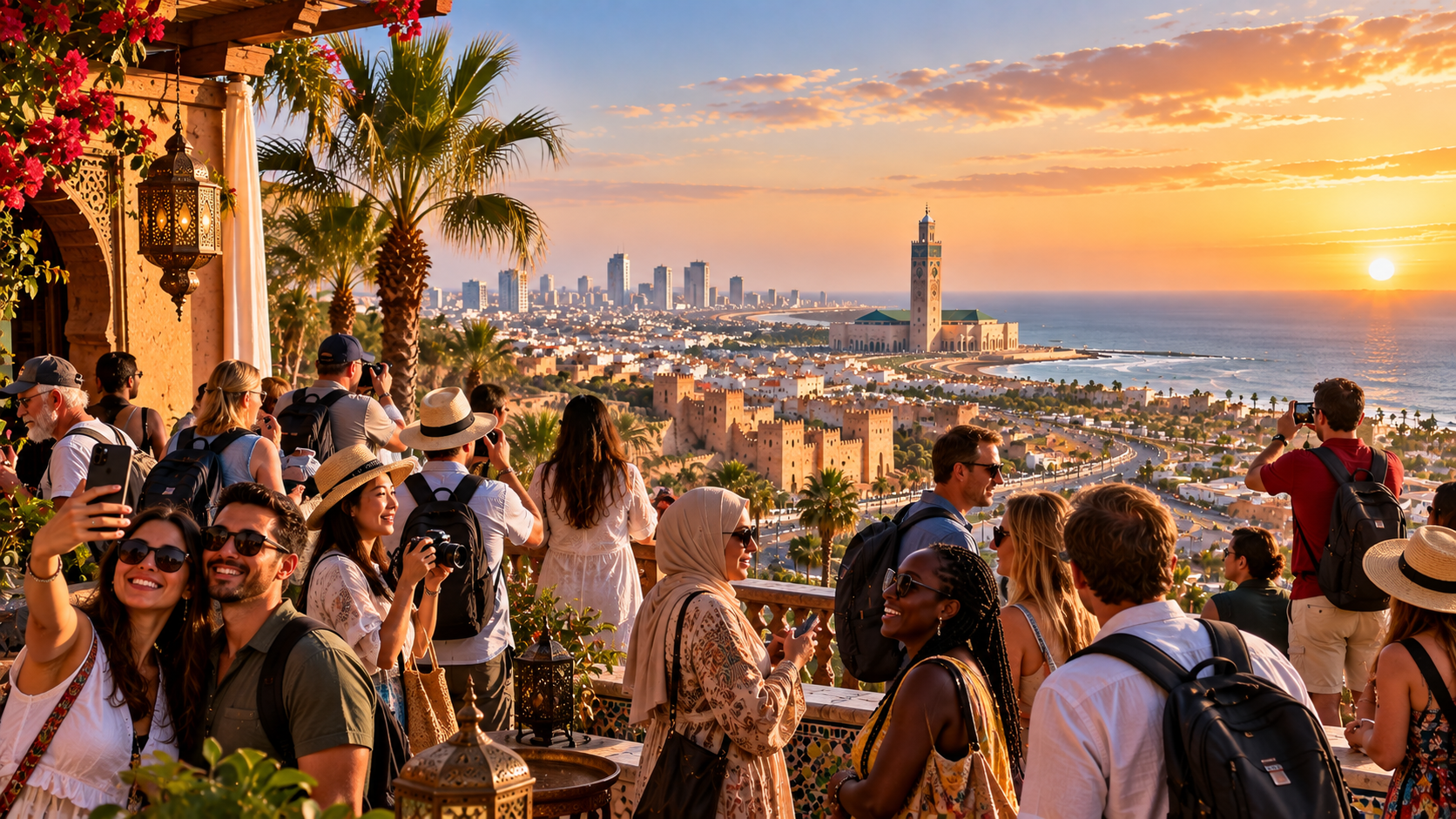
Morocco has set an official target of 26 million tourist arrivals in 2030, when it is scheduled to co-host the FIFA World Cup with Spain and Portugal.
The 14.1 million arrivals recorded through August show that Morocco is already attracting travellers at unprecedented scale. They do not guarantee that the 2030 target will be achieved.
Reaching 26 million sustainably will require continued investment in air connectivity, airport and port capacity, accommodation, transport, tourism skills and regional experiences.
The World Cup will place Morocco before an enormous international audience. But a major sporting event creates attention, not guaranteed long-term tourism.
The lasting result will depend on what visitors experience after they arrive.
Successful marketing can persuade someone to book a first journey. Reliable service, fair treatment and a memorable stay can persuade that person to return and recommend Morocco to others.
A RECORD MONTH, AND A BIGGER OPPORTUNITY
August 2026 has given Morocco a genuine tourism landmark: more than two million arrivals in one month for the first time.
The number proves that Morocco can attract travel at a scale once reserved for annual ambitions. The greater opportunity is to convert that volume into better journeys, stronger local enterprises and benefits reaching more parts of the country.
Two million arrivals made history. What Morocco builds around them will determine the record’s real value.