

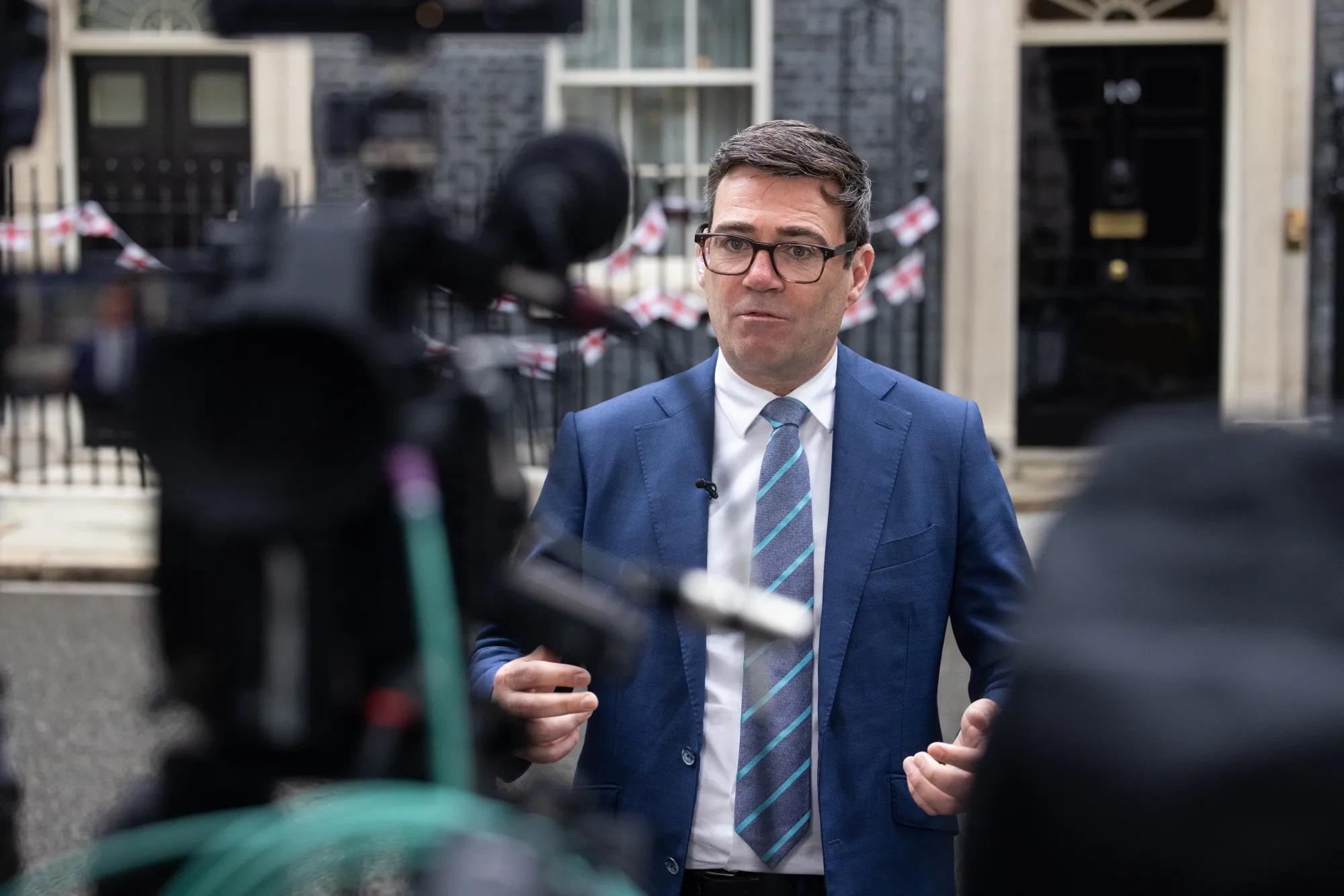
Britain is entering its Burnham Moment, and the symbolism is hard to miss.
The politician once nicknamed the “King of the North” is now moving towards Downing Street, turning a regional power base into the highest office in British politics.
Andy Burnham’s rise is not just another leadership change inside the Labour Party. It is the latest chapter in a country that has changed prime ministers with extraordinary speed, while still searching for a governing formula that can reconnect Westminster with ordinary households, frustrated towns, public services and regions that feel ignored.
This is not only a personal comeback.
It is a test of whether Britain can be governed differently after years of political turbulence.
Burnham Moment Arrives After Starmer
The Burnham Moment begins with the end of Keir Starmer’s premiership.
AP reports that Starmer is expected to make a farewell statement before visiting Buckingham Palace to formally resign, after which Burnham is set to become Britain’s next prime minister and make his first statement outside 10 Downing Street.
That process is constitutional routine.
But politically, the moment is anything but routine.
Burnham will become another prime minister without a general election, continuing a pattern that has made British leadership feel unstable even when the country’s institutions remain orderly.
The handover may be calm.
The message underneath is not.
Britain is still searching for a leader who can make government feel durable again.
The King Of The North Goes National
Burnham’s greatest political asset is not that he is unknown.
It is that he is known differently.
His years as Greater Manchester mayor gave him a public identity outside Westminster. Reuters notes that his mayoral period helped build the “King of the North” image, turning him into a symbol of regional confidence and resistance to London-centred politics.
That matters because Britain’s political problem is not only ideological.
It is geographic.
Many voters feel the country is too centralised, too London-heavy, too slow to understand regional transport, housing, wages, local industry, public services and daily frustration outside the capital.
Burnham can speak to that feeling more naturally than many national politicians.
His challenge now is harder.
It is one thing to criticise Westminster from the North.
It is another to run Westminster from inside Downing Street.
A Comeback Built On Defeat
Burnham’s route to power has not been straight.
Reuters describes his political story as a rise, fall and return, including the pain of losing the 2015 Labour leadership contest before leaving Westminster politics for Greater Manchester.
That history may help him.
British voters often distrust politicians who appear too polished by Westminster. Burnham can present himself as someone who left, governed locally, learned from regional power and returned with a different political language.
The comeback story gives him emotional material.
Rejected by Labour once.
Rebuilt in Manchester.
Returned to lead the party.
Now preparing for Downing Street.
That arc is powerful, but it also creates expectations.
A politician who built his brand on being different must now prove that difference in office.
Britain’s Seventh Prime Minister In A Decade
The number is brutal.
Reuters and AP both report that Burnham is set to become Britain’s seventh prime minister in a decade.
That tells the story of modern Britain better than any slogan.
Leadership has changed repeatedly.
Governments have promised resets.
Prime ministers have arrived with authority and left with disappointment.
Brexit, inflation, public-service pressure, immigration tension, housing costs, productivity weakness and regional inequality have all outlasted several leaders.
Burnham does not inherit a blank page.
He inherits public exhaustion.
The country has heard too many fresh starts. It now wants results that survive the first press conference.
Reform UK Is The Immediate Threat
Burnham’s rise also has a defensive purpose for Labour.
Reuters reports that his leadership comes with a pledge to counter the rise of Reform UK, the populist party putting pressure on Labour and the Conservatives.
That is crucial.
British politics is no longer shaped only by the old Labour-Conservative battle. Reform has turned frustration into an electoral weapon, especially among voters who feel ignored, economically squeezed or culturally alienated.
Burnham’s task is therefore not only to manage government.
He has to stop Labour bleeding support to a populist challenger that thrives when mainstream politics looks weak.
That means his premiership will be judged quickly on living standards, migration, public services and whether politics feels responsive again.
Devolution Becomes His Signature Theme
Burnham has already signalled that shifting power away from the centre will be central to his project.
Reuters reports that in his only speech since returning to parliament, he described moving power from central government to regional leaders as the “biggest rebalancing of power” in recent British history.
That could become the defining idea of his premiership.
Britain has talked about devolution for years, but much of the country still feels governed through a narrow Westminster machine. Burnham’s argument is that mayors, regions and local leaders should have more power over transport, skills, housing, infrastructure and economic strategy.
The political attraction is obvious.
Let places shape their own future.
The governing difficulty is also obvious.
Central government often likes devolution until local leaders want money, authority and freedom to disagree.
The North Will Expect Delivery
Burnham’s northern brand is powerful, but it also creates pressure.
Greater Manchester and the wider North of England will expect more than symbolic recognition. They will look for transport investment, housing action, skills funding, public-service improvement and a stronger voice in national economic planning.
If Burnham appears to enter Downing Street and then behave like every other London-centred leader, the disappointment could be sharper because his promise was different.
His supporters will expect him to remember where his authority was rebuilt.
His critics will accuse him of regional favouritism if he moves too visibly towards northern priorities.
That is the balance he must manage.
He must govern the whole United Kingdom without losing the regional authenticity that brought him back.
The Cabinet Will Reveal The Real Direction
The first real signal will be his cabinet.
Names matter.
Appointments show whether Burnham wants continuity, disruption, technocratic competence, regional balance, party unity or ideological change. A leader can speak about renewal, but a cabinet reveals how much risk he is willing to take.
Labour will also be watching closely.
Burnham arrived as leader unopposed, but that does not mean every internal faction is equally enthusiastic. Some will want stability. Others will want a sharper break from Starmer. Trade unions will want stronger worker-focused policy. Centrists will want reassurance on markets and fiscal discipline.
The cabinet is where the slogan becomes structure.
The Economy Gives Him Little Room
Every new prime minister wants space.
Burnham may not get much.
Britain’s economic problems remain difficult: weak productivity, high housing pressure, tight public finances, stressed health services, regional inequality and voters still feeling poorer than they expected to feel after years of political promises.
This limits dramatic action.
A prime minister can promise renewal, but markets, budgets and delivery capacity impose discipline quickly. Burnham must show enough ambition to look different, but enough seriousness to avoid alarming investors or public institutions.
That is not easy.
The public wants more spending.
The Treasury wants limits.
Regions want power.
Departments want control.
Opponents want mistakes.
The first months will be a test of political balance.
Public Services Could Define The Premiership
The British public may judge Burnham less by speeches and more by waiting lists, trains, housing, schools, policing and local services.
That is where politics becomes visible.
If a person cannot get a GP appointment, a speech on national renewal does not matter. If trains remain unreliable, devolution language feels abstract. If rent keeps rising, regional empowerment sounds distant.
Burnham’s strength is that he built his image around practical regional governance.
Now he must prove that practical politics can scale nationally.
The problem is that national government moves slower, carries more constraints and attracts harsher scrutiny.
The mayor can be direct.
The prime minister must deliver through the machine.
Westminster May Resist A Mayor’s Style
Burnham’s style may clash with Westminster culture.
Mayors often speak in direct, place-based language. They can present themselves as problem-solvers against bureaucracy. Prime ministers, however, live inside bureaucracy. They must negotiate Parliament, cabinet, civil service, markets, courts, media and international partners.
That transition is difficult.
A mayor can blame the centre.
A prime minister is the centre.
Burnham’s challenge is to keep the clarity of a regional leader while accepting the complexity of national office. If he becomes too cautious, he loses his brand. If he remains too insurgent, he may struggle to govern.
The “King of the North” image helped him rise.
Downing Street will test whether it can survive power.
Foreign Policy Cannot Wait
Although Burnham’s brand is domestic, the prime minister’s office is global.
He will inherit relations with Europe, the United States, NATO, Ukraine, migration pressures, trade questions and a volatile international environment. A leader known for regional policy must quickly prove he can operate at global level.
This is often where domestic politicians are tested fastest.
International partners want clarity.
Markets want stability.
Opponents look for inexperience.
The media will examine every diplomatic gesture.
Burnham does not need to reinvent British foreign policy on day one, but he must show command. A prime minister cannot be only a regional reformer.
He becomes the country’s face abroad.
The No-Election Question Will Follow Him
Because Burnham is taking office through party leadership rather than a general election, the legitimacy debate will follow him.
AP explains that Britain’s parliamentary system allows a governing party to change leader without an immediate national vote, but public debate often intensifies when this happens repeatedly.
The constitutional answer is clear.
The political answer is messier.
Voters may ask why they have another prime minister they did not directly choose at the ballot box. Opponents will use that argument. Burnham will need to build authority quickly through competence, communication and visible priorities.
In Britain, formal legitimacy gets a leader into Downing Street.
Performance keeps him there.
Labour Needs A Reset Without Panic
Labour’s problem is delicate.
It needs renewal, but not chaos.
It needs a sharper message, but not a civil war.
It needs to answer Reform UK, but not simply chase populist language.
It needs to defend its record, while admitting enough weakness to justify the leadership change.
Burnham’s advantage is that he can claim both continuity and difference. He is Labour, but not only Starmer’s Labour. He has cabinet experience, but also mayoral distance. He can speak to working-class voters without sounding like he discovered them in a polling memo.
The test is whether that advantage survives the first serious crisis.
The Media Narrative Will Move Fast
Burnham will enter office with a strong story.
But British media cycles are unforgiving.
The first cabinet leak, the first market reaction, the first policy confusion, the first unpopular compromise or the first internal Labour briefing can change the mood quickly. A politician who arrives as a comeback hero can become another pressured prime minister within weeks.
That is why narrative discipline matters.
Burnham needs a few clear priorities that voters can understand immediately. Devolution, living standards, public services and trust in politics may form that package.
Too many promises would dilute the moment.
Too little ambition would waste it.
The Bottom Line
Britain’s Burnham Moment is a rare political transformation.
The former Greater Manchester mayor once known as the “King of the North” is moving to Downing Street after becoming Labour leader, preparing to replace Keir Starmer as Britain’s next prime minister. Reuters and AP report that he will become the country’s seventh prime minister in a decade, a striking sign of how unstable British leadership has become.
His promise is clear: shift power from Westminster, reconnect politics with regions, improve living standards and stop the populist pressure building around Reform UK.
But the challenge is just as clear.
Burnham can no longer be the regional outsider demanding change from London.
He is about to become London’s most powerful political figure.
The King of the North is entering Downing Street.
Now Britain will find out whether his regional revolution can survive national power.