

Part I of the MTD Investigates MH370 Series
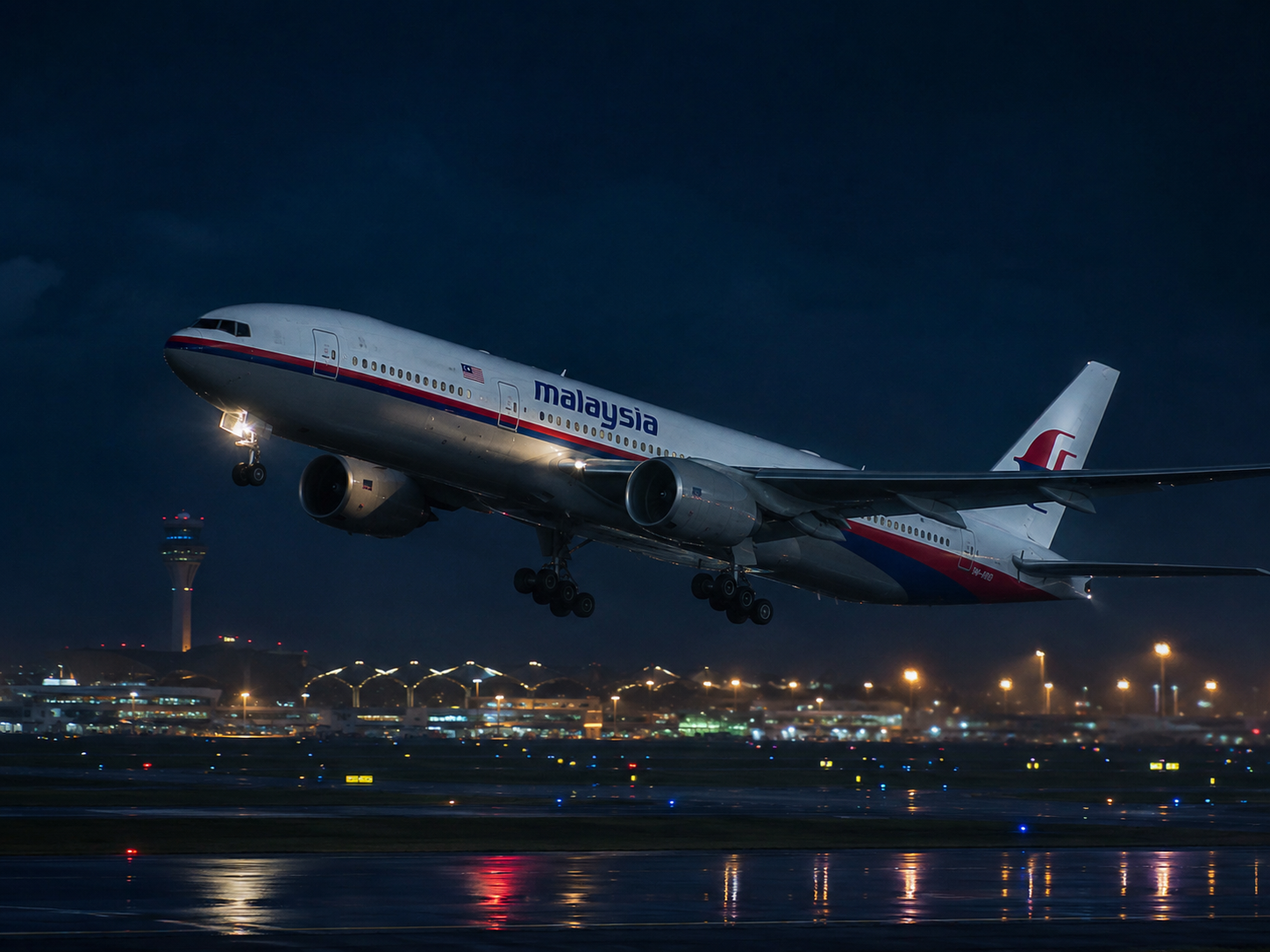
At 1:19 a.m. on 8 March 2014, Malaysia Airlines Flight MH370 still looked like an ordinary overnight flight.
A Boeing 777-200ER carrying 239 people was cruising from Kuala Lumpur toward Beijing. Ahead lay waypoint IGARI and the transfer from Malaysian to Vietnamese air traffic control.
At 01:19:26, Kuala Lumpur instructed MH370 to contact Ho Chi Minh on 120.9 MHz.
Four seconds later came the final recorded voice transmission from the aircraft:
“Good night Malaysian Three Seven Zero.”
The official Malaysian investigation identified the speaker as Captain Zaharie Ahmad Shah. Investigators detected no evidence of anxiety or stress in the cockpit radio transmissions. One detail was unusual: Zaharie did not read back the new Ho Chi Minh frequency, unlike during most earlier frequency changes. Investigators could not determine why.
At 01:20:31, MH370 passed IGARI.
Five seconds later, its Mode S symbol disappeared from the radar display.
At 01:21:13, the last secondary-radar position symbol was recorded.
And then MH370 stopped behaving like a flight to Beijing.
This is where the MTD Investigates reconstruction begins.
Because MH370 was not lost in a single instant.
Its normal visibility disappeared in stages.
The aircraft itself kept moving.
The central question is therefore not simply how MH370 disappeared. It is whether somebody deliberately removed it from the normal air-traffic system.
A Normal Flight Until It Wasn’t
MH370 departed Kuala Lumpur International Airport at approximately 00:42 local time.
On board were 227 passengers and 12 crew members.
Captain Zaharie Ahmad Shah, 53, was an experienced Malaysia Airlines Boeing 777 captain and an authorised aviation examiner. First Officer Fariq Abdul Hamid was seated beside him.
Nothing publicly established about the first portion of the flight indicated an emergency.
The aircraft climbed normally.
Air traffic communications were routine.
At 01:07:29, MH370 transmitted its final normal ACARS position report through the aircraft’s satellite communications system.
The next expected automated reports were never received. The official investigation found that ACARS had been functioning satisfactorily until that final transmission; afterwards, either ACARS had been switched off or a fault in the aircraft information-management system prevented further transmissions. Investigators could not determine which.
That distinction matters.
ACARS going silent does not prove deliberate action.
Systems fail.
Individual communications anomalies occur.
But ACARS was only the beginning.
The Handover
The timing of the disappearance deserves unusually close attention.
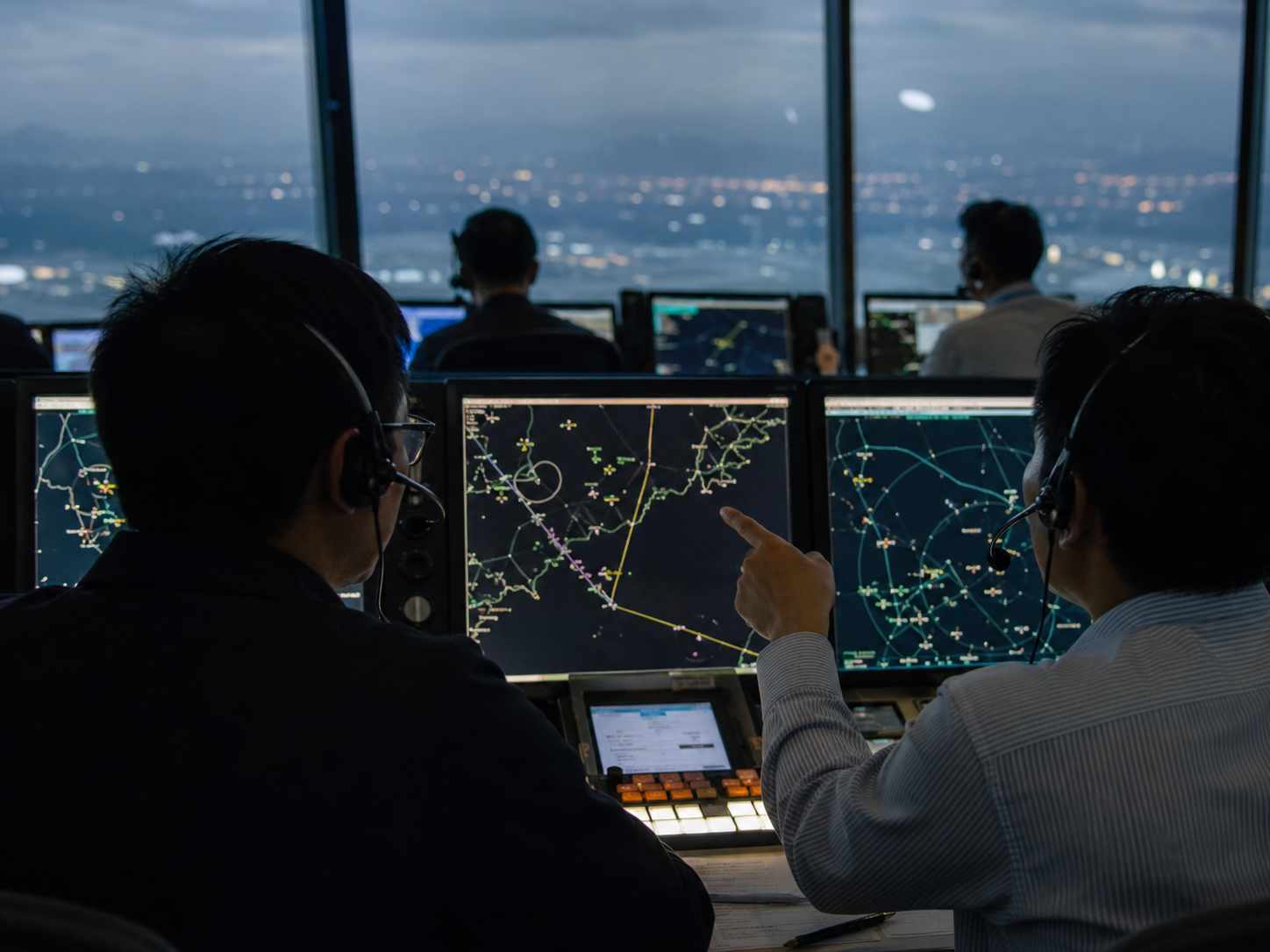
At 01:19:26, Kuala Lumpur told MH370 to contact Ho Chi Minh.
At 01:19:30 came Zaharie’s final transmission.
At 01:20:31, MH370 crossed IGARI.
At 01:20:36, its Mode S symbol disappeared.
At 01:21:13, the last secondary-radar position was recorded.
This occurred at precisely the phase of flight when responsibility was passing between two air traffic control centres.
That does not establish that the timing was deliberately selected.
A technical failure could occur at any moment, including an inconveniently precise one.
But if somebody wanted to create uncertainty, an international ATC handover would offer an unusually favourable opportunity.
And uncertainty is what followed.
Ho Chi Minh failed to establish contact.
Kuala Lumpur did not immediately recognise the seriousness of the situation.
The official investigation later found procedural delays and failures on both sides, including a delay by Ho Chi Minh in informing Kuala Lumpur that two-way communication had not been established and failures by Kuala Lumpur controllers to initiate the standard emergency phases promptly.
While controllers tried to understand where MH370 had gone, the aircraft was no longer flying toward Beijing.
The Turn Back
This is the first moment at which a conventional communications failure becomes insufficient as an explanation.
MH370 did not simply lose its transponder and continue along its filed route.
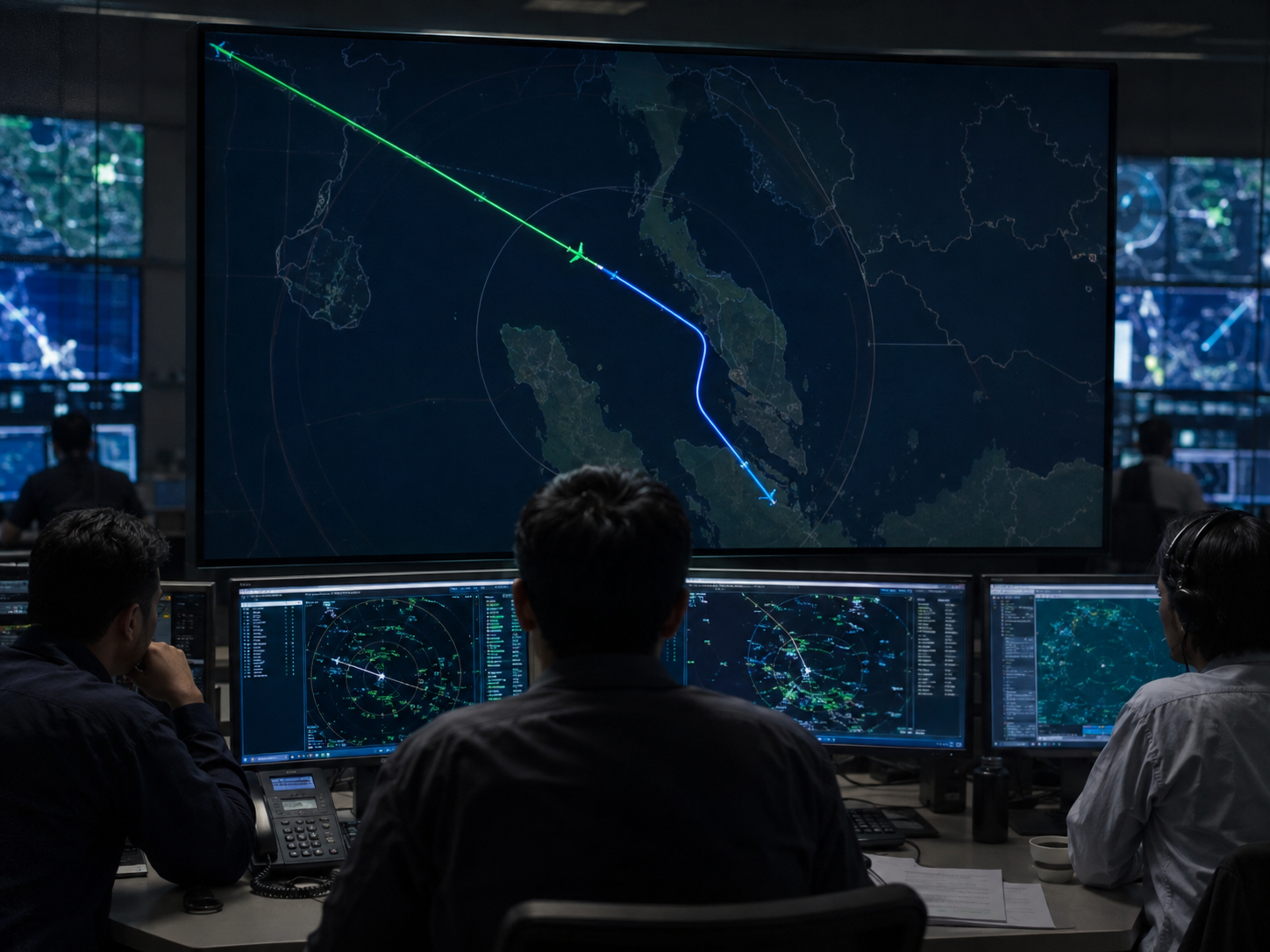
Radar evidence showed the aircraft diverting.
It turned back toward Malaysia.
The Malaysian investigation later recreated the turn on Boeing 777 simulators. The investigators concluded that the turnback was likely performed under manual control rather than autopilot.
They could not establish who was controlling the aircraft.
They also could not establish that anyone other than the pilots was flying it.
But the investigation made an even more important observation.
The route changes after IGARI — the turn back, crossing Peninsular Malaysia, the later turn northwest and the subsequent movement toward the southern Indian Ocean — were described as difficult to attribute to anomalous system issues alone.
That does not prove criminal intent.
It does not identify a perpetrator.
But it moves the evidence beyond a Boeing 777 simply experiencing a communications problem.
The early diversion increasingly points toward deliberate human control.
Where Was the Emergency?
Any responsible reconstruction must attack that interpretation before accepting it.
Could MH370 have suffered an emergency?
Absolutely.
A fire could affect communications.
An electrical failure could disrupt several systems.
Smoke could force an immediate turn back.
Decompression could incapacitate passengers and crew.
A pilot responding to a serious failure might first concentrate on controlling the aircraft rather than transmitting a Mayday.
Those alternatives cannot be dismissed.
But they encounter a problem when applied to the sequence as a whole.
There was no recorded Mayday.
No publicly established emergency transmission.
No transponder emergency code.
No radio message reporting smoke, fire, decompression or electrical failure.
And the aircraft did not merely remain airborne.
It changed direction and subsequently crossed Malaysia.
The official investigators ultimately stated that, without the wreckage and flight-recorder data, they could not identify any plausible aircraft or systems failure mode capable of accounting for the observed systems deactivation, diversion and subsequent flight path.
That does not make technical failure impossible.
It makes it increasingly difficult to use technical failure as a complete explanation.
MH370 was not simply silent.
It was silent while going somewhere else.
Back Across Malaysia
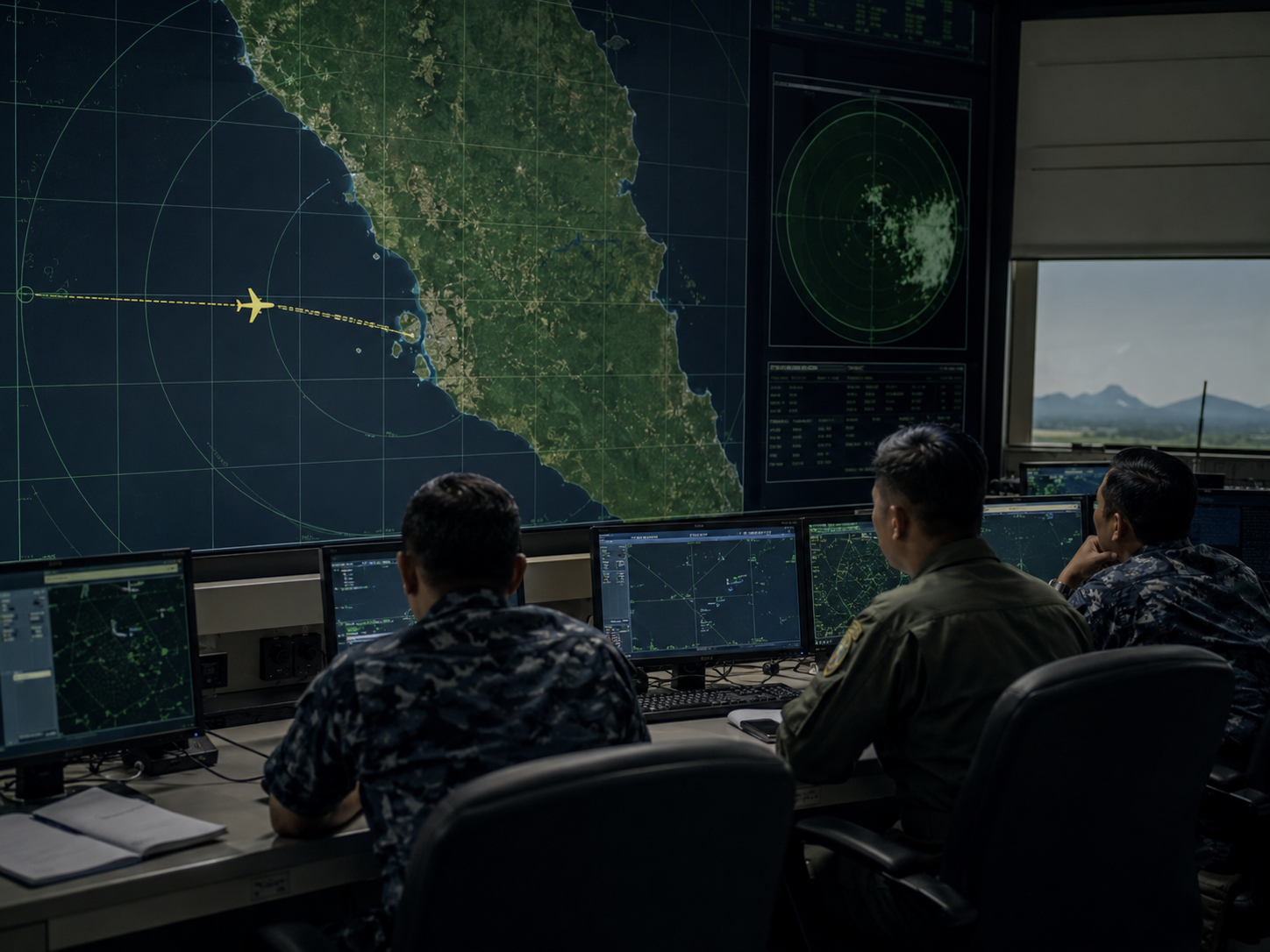
Military primary radar continued tracking a target corresponding with MH370 as it crossed the Malay Peninsula and headed toward the Strait of Malacca.
No fighter aircraft intercepted it.
That has become one of the most uncomfortable institutional elements of the case.
The Malaysian military later stated that the target was recognised as MH370 from its track behaviour and characteristics. It was categorised as “friendly” and was not considered a threat to Malaysian airspace, so no interception was launched.
There is an important boundary here.
The official investigation found no evidence that MH370 was deliberately manoeuvring to evade radar.
MTD therefore does not claim that the route proves sophisticated radar avoidance.
But the practical result is undeniable.
A Boeing 777 had:
- lost its transponder identity,
- reversed course,
- crossed Malaysia,
- and continued westward —
without being intercepted.
Whatever the intentions of whoever was controlling MH370, that absence of intervention bought the aircraft something critically valuable.
Time.
Penang: Geography or Farewell?
MH370’s reconstructed route took it south of Penang before it continued northwest.
Penang matters because Captain Zaharie was born on the island and attended school there.
That geographical fact has produced one of the most emotionally powerful interpretations of the entire mystery:
that Zaharie may have taken MH370 past his home region as a final farewell.
It is compelling.
It is also unproven.
Radar cannot tell us what somebody inside the cockpit was thinking.
The Malaysian investigation could not even establish whether the later turn south of Penang was flown manually or by autopilot.
A westbound route across Malaysia can naturally take an aircraft near Penang without the location having any symbolic meaning.
MTD therefore treats the Penang theory as exactly what it is:
an interpretive clue, not evidence of motive.
If later evidence points strongly toward Zaharie, the detail may acquire greater significance.
Until then, geography is not psychology.
The Last Radar Return
MH370 continued northwest.
Military radar intermittently tracked the aircraft until 02:22:12, when the final primary-radar target disappeared approximately ten nautical miles beyond waypoint MEKAR.
From that moment, conventional radar could no longer tell investigators where MH370 went.
This is where the popular story says the aircraft vanished.
It did not.
Something aboard it was still communicating.
The Machine That Kept Answering
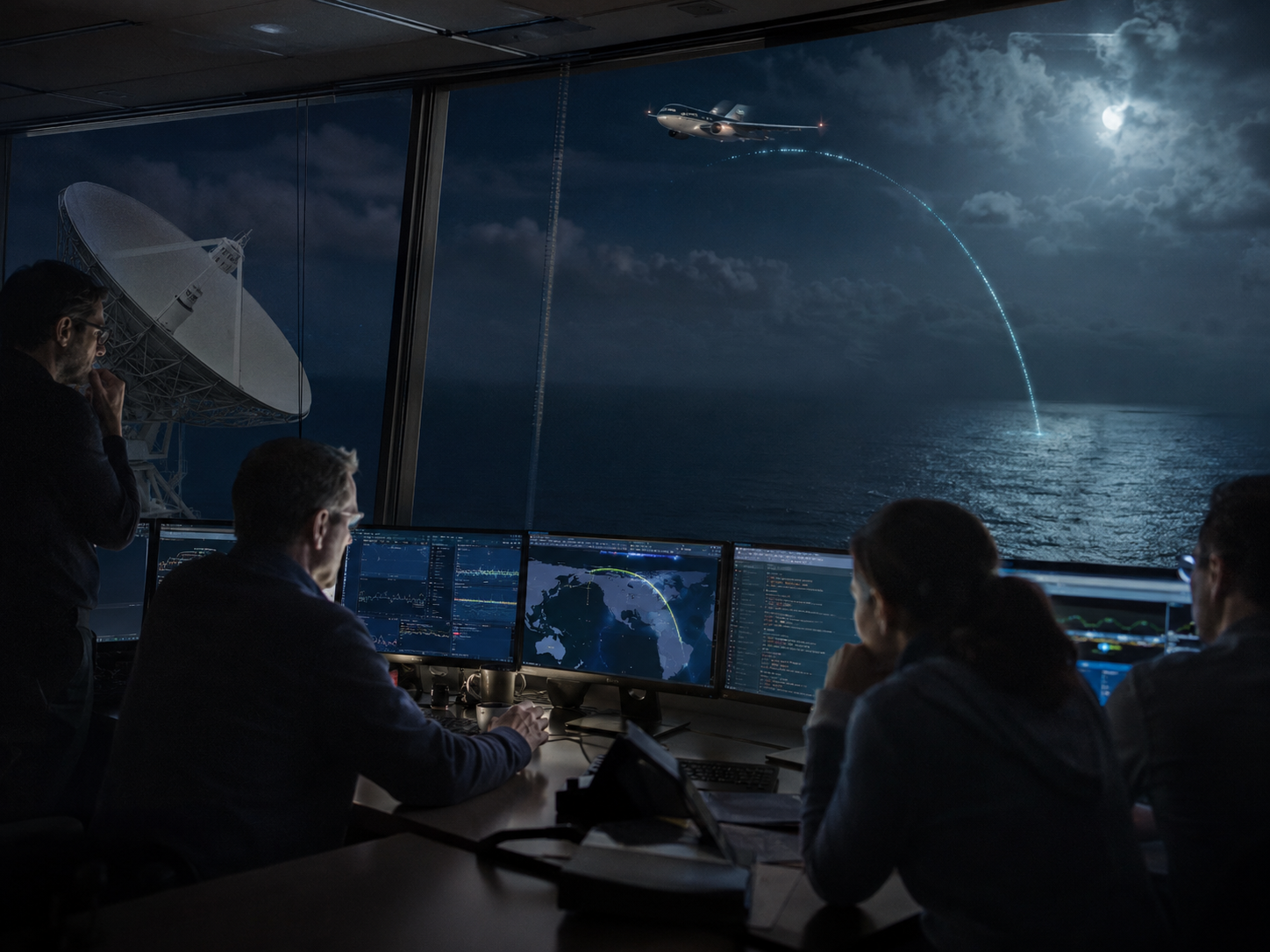
MH370 carried satellite communications equipment connected to the Inmarsat network.
Long after ordinary ATC communication had ended, the aircraft’s satellite terminal continued exchanging automated signalling data with a ground station.
These were not pilot messages.
They contained no statement of intent.
They did not transmit an ordinary GPS position.
They were routine network exchanges — electronic handshakes that would ordinarily have attracted almost no attention.
But after MH370 disappeared, they became extraordinary.
The official investigation concluded from the SATCOM data that the aircraft remained airborne for more than seven hours, and that basic autopilot functions were probably available for at least much of that period.
That destroyed the earliest assumption that MH370 had simply crashed close to where its transponder disappeared.
The aircraft had continued.
For hours.
Into the night.
The 02:25 Log-On
Then comes one of the technically strangest moments in the sequence.
At 02:25:27 local time, the satellite terminal initiated a new log-on request.
The satellite link had previously been lost.
Now it returned.
The official investigation later concluded that the log-on was most likely associated with a power interruption to the SATCOM avionics and said the interruption preceding the 02:25 log-on was probably caused by power-bus cycling, although the reason for that cycling remained unknown.
That distinction is essential.
Power cycling does not prove deliberate switching.
An electrical event could potentially produce it.
But if deliberate electrical reconfiguration occurred, it would introduce another human action into an already unusual sequence.
And there is a striking irony.
If somebody intended to make MH370 disappear, the satellite system may have preserved the one trail that person did not understand could later be exploited.
Routine handshakes were never designed to track a missing aircraft.
Yet engineers eventually extracted timing and frequency information from those signals and used them to constrain possible locations across vast arcs of the Indian Ocean.
MH370 may have disappeared from radar.
It did not disappear mathematically.
That mathematical shadow becomes the subject of Part II.
Could a Hijacker Have Done It?
Deliberate human control does not automatically mean pilot responsibility.
That is perhaps the most important distinction in this entire article.
The official investigation explicitly stated that intervention by a third party could not be excluded.
A prepared hijacker could theoretically have waited for the ATC handover.
A hijacker could have gained access to the cockpit.
The pilots could have been incapacitated.
Someone with sufficient aviation knowledge could then have changed the aircraft’s route.
It is possible.
But that scenario requires additional events.
Someone had to obtain cockpit access.
The flight crew had to be neutralised without a successful distress transmission.
The individual then needed enough aviation skill to conduct the diversion and maintain control of a Boeing 777.
The absence of direct public evidence for those steps does not make them impossible.
It means only that two propositions must remain separate:
The evidence for deliberate human intervention is stronger than the evidence identifying the person responsible for it.
That distinction will become critical later in this series.
Could MH370 Have Become a Ghost Flight?
Hypoxia presents another serious alternative.
A decompressed aircraft can continue flying under autopilot after those aboard become incapacitated.
Aviation history demonstrates that such events can occur.
A ghost-flight scenario therefore offers a credible mechanism for the long period of silence after MH370 had established a new course.
But it has difficulty explaining the beginning.
Hypoxia does not by itself explain why MH370 left its filed route.
It does not explain why the initial turnback was likely flown manually.
It does not explain why the transponder disappeared immediately around the ATC handover.
It may explain what happened later.
It does not easily explain how the disappearance began.
That is a crucial distinction.
The Sequence Is the Evidence
MH370 becomes misleading when each anomaly is considered in isolation.
- ACARS stops transmitting.
- Possible fault.
- The transponder disappears.
- Possible fault.
- The aircraft turns around.
- Possible emergency.
- No Mayday.
- Possible communications failure.
- The aircraft flies for hours.
- Possible autopilot.
Every individual event can be given an innocent explanation.
The problem is the sequence.
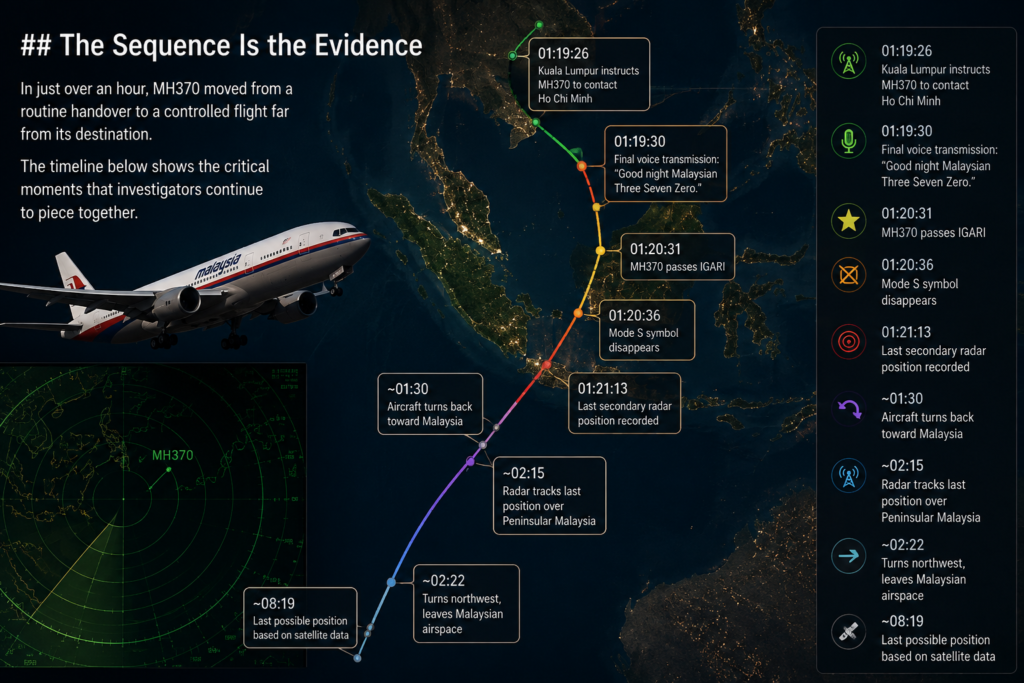
At 01:07, the last ACARS report.
At 01:19, a routine final transmission during the handover to Ho Chi Minh.
At 01:20, the Mode S symbol disappears.
The aircraft then leaves its route.
The initial turnback is later judged likely to have been manually flown.
MH370 crosses Malaysia.
The military sees it but does not intercept it.
The aircraft continues northwest.
Conventional radar finally loses it at 02:22.
Three minutes later, its satellite terminal logs back onto the Inmarsat network after an apparent power interruption.
And the aircraft continues for hours.
None of those events alone establishes intent.
Together, they create something very different from an ordinary technical malfunction.
The Malaysian investigation itself could not identify a plausible aircraft or system failure explaining the full combination of systems deactivation, diversion and subsequent flight path.
That does not close the case.
It changes the weight of the competing explanations.
MTD’s Assessment
MTD Investigates does not conclude in Part I that Captain Zaharie Ahmad Shah caused the disappearance of MH370.
The publicly available evidence does not permit that conclusion.
A sophisticated third-party hijacking cannot be excluded.
Nor can an extraordinary technical sequence be eliminated completely without the main wreckage, flight data recorder and cockpit voice recorder.
But after reconstructing the known chronology, MTD reaches a narrower conclusion:
The known sequence is substantially more consistent with deliberate human intervention than with a conventional aircraft or systems failure.
That assessment rests not on one suspicious fact but on the interaction between several:
- timing;
- loss of communications;
- probable manual control;
- deliberate-looking route changes;
- continued navigation;
- absence of a distress call;
- and hours of subsequent flight.
MH370 did not disappear in one moment.
Step by step, it was removed from the normal aviation system.
By the time the aircraft had crossed back over Malaysia, accident was no longer the easiest explanation.
Someone appears to have been controlling the sequence.
But that creates a much harder question.
Who?
Before MTD attempts to answer it, however, we must understand the evidence that eventually sent investigators thousands of kilometres south.
Seven satellite handshakes.
Seven invisible arcs.
And one mathematical trail left behind by an aircraft that almost succeeded in disappearing.
Next in MTD Investigates
Part II — Seven Handshakes and a Missing Aircraft: What the Satellite Data Really Proves
MH370 disappeared from conventional radar.
It did not disappear from space.
In Part II, MTD Investigates examines what Inmarsat’s Burst Timing Offset and Burst Frequency Offset data actually measured, how investigators created the northern and southern corridors, why attention shifted toward the southern Indian Ocean — and the crucial difference between locating an aircraft and calculating where it might have been.
Sources & Methodology
The core chronology and technical findings in Part I are based primarily on the Malaysian ICAO Annex 13 Safety Investigation Report for MH370, supported by official technical work produced during the international search.
The Malaysian investigation established the last ACARS position report at 01:07:29 MYT, the final recorded radio transmission at 01:19:30, the loss of the Mode S radar symbol at 01:20:36, the final secondary-radar position at 01:21:13 and the final military primary-radar contact at 02:22:12.
Simulator reconstruction led the investigation to conclude that the initial turnback was likely flown manually rather than by autopilot. The same report characterised the subsequent route changes as difficult to explain through anomalous system behaviour alone, while explicitly stating that investigators could not determine who was controlling the aircraft.
The official investigation also found no evidence that MH370 deliberately manoeuvred to evade radar and recorded that Malaysian military authorities considered the aircraft’s primary radar target “friendly”, explaining why no interception occurred.
SATCOM records showed a log-on initiated by the aircraft terminal at 02:25:27 MYT after a period of lost satellite connectivity. The Malaysian investigation assessed the preceding interruption as probably involving power-bus cycling but could not determine why that occurred. The SATCOM evidence also indicated that MH370 remained airborne for more than seven hours.
MTD Investigates distinguishes throughout between:
established evidence;
official investigative findings;
technically plausible alternatives;
and MTD analytical hypotheses.
The interpretation of the Penang passage as a possible personal farewell is explicitly treated as hypothesis, not evidence.
No criminal responsibility is assigned to any individual in Part I.
The purpose of MTD Investigates is not to eliminate uncertainty where the evidence cannot.
It is to determine precisely where fact ends, where inference begins — and which explanation best survives the evidence.