
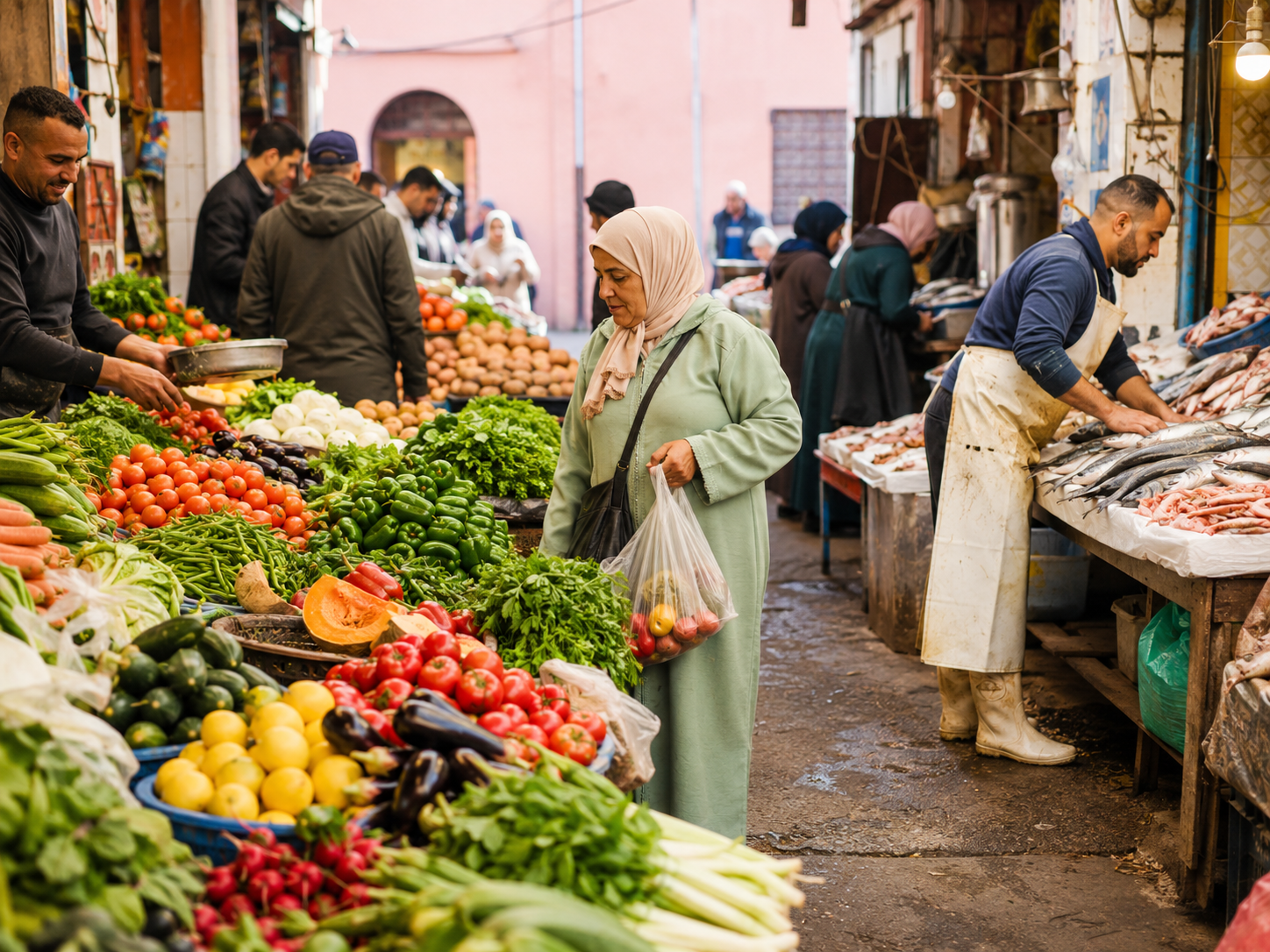
Official July figures show lower prices for vegetables, fish, fruit, meat and dairy, but the national index does not mean every household or shop experienced the same decline.
Vegetables, fish, fruit and meat all became cheaper in Morocco during July 2026, according to the latest official figures.
The national food-price index fell by 1.9% from June and stood 3.7% below its level one year earlier.
But your own shopping bill may tell a different story.
The figures, published by Morocco’s Haut-Commissariat au Plan, HCP, on 19 August, track average price movements across a representative basket. They do not mean every product became cheaper, every shop cut its prices or every household saved the same amount.
Here is what changed, what became more expensive and how consumers can make a fair comparison.
MOROCCO’S FOOD-PRICE INDEX FELL IN JULY
Morocco’s overall Consumer Price Index, CPI, fell by 1.0% between June and July 2026.
The decrease resulted from a 1.9% fall in the food-price index and a smaller 0.3% decline in the non-food index, according to the official HCP release.
MOROCCO FOOD PRICES, JULY 2026 AT A GLANCE
| Measure | Official change |
|---|---|
| Total CPI, July versus June | -1.0% |
| Food index, July versus June | -1.9% |
| Non-food index, July versus June | -0.3% |
| Total CPI, July 2026 versus July 2025 | -0.6% |
| Food index, July 2026 versus July 2025 | -3.7% |
| Non-food index, July 2026 versus July 2025 | +1.9% |
| Official reporting period | July 2026 |
| HCP publication date | 19 August 2026 |
The monthly figures compare July with June 2026.
The annual figures compare July 2026 with July 2025. On that basis, the overall CPI was 0.6% lower, as the decline in food prices outweighed a 1.9% increase in non-food prices.
That does not mean inflation fell by 0.6 percentage points. It means Morocco’s measured general price level was 0.6% lower than in July 2025.
Among non-food categories, annual changes ranged from a 0.2% decline in communication to a 4.1% increase in transport.
HCP’s underlying inflation indicator, which excludes products with volatile prices and products subject to public tariffs, decreased by 0.1% both month-on-month and year-on-year.
VEGETABLES RECORDED THE BIGGEST MONTHLY DROP
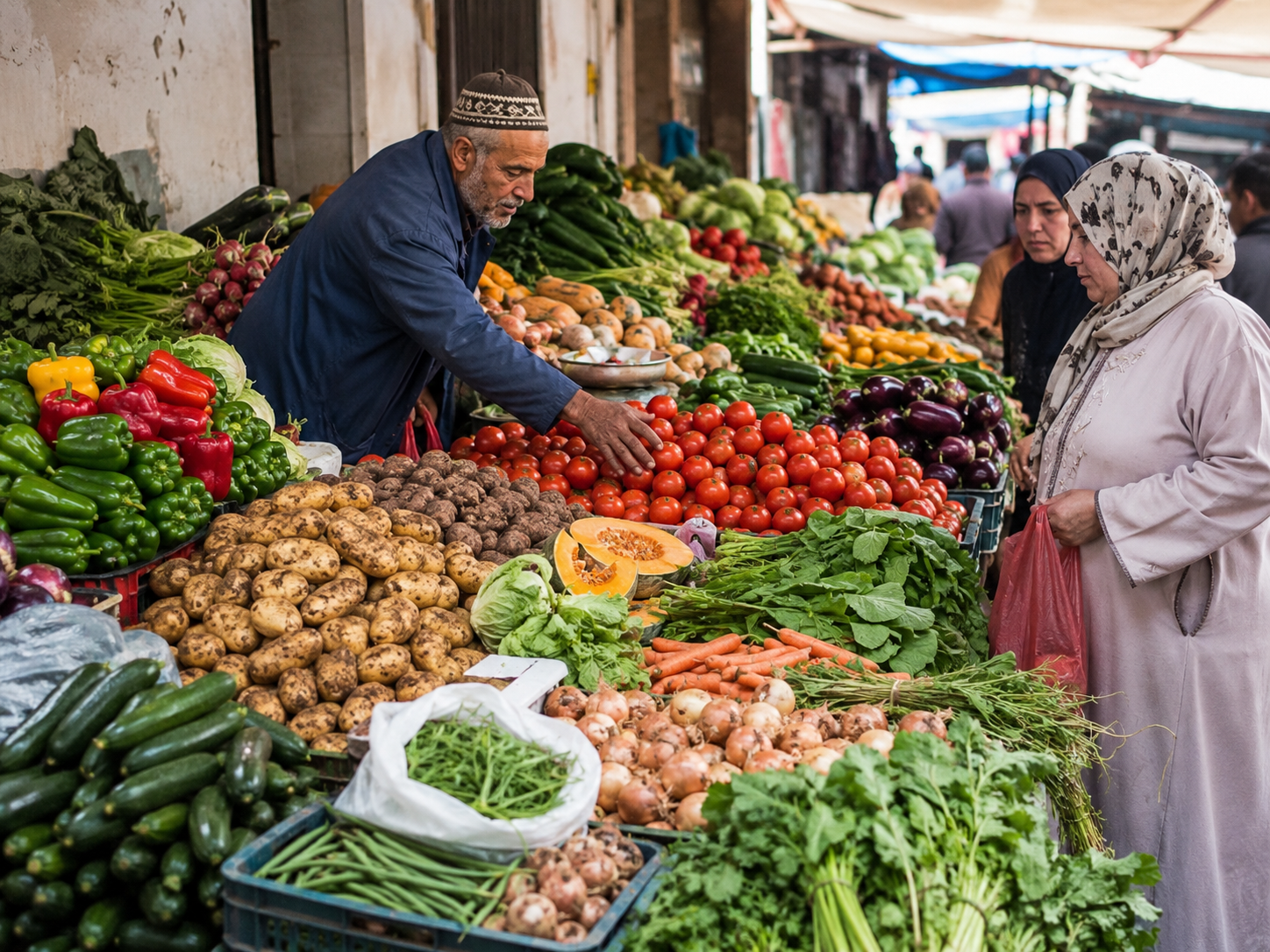
Vegetables led the July declines, with their category index falling by 7.6% from June.
Fish and seafood followed with a 3.9% decrease, while fruit fell by 3.7%.
Meat prices declined by 1.2%. The combined category covering milk, cheese and eggs recorded a smaller decrease of 0.3%.
WHAT GOT CHEAPER FROM JUNE TO JULY?
| Category | Monthly price change |
|---|---|
| Vegetables | -7.6% |
| Fish and seafood | -3.9% |
| Fruit | -3.7% |
| Meat | -1.2% |
| Milk, cheese and eggs | -0.3% |
These are average movements within broad categories. They do not mean every tomato, fish, cut of meat or carton of milk changed by exactly the same percentage.
HCP also reported that fuel prices fell by 4.9% from June. Fuel is a non-food category and should not be confused with the grocery-product declines.
SOME DRINKS BECAME MORE EXPENSIVE

Not everything in the food and drink basket became cheaper.
The combined category covering mineral water, soft drinks, and fruit and vegetable juices increased by 0.3% between June and July.
Coffee, tea and cocoa rose by 0.2% as a combined category.
This does not prove that coffee alone increased by exactly 0.2%. HCP published one figure covering all three products.
The increases were modest, but they matter. The correct conclusion is that Morocco’s overall food-price index fell, not that every food and drink item became cheaper.
WHY YOUR SHOPPING BILL MAY FEEL DIFFERENT

A national index follows a representative basket. A family fills a real basket based on its own needs.
A household buying plenty of vegetables, fruit and fish may have benefited more directly from July’s largest declines. Another family spending more on beverages, packaged goods or products that barely changed may have noticed much less difference.
Brand, quality, package size and place of purchase also affect the amount paid. Prices can differ between a traditional market, neighbourhood shop, supermarket and specialist retailer.
Timing matters too.
A monthly decline can follow earlier increases. An item may cost less than it did in June but still feel expensive when compared with a household’s income or the price remembered from several months ago.
A cheaper category may also represent only a small part of one family’s budget. Meanwhile, rent, transport, utilities and other non-food costs can continue to place pressure on total household spending.
That is why official statistics and personal experience can both be valid.
The index measures price changes across the economy. It does not directly measure affordability, purchasing power or how comfortable a family feels after paying for its weekly shopping.
WHICH MOROCCAN CITIES RECORDED THE LARGEST CPI FALLS?
Marrakech recorded the largest monthly decline in the overall Consumer Price Index, at 1.7%.
Safi followed with a 1.4% decrease, Guelmim with 1.3% and Tangier with 1.1%.
| City | Total CPI change, July versus June |
|---|---|
| Marrakech | -1.7% |
| Safi | -1.4% |
| Guelmim | -1.3% |
| Tangier | -1.1% |
| Casablanca | -1.0% |
| Rabat | -1.0% |
| Meknes | -1.0% |
| Agadir | -0.9% |
| Settat | -0.9% |
| Beni Mellal | -0.9% |
| Fes | -0.8% |
| Oujda | -0.8% |
| Tetouan | -0.7% |
| Al Hoceima | -0.6% |
| Dakhla | -0.5% |
| Errachidia | -0.3% |
These are changes in each city’s total CPI, which includes food and non-food categories. They are not separate city-level food-price figures.
The table also does not show which city is cheapest.
A price index measures change over time, not the absolute cost of living. Marrakech recorded the largest monthly decrease, but that does not automatically make it Morocco’s least expensive city.
WHAT THE FIGURES DO NOT TELL US
The HCP release provides a reliable national picture, but it cannot answer every question facing shoppers.
It does not directly reveal:
What a complete family basket cost in dirhams
Which individual shop or market was cheapest
How much a particular household saved
Whether every brand or product variant became cheaper
Whether products were available everywhere
Whether prices continued to fall in August
What will happen in September or later
The statistics cover July 2026 and were released on 19 August. They are not a live measurement of prices on 28 August and should not be read as a forecast.
FIVE WAYS TO COMPARE FOOD PRICES FAIRLY
Compare the same product and package size
Check the brand, quality, weight and quantity before deciding which option costs less.
Check the price per kilogram or litre
A larger package can cost more at the till while still offering a lower unit price.
Separate promotions from normal prices
Note whether a discount is temporary, requires a loyalty card or depends on buying several items.
Compare several shops or markets
One seller’s prices cannot represent an entire city or the national market.
Track the total basket
One heavily discounted item can look attractive while the combined cost of everything a household needs remains high.
A simple record of regularly purchased products can provide a clearer personal picture than relying on memory or one promotional price.
LOWER PRICES, BUT NOT THE SAME EXPERIENCE FOR EVERY FAMILY
The July figures are encouraging for consumers, particularly the declines in vegetables, fish and fruit.
But they do not show that food is suddenly cheap, that cost-of-living pressure has disappeared or that every family benefited equally.
The reliable conclusion is simpler: Morocco’s measured food-price level fell in July, while the effect on each household depended on what it bought, where it shopped and how much prices had already changed.
The national index tells us where prices moved. The family shopping basket tells us how much that movement mattered.