

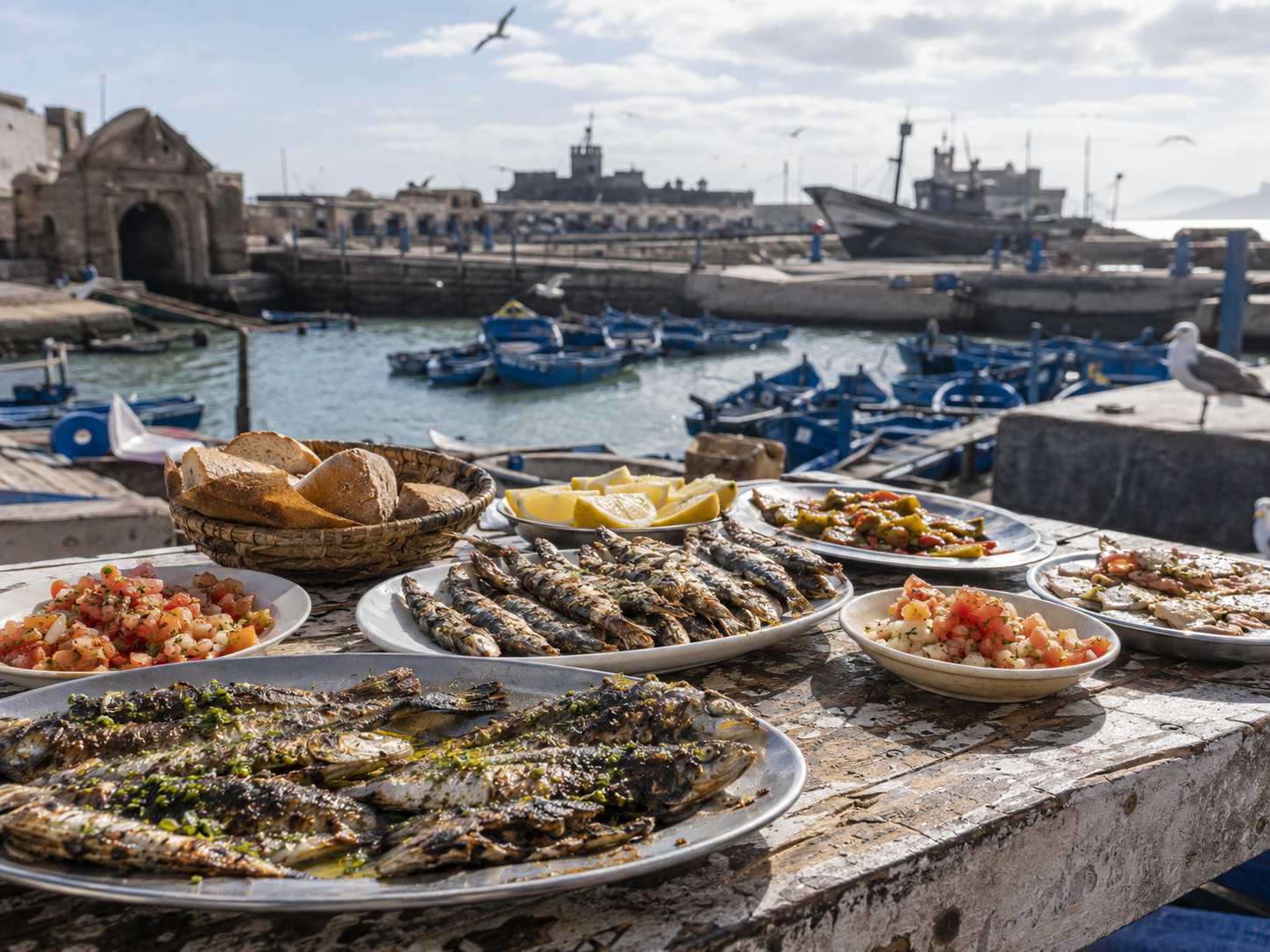
In Essaouira, the Atlantic is not just the view. It is the menu. Sardines, sea bream, monkfish, squid, octopus and lobster move from the coast to restaurant tables across the medina, giving this small Moroccan city one of the country’s most distinctive food identities.
Essaouira is the kind of city where lunch can still begin with a walk past the fishing port.
The Atlantic sits beside the medina.
Boats unload their catch.
Fish moves through the market.
And across the city, restaurants turn that supply into some of the simplest and most memorable food you can eat in Morocco.
That is what makes Essaouira different.
Marrakech has its tanjia.
Fès has one of Morocco’s most celebrated culinary traditions.
Essaouira has the ocean.
And much of its best food comes directly from it.
SARDINES ARE THE DISH TO START WITH

If you eat only one seafood dish in Essaouira, make it grilled sardines.
They are cheap.
Abundant.
Simple.
And deeply connected to Morocco’s Atlantic fishing economy.
The food guide from Will Fly for Food calls grilled sardines the single dish it would choose above all others in Essaouira after spending two weeks eating across the city.
That recommendation makes sense.
Sardines do not need much.
A hot grill.
Salt.
Maybe cumin.
Fresh bread.
Perhaps a Moroccan salad beside them.
The attraction is freshness, not complexity.
THE FISH MARKET SHAPES THE CITY’S FOOD

Essaouira’s seafood culture works because the supply is so close.
Fresh sardines and other fish arrive daily, and traditional restaurants throughout the city serve grilled seafood, tagines and whole fish.
That gives diners something large cities often struggle to recreate.
Immediacy.
The fish has not travelled halfway across a country before reaching the plate.
The restaurant is sitting beside the ecosystem that supplies it.
For visitors, that changes the experience.
You are not simply ordering seafood in a Moroccan city.
You are eating in a port city built around the Atlantic.
OCTOPUS BELONGS IN A TAGINE TOO
Seafood in Essaouira is not limited to the grill.
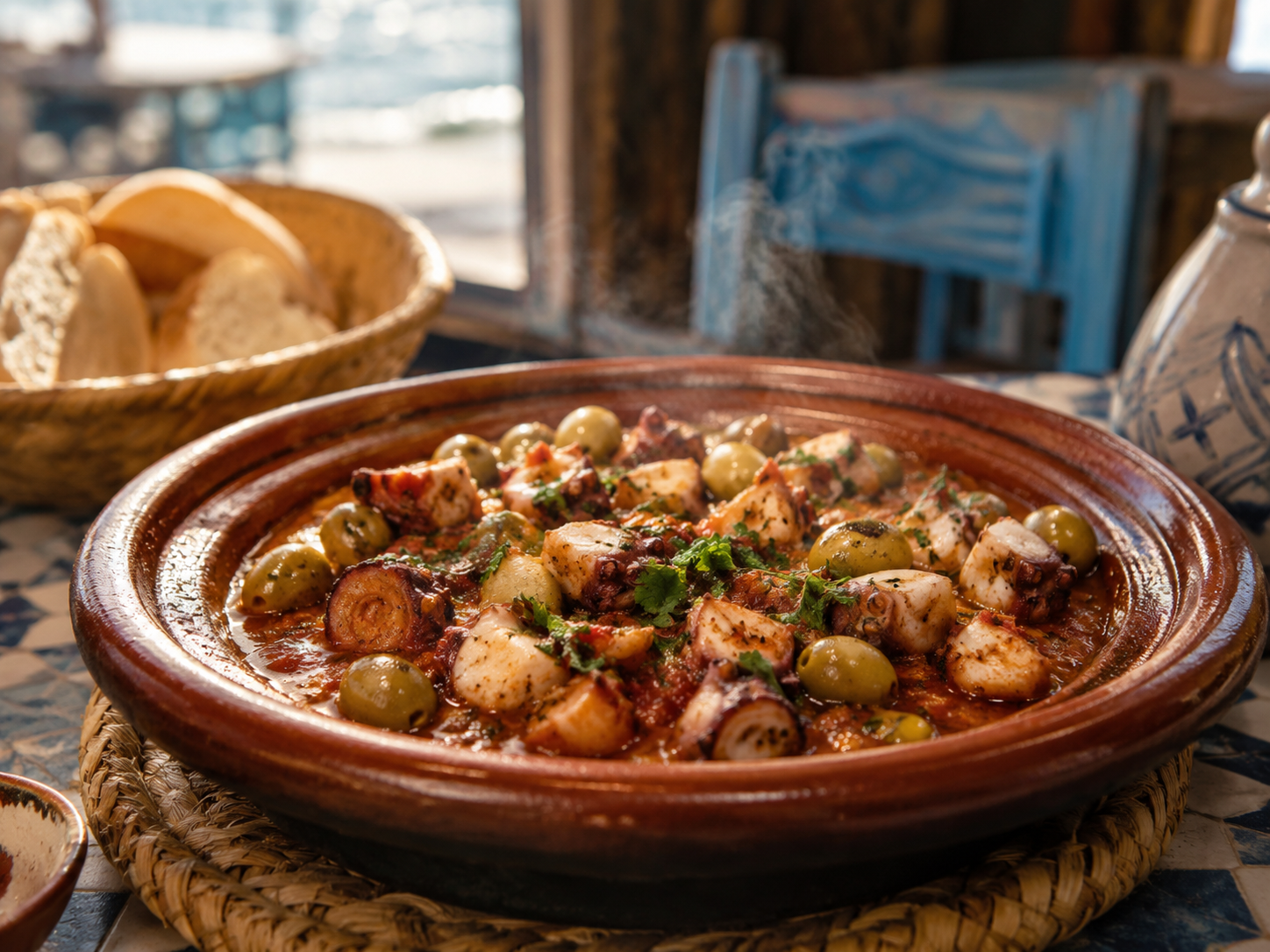
One of the more interesting dishes is octopus tagine.
The guide describes a version cooked in a tomato-based sauce with herbs and green olives, with the octopus cut into bite-sized pieces rather than served as whole tentacles.
It is a perfect example of how Moroccan cooking absorbs local ingredients.
Tagine is one of the country’s most familiar cooking methods.
In Essaouira, the Atlantic changes what goes inside the pot.
Slow cooking softens the octopus.
Tomato provides richness.
Olives add salt and acidity.
The result feels completely Moroccan and completely coastal at the same time.
SARDINE TAGINE IS ANOTHER LOCAL SURPRISE
There is more than one way to eat sardines here.
At Restaurant Zaytouna, the guide highlights a sardine-ball tagine, with the fish shaped into small balls and cooked in a bubbling tomato sauce.
It is less obvious than a plate of grilled sardines.
And that is exactly why it is worth trying.
The dish takes one of Morocco’s most abundant fish and turns it into something closer to comfort food.
Soft fish.
Tomato.
Spice.
Bread to scoop up the sauce.
This is the kind of plate that makes Essaouira’s food scene more interesting than a simple seafood market.
WHOLE GRILLED FISH KEEPS THINGS SIMPLE
Sometimes the best decision is also the easiest.
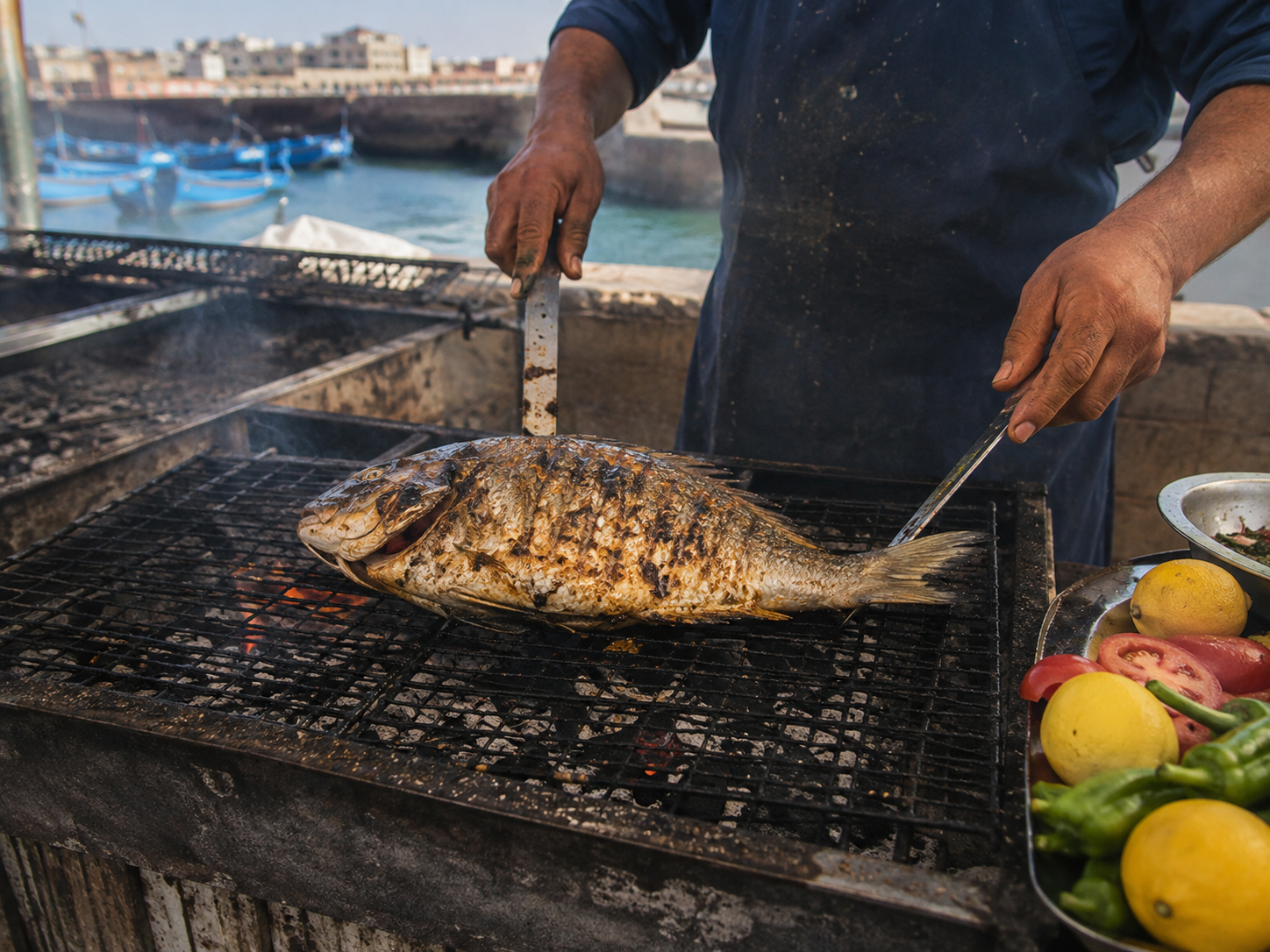
Choose a fresh fish.
Grill it whole.
Eat it.
At La Rose du Sud, the guide highlights a charred whole sea bream, one of the many examples of locally caught fish appearing directly on restaurant menus.
There is something satisfying about food that does not need a complicated explanation.
You see the fish.
You know where it came from.
You know what happened to it.
Fire did the rest.
In a city surrounded by wind, salt and ocean, that simplicity feels right.
MONKFISH MAKES ITS WAY ONTO THE SKEWERS
Not every seafood dish is traditional in the obvious sense.
At Restaurant Sayef, the guide points to monkfish brochettes, served with grilled potatoes and vegetables.
Fish skewers are common enough in Morocco.
Monkfish is more unusual.
Its firm texture makes it particularly well suited to grilling because it holds together instead of falling apart over the heat.
The result sits somewhere between familiar Moroccan brochettes and a more distinctive Atlantic seafood dish.
It is another sign that Essaouira’s food identity is not static.
The ingredients are local.
The formats can evolve.
SQUID ALSO GETS THE TAGINE TREATMENT
Squid tagine is another dish that stands out.
The guide describes squid cooked with vegetables and olives, a combination that brings together the sea and one of Morocco’s most recognisable cooking styles.
Again, the interesting part is not simply the ingredient.
It is the adaptation.
Moroccan food culture has always been good at taking a basic structure and changing it depending on geography.
Mountains produce one kind of table.
Agricultural plains another.
Coastal cities build theirs around fish.
Essaouira is one of the clearest examples.
AND THEN THERE IS LOBSTER
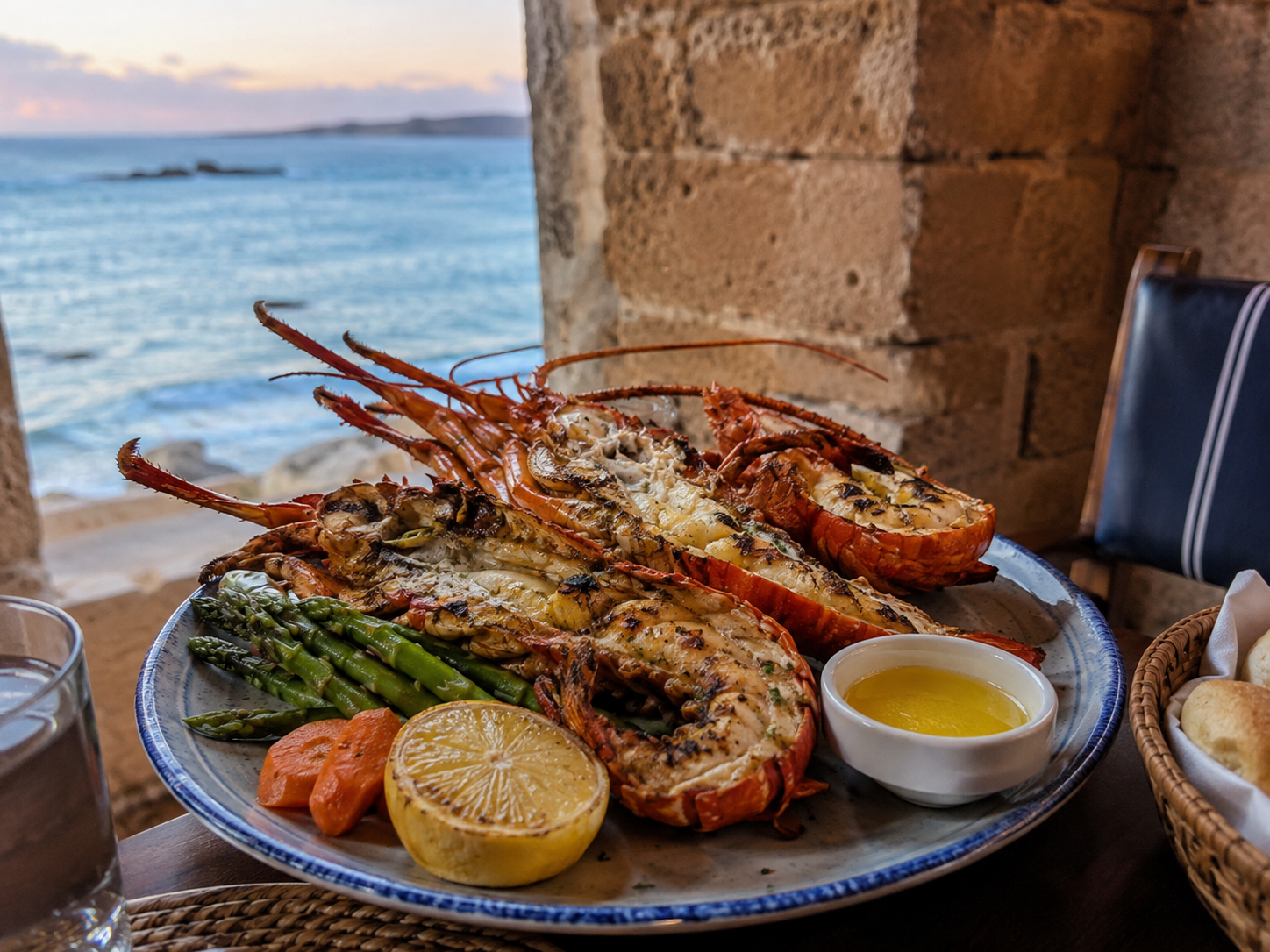
At the more indulgent end of the spectrum sits lobster.
Chez Zak specialises in spiny lobster and other seafood, with the guide highlighting grilled lobster served with vegetables and lemon butter.
Lobster obviously sits in a different price category from sardines.
But it shows the range Essaouira can offer.
A visitor can eat a cheap plate of grilled fish one day and sit down to lobster the next.
Both come from the same Atlantic identity.
The difference is what happens after the catch.
THE BEST MEALS DO NOT NEED TO BE EXPENSIVE
That may be one of Essaouira’s biggest advantages.
Seafood can be luxurious.
It can also be everyday food.
The guide points to Restaurant Baghdad as an example of inexpensive dining, where grilled sardines, salads and tagines can be eaten without turning lunch into a major expense.
That matters for travellers.
A strong food destination should not require every memorable meal to be fine dining.
Essaouira gives you both ends.
Rooftops.
Hidden medina restaurants.
Small local places.
Seafood specialists.
And simple grills.
THE WIND IS PART OF THE EXPERIENCE
Food in Essaouira is inseparable from the city around it.
This is one of Morocco’s windiest destinations.
Seagulls circle above the medina.
Fishing boats fill the port.
Rooftop terraces can become chilly even when the rest of Morocco feels hot.
The Atlantic is always present.
That atmosphere changes the meal.
A plate of grilled sardines in a landlocked city is food.
A plate of grilled sardines in Essaouira, with salt in the air and fishing boats nearby, becomes part of the place.
ESSAOUIRA DOES NOT NEED TO COMPETE WITH MARRAKECH
Morocco’s food conversation is often dominated by Marrakech.
That makes sense.
The city has an enormous restaurant scene and attracts international chefs, luxury hotels and millions of visitors.
But Essaouira offers something Marrakech cannot reproduce.
A working Atlantic port beside a walkable historic medina.
Fresh fish at the centre of daily life.
And restaurants whose menus are shaped by what the coast provides.
It is a different kind of food destination.
Less theatrical.
More elemental.
COME FOR THE BLUE DOORS, STAY FOR THE FISH
Essaouira is easy to photograph.
The white walls.
The blue shutters.
The ramparts.
The harbour.
The Atlantic.
But the city makes even more sense once you start eating.
Grilled sardines.
Octopus tagine.
Sardine balls in tomato sauce.
Whole sea bream.
Monkfish brochettes.
Squid.
Lobster.
Different dishes.
Same source.
In Essaouira, some of the best food in the city begins only a few metres away, in the Atlantic.